
Germany
No European country changed its money more often than Germany: the imperial Goldmark (coins from 1871, official 1873), the Weimar Rentenmark, the Reichsmark, the Deutsche Mark of 1948, and the euro in 2002 at a fixed rate of 1 € = 1.95583 DM. Each regime left one landmark coin — the 20 mark, the Oak Tree 5 mark, the 1952 Germanisches Museum 5 DM — and this chapter covers all three.
Coins of Germany
Every coin entry in this wiki — one tap to the full page.
Showing 11 of 11
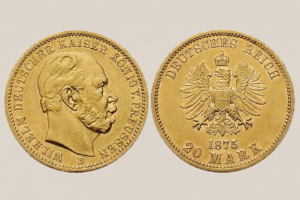 1875 20 Mark GoldPrussia (Wilhelm I)View coin ›
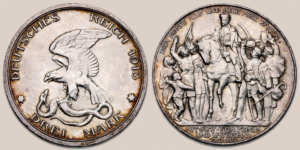 1913 3 Mark “Der König rief”Prussia (KM-534)View coin ›
 1921 Luther 3 Mark (No Official Issue)No coin was ever issued for this date — this graphic stands in for a photograph…View coin ›
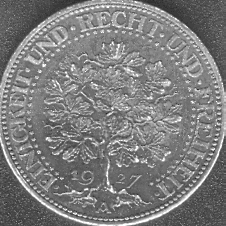 1927 5 Reichsmark “Oak Tree”Weimar Republic (KM-56)View coin ›
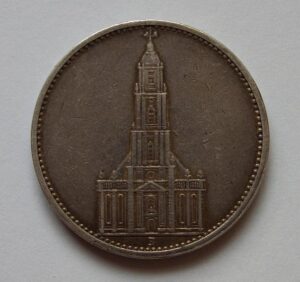 1934 5 Reichsmark “Potsdam Garrison Church”Germany (KM-83)View coin ›
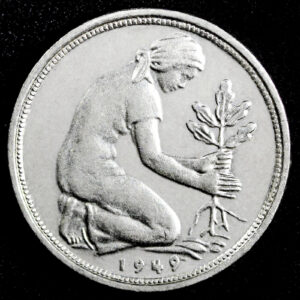 1949-G 50 PfennigAI-generated illustration — not a photograph of a genuine coin. West Germany's first-year 50 pfennig ·…View coin ›
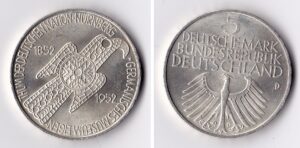 1952 Germanisches Museum 5 Deutsche MarkWest Germany’s First CommemorativeView coin ›
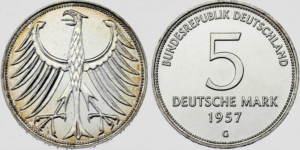 1957 5 Deutsche Mark SilverWest Germany (KM-112.1)View coin ›
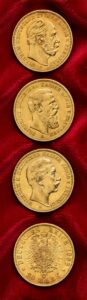 Friedrich III 1888 20 MarkThe “Year of Three Emperors” CoinView coin ›
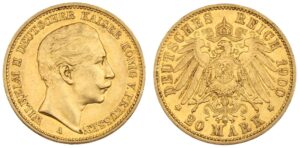 German Empire Gold 20 Mark (1871–1915)Europe’s Workhorse Gold CoinView coin ›
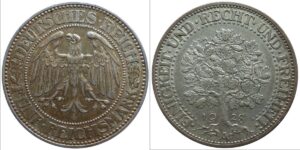 Weimar “Oak Tree” 5 Mark (1927–1933)The Republic’s Silver IconView coin ›
History & collecting
The story behind the coins, one tap away.
- Issued: 1871–1915, the empire’s standard gold trade coin and the most-used gold piece in continental Europe, struck at the mints of Berlin (A), Hannover (B), Frankfurt (C) and the state mints.
- Composition: .900 fine gold, 7.965 g, 22.5 mm, 0.2304 oz AGW; imperial eagle reverse with the state portraits of Wilhelm I, Friedrich III and Wilhelm II.
- Key dates (verified only): the Friedrich III 1888 single-year issue — the “Year of Three Emperors” coin, struck during his 99-day reign, with a reported mintage of 5,363,501 (USAGOLD, citing the Standard Catalog of World Coins / NGC). Wilhelm II’s issues split into the civilian bust (1888–1913) and the uniformed bust (1913–1915).
Value: Check live sold listings on the linked guides before buying or pricing. For metal value, use the melt calculator.
- Issued: 1927–1933 (KM56), the Republic’s big silver showpiece with the famous oak tree reverse.
- Composition: .500 fine silver, 25 g, 37 mm, 0.4019 oz ASW (Heritage auction records).
- Mintage highlights (verified, Heritage): 1927-A: 7,926,000; 1927-D: 1,471,000; 1927-F: 700,000; 1929-A: 6,730,000; 1930-J: 740,000. The 1927-F is the low-mintage sleeper of the opening year.
Value: Check live sold listings on the linked guide before buying or pricing.
- Issued: 1952, released 1953 — West Germany’s first commemorative coin, honoring the Germanisches Nationalmuseum in Nuremberg; Munich (D) mint; designed by Karl Roth.
- Composition: .625 fine silver, 11.2 g, 29 mm.
- Key dates: the key is the 1952 itself — verified mintage 198,760 circulation strikes plus 1,240 proofs (200,000 total). It leads the celebrated “first five” commemoratives: 1952 Germanisches Museum, 1955 Schiller, 1955 Türkenlouis, 1957 Eichendorff and the 1964 Fichte (issued 14 March 1966).
Value: Check live sold listings on the linked guide before buying or pricing.
- Issued: German euros were struck from 1999 ahead of the 2002 circulation launch.
- Design (verified): the 1, 2 and 5-cent coins carry the oak twig by Rolf Lederbogen, per the European Central Bank.
Value: Compare authenticated sold listings before buying or pricing.
The imperial 20 mark is Germany’s bullion-adjacent coin — .2304 oz of gold that trades with sovereigns and Napoléons. Germany has no standalone modern bullion wiki entry in this guide.
Value: Check live sold listings on the linked guide before buying or pricing. For metal value, use the melt calculator.
Values move; always check live sold listings on the linked guides. Key dates and high-value pieces require authentication.
Germany is three coins, three regimes: buy the 20 mark for gold weight (the Friedrich III premium is real but modest against melt), the Oak Tree for Weimar silver (watch the mintmarks — F and J pieces are the scarcer ones), and the Germanisches Museum for the postwar commemorative story. The “first five” 5-DM commemoratives are the natural next set after the Germanisches Museum. For values, work from the linked entries’ live sold listings; the 20 mark also tracks gold spot via the melt calculator.
Europe Red Book v2 research chapter, published September 15, 2026. Values are intentionally excluded; use authenticated sold-market evidence.
Real prices come from real sales. Check what Germany coins are actually selling for right now.
Live eBay listingsSee live Germany dealsMatching checklists & toolsAs an eBay Partner, The Coin Wiki may earn from qualifying purchases.
FREE DOWNLOAD
Before you spend that coin, check it.
The Pocket Change Key-Date Checklist covers the cents, nickels, dimes, quarters and halves still hiding in circulation — including the 1943 and 1983 errors worth five figures. One page to print, a lifetime of jars to check.