
Specifications
- Denomination
- 20 Mark
- Series
- Prussia — Wilhelm I (gold 20 Mark)
- Years of issue
- 1875
- Composition
- 90% Gold, 10% Other
- Weight
- 7.965 g
- Diameter
- 22.5 mm
- KM
- KM 505 (J-246)
- Mintage
- 4203301
- Key mintages
- 1875-A (Berlin): 4,203,301 (Heritage). 1875-B (Hannover): estimated ~1,500 (Heritage). 1875-C (Frankfurt): mintage unverified in this research.
Melt value: $814.48
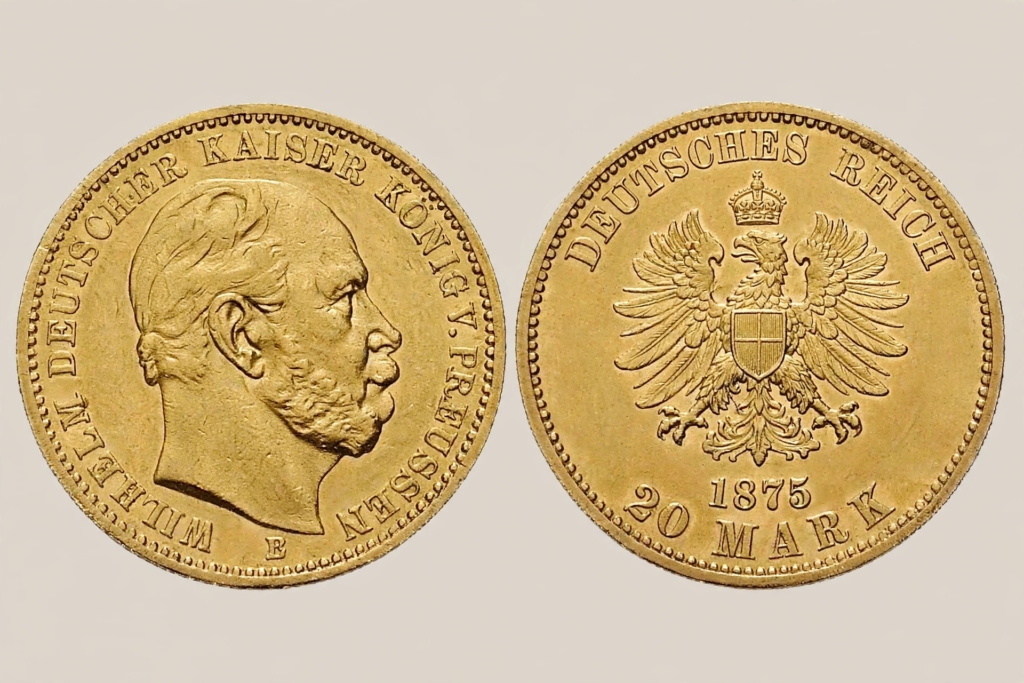
Wilhelm I's gold 20 Mark — the workhorse of Germany's gold standard, struck at Berlin and Hannover in 1875.
History
- The 20 Mark was Germany’s standard gold coin from unification: PCGS’s complete Prussia set covers the 1871–1915 series, and the Wilhelm I portrait type cataloged as KM-505 (Jaeger 246) was struck 1874–1888 (PCGS Set Registry; NGC/NumisMaster; Reppa, accessed 2026-09-16).
- The KM-505 obverse shows a bareheaded bust of Wilhelm I facing right with the legend WILHELM DEUTSCHER KAISER KÖNIG V. PREUSSEN; the reverse carries the crowned Imperial Eagle (Type II) with DEUTSCHES REICH, the date, and 20 MARK below, and the edge is inscribed GOTT MIT UNS (NGC; lot-art KM-505 listing, accessed 2026-09-16).
- In 1875 the coin was struck at Berlin (A) with 4,203,301 pieces, and at Hannover (B) with a mintage estimated at only about 1,500, making the Hannover piece the scarce 1875 issue (Heritage Auctions, accessed 2026-09-16).
- Frankfurt (C) struck the KM-505 type in other years — a dealer census records the 1878-C at 82,430 — but no verified 1875-C mintage figure was found in this research (coinstrail, accessed 2026-09-16).
- Specifications are uniform across the type: 7.965 g gross weight, 0.900 gold fineness (7.1685 g fine gold, 0.2305 oz AGW), 22.5 mm diameter (Heritage; Tavex; Liberty Coin, accessed 2026-09-16). Dealers treat the 20 Mark as near-bullion gold — one listing prices Prussia 20 Marks at about $23 over melt (APMEX, accessed 2026-09-16).
- The 1871–1915 Prussia 20 Mark set comprises 63 circulation strikes with no true rarities, so common dates like the 1875-A trade close to gold value while the low-mintage 1875-B commands a premium (PCGS Set Registry, accessed 2026-09-16).
- The coin’s gold-standard role was dramatized in the 1923 hyperinflation: by the end of 1923 a 20 Mark gold piece was worth over 23 trillion paper marks, a testament to gold’s quality as a hedge (Tavex, accessed 2026-09-16).
- Counterfeits circulate: NGC’s Munich office examined a purported 1905-A struck in a gold alloy but betrayed by pale-yellow color, loss of detail in the hair and ear, and doubled lettering — verify weight, color, and detail, or buy certified (NGC Counterfeit Detection, accessed 2026-09-16).
Key dates and varieties
- 1875-A (Berlin) — 4,203,301 struck; the common, affordable 1875 issue (Heritage)
- 1875-B (Hannover) — mintage estimated at ~1,500; the scarce 1875 issue (Heritage)
- 1875-C (Frankfurt) — struck for the type but no verified 1875-C mintage figure was found in this research
Specifications
- composition
- diameter
- edge
- weight
Collector notes
- Do not confuse this KM-505 type (bust facing right, 1874–1888) with the 1871–1873 KM-501 ‘small eagle’ type — the portraits and reverse eagles differ.
- Common dates trade near melt; the 1875-B premium is driven by its tiny estimated mintage, so demand certification for that mintmark.
- Check the edge inscription GOTT MIT UNS — missing or mushy edge lettering is a counterfeit tell (NGC).
Market check
Compare live listings for this coin on eBay:
Search eBay for 1875 20 Mark Gold — Prussia (Wilhelm I)
As an eBay Partner, The Coin Wiki may earn from qualifying purchases.
Related Coins
Live on eBay
Live asking prices — not sale records.
 Coin gold Brunswick 20 Mark 1875 in VF-XF Leipzig$2,056.50View on eBayCoin Gold Braunschweig 20 Mark 1875 IN Vf-Xf nswleipzig$2,184.27View on eBay
 1875-A German States Prussia 20 Mark Gold Coin$1,600.00View on eBay
As an eBay Partner, The Coin Wiki may earn from qualifying purchases.
FREE DOWNLOAD
Before you spend that coin, check it.
The Pocket Change Key-Date Checklist covers the cents, nickels, dimes, quarters and halves still hiding in circulation — including the 1943 and 1983 errors worth five figures. One page to print, a lifetime of jars to check.