
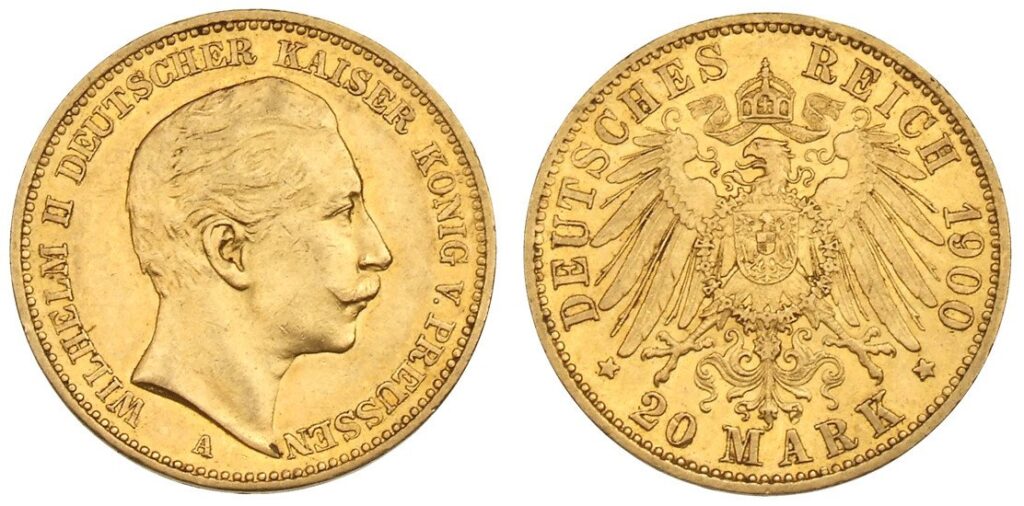
The 20-mark gold piece was Imperial Germany’s standard gold coin for 44 years — a .900-fine, quarter-ounce coin struck by Prussia and the other German states. This entry covers the type, its specs, and the portraits collectors chase.
Key facts
- Struck 1871–1915 across the German Empire’s mints (Berlin A, Hannover B, Frankfurt C, plus Bavaria, Hamburg, Württemberg, Baden, Saxony and others). Struck in .900 fine gold at 7.965 g (0.2305 oz AGW) and 22.5 mm. The Prussian Wilhelm II type is catalogued as KM 521 / Jaeger 252.
- Obverse: portrait of the Kaiser (Wilhelm I 1871–1888, Friedrich III in 1888, Wilhelm II 1888–1915); reverse: the crowned imperial eagle with DEUTSCHES REICH and the denomination. The Wilhelm II obverse portrait dies were cut by Berlin mint medallist Emil Weigand; the standard imperial-eagle reverse is by Friedrich Wilhelm Kullrich.
- Wilhelm II issues come in two portrait varieties: civilian profile (1888–1913) and the uniformed “military” bust (1913–1915); Berlin-mint Prussian issues are the common, near-bullion dates, while smaller-state issues carry premiums (USAGOLD).
- Wilhelm I first-year-of-empire issues (1871) are the founding coins of the series. No official aggregate mintage for the type is published; mintages differ by issuing state, year, and mint — for example, the catalogued mintage for Prussia 1901-A is 5,188,340. No reliable survival estimates exist. KM 521 / Jaeger 252 identifies the Prussian issue; other German states’ Wilhelm II twenty-mark coins have separate catalog numbers (e.g., Württemberg KM 634).
Market check
As an eBay Partner, The Coin Wiki may earn from qualifying purchases.
FREE DOWNLOAD
Before you spend that coin, check it.
The Pocket Change Key-Date Checklist covers the cents, nickels, dimes, quarters and halves still hiding in circulation — including the 1943 and 1983 errors worth five figures. One page to print, a lifetime of jars to check.