
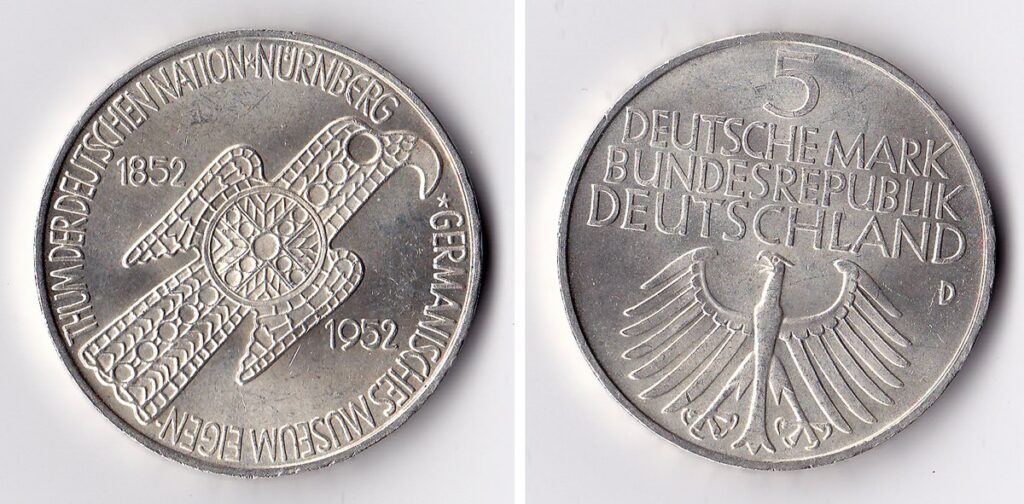

The first commemorative coin of the Federal Republic of Germany — a low-mintage silver 5 DM honoring Nuremberg’s Germanisches Nationalmuseum — kicked off the beloved “first five” series. This entry covers the issue and its specs.
Key facts
- Issued September 11, 1953, though dated 1952; struck at the Bavarian State Mint in Munich (D) (German Wikipedia).
- Mintage: 198,760 circulation strikes plus 1,240 proofs (Spiegelglanz) — 200,000 total (German Wikipedia; KM#113).
- Specifications: 11.2 g, 29 mm, .625 silver; designed by Karl Roth (German Wikipedia; HeritCoin catalog data).
- Obverse design: an Ostrogothic fibula brooch with a stylized eagle, from the Domagnano treasure find in San Marino; legend “GERMANISCHES MUSEUM … NÜRNBERG” (German Wikipedia).
- It began the “first five” DM commemoratives (1952 Germanisches Museum, 1955 Schiller, 1955 Ludwig Wilhelm “Türkenlouis”, 1957 Eichendorff, 1964 Fichte (issued 14 March 1966)) — all 5 DM, all .625 silver, all low-mintage — the classic entry point to German commemorative collecting (German Wikipedia).
Market check
As an eBay Partner, The Coin Wiki may earn from qualifying purchases.