
Specifications
- Denomination
- 1 trade dollar
- Series
- Meiji trade dollar
- Engraver
- Kano Natsuo (加納夏雄) (obverse); Yoshisuke Kikuchi (菊池義助) (reverse)
- Years of issue
- 1875–1877
- Composition
- 90% Silver, 10% Copper
- Weight
- 27.22 g
- Diameter
- 38.58 mm
- Edge
- Reeded
- KM
- KM-14; Y#14; JNDA#01-12
- Key mintages
- No separately verified 1875-dated mintage; NGC reports just over 3 million trade dollars struck across 1875–1877.
Melt value: $32.46
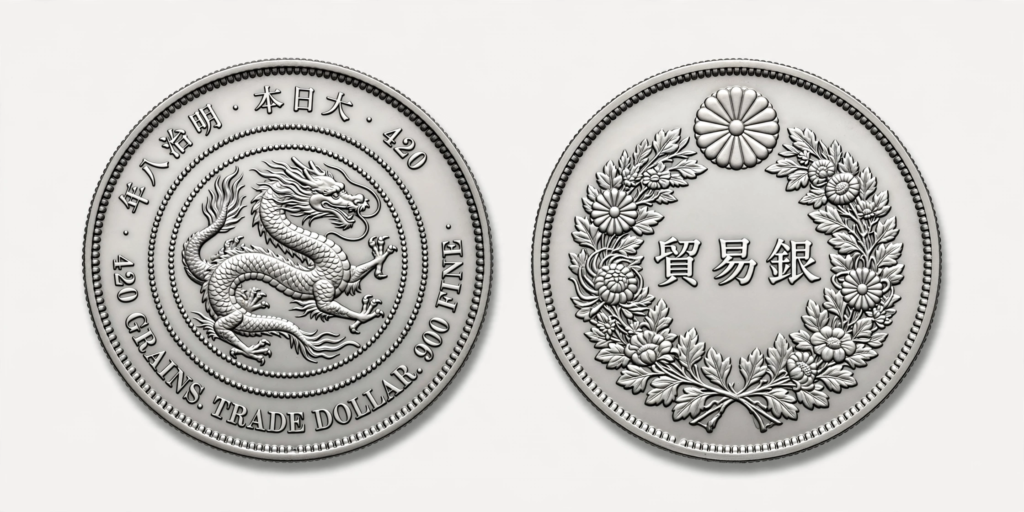
Japan's 420-grain answer to the trade dollar — a heavier silver crown built for the China trade.
History
- Japan’s trade dollar was created to win a share of the East Asian silver trade then dominated by the Mexican dollar: at 27.22 g of .900 silver — a full 420 grains, heavier than the domestic 1 yen — it was expressly sized for merchants in China, Taiwan, and Korea (NGC; Numista, accessed 2026-09-16).
- The first year of issue was Meiji 8 (1875), cataloged as Y#14 / KM-14, JNDA#01-12; the type continued through Meiji 10 (1877) (Heritage Auctions; Numista, accessed 2026-09-16).
- The obverse carries the dragon within a beaded circle and a bilingual legend — 年八治明 本日大 · 420 GRAINS. TRADE DOLLAR. 900 FINE · — while the reverse sets the three characters 貿易銀 (trade silver) inside a wreath of paulownia and chrysanthemum, with the imperial chrysanthemum crest above (Numista; Heritage Auctions, accessed 2026-09-16).
- Numista credits the obverse engraving to Kano Natsuo (加納夏雄) and the reverse to Yoshisuke Kikuchi (菊池義助), with the Osaka Mint striking the type at 38.58 mm with a reeded edge and coin alignment (Numista, accessed 2026-09-16).
- NGC reports just over 3 million trade dollars struck across all three years, 1875–1877, and notes the series was intended for circulation in Japan, Taiwan, Korea, and beyond (NGC, accessed 2026-09-16).
- Authentication matters more than average here: NGC’s counterfeit guide warns that transfer-die fakes circulate with weak detail, spikes from the reeding, and tool marks beneath the reverse leaves — and that private chopmarks, while common from the China trade, must not be confused with later official countermarks (NGC, accessed 2026-09-16).
- In the marketplace, original 1875 examples in AU with prooflike surfaces are among the most sought-after Japanese silver crowns of the Meiji era (Heritage Auctions, accessed 2026-09-16).
Key dates and varieties
- 1875 (Meiji 8) — first year of the Japanese trade dollar (Heritage Auctions)
- 1876 (Meiji 9) — second year of the type (Numista)
- 1877 (Meiji 10) — final year; just over 3 million struck across all three years 1875–1877 (NGC)
Specifications
- composition
- weight
- diameter
- edge
- alignment
- engravers
- references
Collector notes
- The 1875-dated mintage could not be verified separately — NGC gives only the three-year aggregate of just over 3 million. Do not cite an annual figure without a source.
- At 27.22 g it is heavier than the 26.96 g domestic 1 yen — the weight difference is the quickest check that you are looking at a trade dollar.
- Transfer-die counterfeits are the main risk: look for weak detail, reeding spikes, and tool marks under the reverse leaves (NGC).
- Private chopmarks are contemporary merchant marks; the official 銀 countermark is a separate, later variety — they are not the same thing.
Market check
Compare live listings for this coin on eBay:
Search eBay for 1875 Trade Dollar
As an eBay Partner, The Coin Wiki may earn from qualifying purchases.
Related Coins

FREE DOWNLOAD
Before you spend that coin, check it.
The Pocket Change Key-Date Checklist covers the cents, nickels, dimes, quarters and halves still hiding in circulation — including the 1943 and 1983 errors worth five figures. One page to print, a lifetime of jars to check.