
Specifications
- Denomination
- 5 yen
- Series
- Meiji gold 5 yen — large type
- Years of issue
- 1870–1871
- Composition
- 90% Gold, 10% Copper
- Weight
- 8.3333 g
- Diameter
- 23.84 mm
- Edge
- Reeded
- KM
- Y-11 (NGC); KM-Y11 per Heritage
- Mintage
- 273536
- Key mintages
- 273,536 dated 1870 (NGC). Also struck dated 1871 including rare proofs. Briefed as KM-12; verified references give Y-11 (NGC) / KM-Y11 (Heritage).
Melt value: $852.15
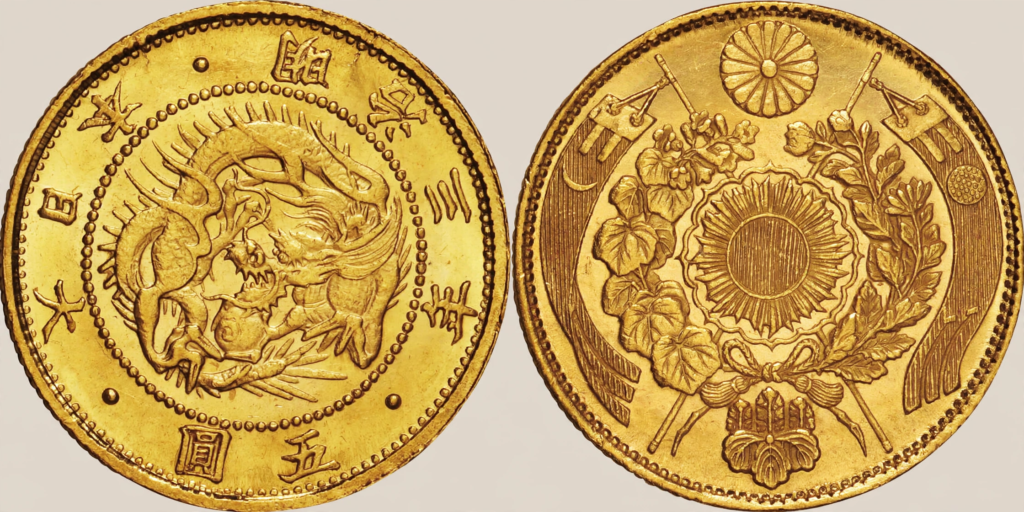
Japan's first modern gold 5-yen piece — a Meiji Year 3 dragon coin struck in .900 gold at the Osaka Mint.
History
- The 1870 5 yen is the first-year issue of Japan’s first modern gold coinage, struck in the third year of the Meiji Emperor’s reign as the new imperial government replaced the complex Tokugawa currency system with Western-style milled coinage (Coin Exchange NY; NGC, accessed 2026-09-16).
- The legal foundation was the New Currency Act of 1871, which created the decimal yen–sen–rin system and defined the yen as 1.5 grams of pure gold or 24.26 grams of pure silver — the 5-yen gold piece was the workhorse of the new gold denominations (Wikipedia — Japanese yen, accessed 2026-09-16).
- NGC catalogs the type as Y-11: .900 fine gold, 8.3333 g, 23.84 mm, with the dragon within a beaded circle on the obverse and the sunburst crest on a sacred mirror — flanked by military banners, chrysanthemum above and paulownia below — on the reverse (NGC, accessed 2026-09-16).
- The reported mintage for the 1870 (Meiji 3) date is 273,536 pieces; the large type was also struck dated 1871 (Meiji 4), including rare proof strikings, before the smaller Y-11a type replaced it (NGC; Heritage Auctions, accessed 2026-09-16).
- Heritage’s research on the companion 1871 proofs notes that almost nothing is documented about why Japan’s first proofs were made, but scholars agree diplomatic or royal presentation and exhibition at fairs were the primary occasions — making any 1870–71 proof a landmark of the series (Heritage Auctions, accessed 2026-09-16).
- Gold yen coins barely circulated at home: as Brinkley’s contemporary account explains, Japan’s gold was quickly driven out of the country by depreciated fiat currency and the country drifted into silver monometallism, with the silver yen becoming the effective unit of account (Brinkley via Wikisource, accessed 2026-09-16).
- Catalog note: this entry was briefed as KM-12, but NGC lists the type as Y-11 and Heritage catalogs the 1871 issue as KM-Y11 — the KM-12 attribution could not be verified in any consulted reference and is not used here (NGC; Heritage Auctions, accessed 2026-09-16).
Key dates and varieties
- 1870 (Meiji 3) — first year of the large-type 5 yen; mintage 273,536 (NGC)
- 1871 (Meiji 4) — second and final year of the large type; proofs of this date are extremely rare (NGC; Heritage Auctions)
- 1872 onward — replaced by the smaller Y-11a type (21.82 mm), struck 1872–1897 (Numista)
Specifications
- composition
- weight
- diameter
- edge
- alignment
- designers
- mint
Collector notes
- Catalog discrepancy: briefed as KM-12, but every consulted reference (NGC Y-11; Heritage KM-Y11) disagrees — verify against the Standard Catalog before citing a KM number.
- The large type (1870–1871, 23.84 mm) and the small type (1872–1897, 21.82 mm, Y-11a) are different types — never use a small-type photo to illustrate the 1870.
- Early Japanese proofs are frequently faked; any claimed 1870/1871 proof needs certification by a major grading service.
- At 0.2411 oz AGW the coin trades near melt in low grades, with large numismatic premiums only in AU and above.
Market check
Compare live listings for this coin on eBay:
Search eBay for 1870 5 Yen Gold
As an eBay Partner, The Coin Wiki may earn from qualifying purchases.
Related Coins
Live on eBay
Live asking prices — not sale records.
 1870 JPN Gold 2 Yen Dragon PCGS MS65 Meiji 3 JNDA 01-4 Gold Shield 🇯🇵$4,300.00View on eBay
 1870 M3 JPN 2 Yen Gold Dragon Coin PCGS MS65+ Meiji Era Historic 💎$4,480.00View on eBay
As an eBay Partner, The Coin Wiki may earn from qualifying purchases.
FREE DOWNLOAD
Before you spend that coin, check it.
The Pocket Change Key-Date Checklist covers the cents, nickels, dimes, quarters and halves still hiding in circulation — including the 1943 and 1983 errors worth five figures. One page to print, a lifetime of jars to check.