
Specifications
- Denomination
- 1 yen
- Series
- Meiji silver 1 yen — old type
- Designer
- Kano Natsuo (加納夏雄)
- Engraver
- Kano Natsuo (加納夏雄)
- Years of issue
- 1870
- Composition
- 90% Silver, 10% Copper
- Weight
- 26.96 g
- Diameter
- 38.58 mm
- Edge
- Reeded
- KM
- Y#5 (NGC); JNDA#01-9
- Mintage
- 3685049
- Key mintages
- 3,685,049 dated Meiji 3 (Numista; NGC). Y#5.1/5.2/5.3 varieties differ in the 圓 character; 銀-in-circle countermark variety exists.
Melt value: $32.15
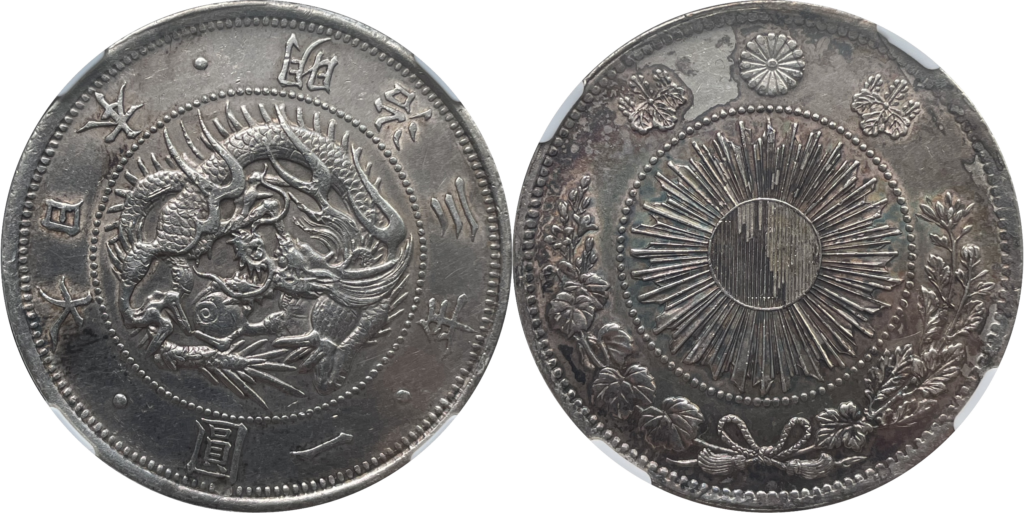
The first silver yen of modern Japan — a Meiji Year 3 dragon coin that carried Japanese trade across East Asia.
History
- Correction to the brief: no Meiji 6 (1873) silver 1-yen coin was ever issued. The old-style silver yen was struck beginning in 1871 and is dated Meiji 3 (1870) only; the redesigned large type began with Meiji 7 (1874) (Wikipedia — 一円銀貨, accessed 2026-09-16).
- The 1870 1 yen is therefore the true first-year issue of Japan’s modern silver yen, created under the New Currency Act of 1871 as a ‘dollar-unit’ coin — 26.96 g of .900 silver — meant to circulate alongside Mexican dollars and Western trade coinage in East Asian commerce (Wikipedia — 一円銀貨; Wikipedia — Japanese yen, accessed 2026-09-16).
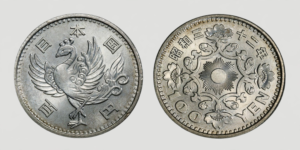
- Numista catalogs it as N#15183: dragon within a beaded circle on the obverse with the legend 年三治明 · 本日大 · 圓一 · (Great Japan · Year 3 of Meiji · One Yen), and a radiant sun within a beaded circle on the reverse, wreathed in paulownia and chrysanthemum with the imperial crest above — designed and engraved by Kano Natsuo (加納夏雄) (Numista, accessed 2026-09-16).
- The reported mintage is 3,685,049 pieces, struck at 26.96 g and 38.58 mm with a reeded edge; NGC’s parallel listing gives 26.9568 g and 38.5 mm for the Y#5.1 type (Numista; NGC, accessed 2026-09-16).
- Numista notes the old yen was used mainly for trade and is often seen with Chinese chopmarks — merchant punches applied in China to verify the silver — making chopmarked survivors historical documents of the 19th-century China trade (Numista, accessed 2026-09-16).
- Three varieties are recognized (Y#5.1, 5.2, 5.3) differing in the form of the 圓 character, plus a variety officially countermarked with 銀 in a circle — the ‘marugin’ mark applied to old silver yen from 1897 (Numista; Wikipedia — 一円銀貨, accessed 2026-09-16).
- As the first-year issue of the 1870–1914 silver yen series, the Meiji 3 yen is collected as a landmark coin and is very rare in high grades (goldsilverjapan.com, accessed 2026-09-16).
Key dates and varieties
- 1870 (Meiji 3) — the only date of the old type; mintage 3,685,049 (Numista; NGC)
- Y#5.1 / 5.2 / 5.3 — varieties differing in the form of the 圓 character (Numista)
- 銀-in-circle countermark — officially countermarked old yen from 1897 (Numista; Wikipedia — 一円銀貨)
Specifications
- composition
- weight
- diameter
- edge
- alignment
- designers
- references
Collector notes
- Correction: briefed as ‘1873 1 Yen (Meiji 6)’ — no such coin exists. The slug and title have been corrected to the genuine first-year issue, the 1870 (Meiji 3) old type.
- Two candidate free photos exist on Wikimedia Commons (‘1 yen Meiji 3 – 1870.png’ and ‘1 yen of Japan, Meiji 3 – 1870.png’) but their author/license lines could not be verified this session — confirm on the file pages before swapping in a real photo.
- Chopmarks are contemporary merchant damage, not mint varieties — they add historical interest but generally reduce technical grade.
- The 銀 countermark variety is official; private chopmarks are not — learn the difference before paying a premium.
Market check
Compare live listings for this coin on eBay:
Search eBay for 1870 1 Yen (Old Type)
As an eBay Partner, The Coin Wiki may earn from qualifying purchases.
Related Coins
FREE DOWNLOAD
Before you spend that coin, check it.
The Pocket Change Key-Date Checklist covers the cents, nickels, dimes, quarters and halves still hiding in circulation — including the 1943 and 1983 errors worth five figures. One page to print, a lifetime of jars to check.