
Specifications
- Denomination
- 10 cents
- Series
- 10 cents — George V
- Designer
- Edgar Bertram MacKennal (obverse); William Henry James Blakemore (reverse)
- Years of issue
- 1936
- Composition
- 80% Silver, 20% Copper
- Weight
- 2.332 g
- Diameter
- 17.9 mm
- Edge
- Reeded
- KM
- KM-23a
Melt value: $2.48
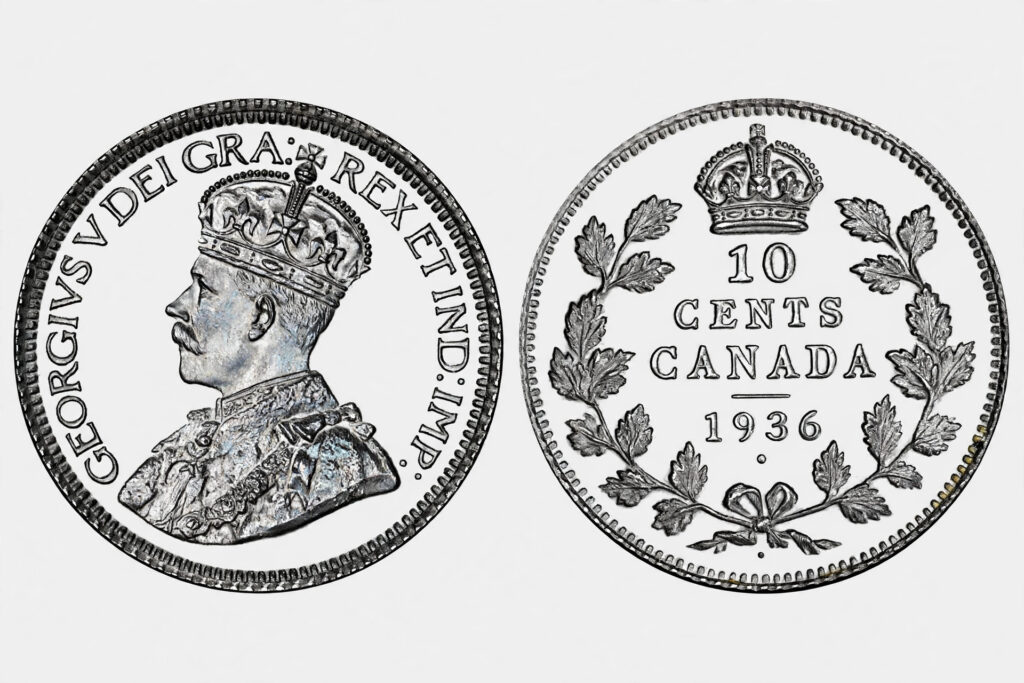
A tiny dot beneath the bow marks Canada's rarest dime — six known examples of an emergency 1937 striking.
History
- Following the death of King George V on January 20, 1936, preparations began on a new 1937 obverse for Edward VIII, but the December 1936 abdication crisis delayed the dies; fearing a coin shortage, the Mint struck 1936-dated coins with the old George V obverse in early 1937, marked by a raised dot on the reverse beneath the bow (Royal Canadian Mint via Silver Gold Bull, accessed 2026-09-16).
- A total of 191,237 dot-marked 10-cent coins were produced in early 1937, all specimen strikes that likely never circulated (Royal Canadian Mint via Silver Gold Bull, accessed 2026-09-16).
- The Royal Canadian Mint states that only six known examples of the 1936 Dot 10 cents exist in the world today (Royal Canadian Mint, accessed 2026-09-16).
- Most of the 191,237 pieces are believed to have been melted down; only three of the six known examples are held outside museum collections, with specimens on display in the Bank of Canada Museum (Royal Canadian Mint via Silver Gold Bull, accessed 2026-09-16).
- Bank of Canada curator David Bergeron calls it ‘one of the rarest Canadian coins ever produced,’ noting the surviving specimens are in permanent museum collections or private collections and ‘unobtainable for most collectors’ (Royal Canadian Mint via Silver Gold Bull, accessed 2026-09-16).
- Recorded dot-dime auction results: $182,160 CAD in October 1997 (Ex Maurice LaFortune/Pittman); $130,000 CAD on September 14, 2006 (PCGS SP-63, Ex Pittman/Belzberg); $196,500 CAD on January 3, 2010 (PCGS SP-68, Ex Maurice LaFortune/Pittman); $87,800 CAD on August 15, 2019 (PCGS SP-63+, Ex Pittman/Belzberg/Cook) (Coins and Canada, accessed 2026-09-16).
- For scale: the regular 1936 circulation 10-cent mintage was 2,460,871 — the dot variety was a microscopic emergency offshoot of that issue (Coins and Canada, accessed 2026-09-16).
Specifications
- composition
- designers
- diameter
- edge
- weight
Collector notes
- The genuine dot is a raised dot beneath the bow on the reverse — a deliberate Mint mark, not a random die chip or spot of toning; compare carefully against the Royal Canadian Mint’s reference description (Royal Canadian Mint, accessed 2026-09-16).
- Do not confuse it with the 1936 ‘Bar’ 10-cent variety, a separate die-crack variety linking the bow (Colonial Acres Coins, accessed 2026-09-16).
- With only six known examples, all accounted for in museums or major private collections, no genuine raw example should ever surface at a flea market — any offered piece demands top-tier third-party authentication.
- For most collectors the realistic way to ‘own’ this rarity is the Royal Canadian Mint’s 2021 1 oz pure gold tribute reproduction, struck with serialized certificate and a mintage of 550 (Royal Canadian Mint, accessed 2026-09-16).
Market check
Compare live listings for this coin on eBay:
Search eBay for 1936 Dot 10 Cents
As an eBay Partner, The Coin Wiki may earn from qualifying purchases.
Related Coins
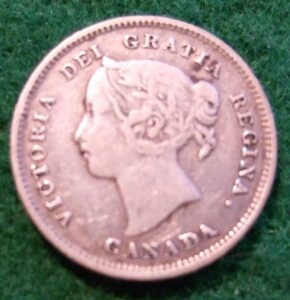
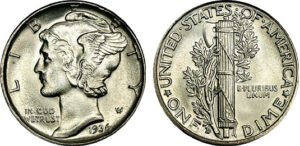
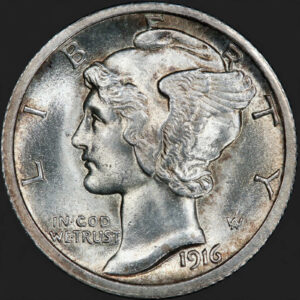
Live on eBay
Live asking prices — not sale records.
 2021 Canada 1 oz Gold 1936 Dot 10 Cents Coin – Ultra Rare (550 Mintage) w/ Box &$8,500.00View on eBay
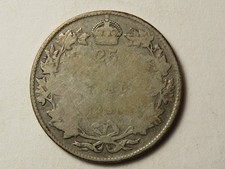 1936 Dot Canata Twenty Five Cents$45.00View on eBay
As an eBay Partner, The Coin Wiki may earn from qualifying purchases.
FREE DOWNLOAD
Before you spend that coin, check it.
The Pocket Change Key-Date Checklist covers the cents, nickels, dimes, quarters and halves still hiding in circulation — including the 1943 and 1983 errors worth five figures. One page to print, a lifetime of jars to check.