
Specifications
- Denomination
- 1 dollar
- Series
- Pattern dollar — George V
- Designer
- Edgar Bertram MacKennal (obverse); William Henry James Blakemore (reverse)
- Years of issue
- 1911
- Composition
- 92.5% Silver, 7.5% Copper
- Weight
- 23.328 g
- Diameter
- 36 mm
- Edge
- Reeded
- KM
- KM-Pn15
- Mintage
- 2
Melt value: $28.58
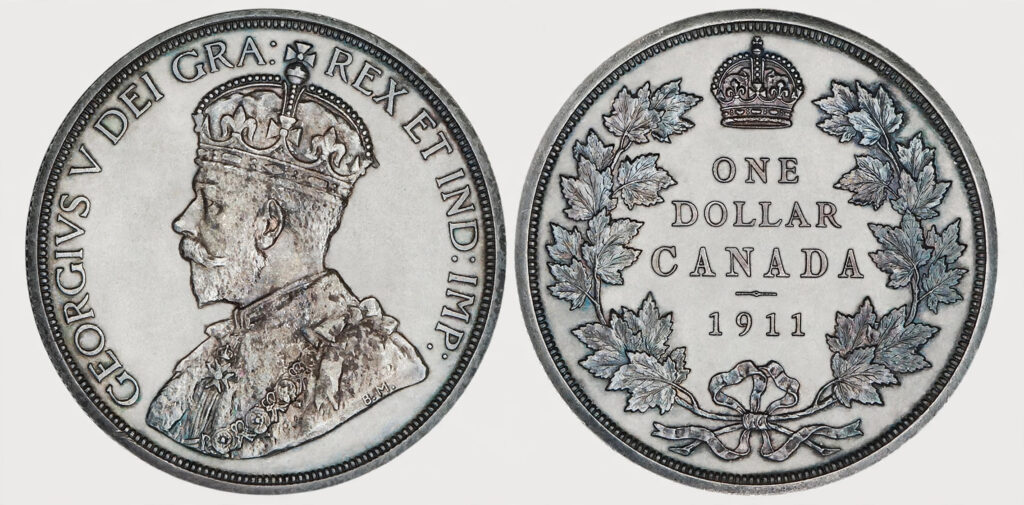
Three trial strikes — two silver, one lead — make the 1911 pattern dollar the 'Emperor of Canadian Numismatics' and Canada's ultimate coin rarity.
History
- The Dominion of Canada Currency Act of 1910 authorized a Canadian silver dollar in .925 silver weighing 360 grains, and a coinage press was obtained from England specifically to strike dollar-sized coins (Heritage Auctions, accessed 2026-09-16).
- The Royal Mint in London prepared dies and struck two specimens in silver and one in lead as proposed patterns for the new dollar; the cases for the specimen sets of George V’s first Canadian coinage even contained a slot designated for a dollar coin (Heritage Auctions, accessed 2026-09-16).
- No business strikes were ever produced: for reasons unknown, Canadian government authorities decided against issuing silver dollars at the time, and the deputy master of the Ottawa Mint reported in 1911 that ‘the Dollar piece was not struck’ (Heritage Auctions, accessed 2026-09-16).
- The obverse was designed by Sir E. Bertram MacKennal, showing a crowned and robed George V facing left with a Latin legend (GEORGIVS V DEI GRA REX ET IND IMP); the reverse by W.J. Blakemore, adapted from a design by Leonard C. Wyon, shows a crown over a maple wreath around the legend ONE DOLLAR CANADA 1911 (Heritage Auctions, accessed 2026-09-16).
- The 1911 pattern is the only first-year-of-reign George V issue bearing DEI GRA — all other 1911 Canadian coinage omits it and is nicknamed ‘Godless’ — and a letter from Deputy Master James Bonar attributes the dollar’s cancellation to controversy over the missing reference to God (Heritage Auctions; Wikipedia, accessed 2026-09-16).
- With only three trial strikes in existence, the coin earned the nickname ‘The Emperor of Canadian Numismatics’ (the 1921 50-cent piece being the ‘King’), and it was listed in the Guinness Book of World Records during the 1960s–1970s as the world’s rarest coin (Heritage Auctions, accessed 2026-09-16).
- The finer silver example (ex-Belzberg, later George H. Cook) realized $1.1 million at auction in 2003 and $734,000 at a 2019 U.S. auction (Capital Current, accessed 2026-09-16); dealers Sandy Campbell and Ian Laing acquired it in 2019 and transferred it to the Bank of Canada Museum in the summer of 2021 (Canadian Coin News, accessed 2026-09-16).
- All three trial strikes now sit in the National Currency Collection: the museum owns one silver example plus the lead pattern (discovered in a federal finance department desk in 1977), while the second silver piece is on loan from the British Royal Mint and has been displayed at the museum since 1980 (Canadian Coin News; Wikipedia, accessed 2026-09-16).
Specifications
- composition
- designers
- diameter
- edge
- weight
Collector notes
- Authentication is straightforward but absolute: only three genuine pieces exist, so any raw or uncertified example offered for sale is fake; the two silver pieces are certified by PCGS as Specimen strikes (SP64 and SP65 in Heritage listings) (Heritage Auctions, accessed 2026-09-16).
- Royal Mint uniface electrotype replicas of the obverse and reverse were produced for contemporary museum displays and are collectible in their own right — a complete electrotype sold for $14,000 at the July 2016 RCNA sale — but they are worth a tiny fraction of a genuine strike (Canadian Coin News, accessed 2026-09-16).
- There is no catalog-price market: value is set by auction, with $1.1 million (2003) and $734,000 (2019) realized for the same silver example (Capital Current, accessed 2026-09-16); a dealer catalog lists an indicative $552,000 in MS64 (coinscatalog.net, accessed 2026-09-16) — treat catalog figures as rough guidance only.
- Verify the DEI GRA legend on any purported 1911 dollar: the pattern is the only 1911 George V issue with it, which helps expose misattributed ‘Godless’ 1911 pieces and modern restrikes such as the non-silver Etsy ‘coronation restrikes’ (Heritage Auctions, accessed 2026-09-16).
- The lead striking is unique and museum-held; lead patterns do not appear on the market, and any offered is spurious (Canadian Coin News, accessed 2026-09-16).
Market check
Compare live listings for this coin on eBay:
Search eBay for 1911 Pattern Dollar
As an eBay Partner, The Coin Wiki may earn from qualifying purchases.
Related Coins
FREE DOWNLOAD
Before you spend that coin, check it.
The Pocket Change Key-Date Checklist covers the cents, nickels, dimes, quarters and halves still hiding in circulation — including the 1943 and 1983 errors worth five figures. One page to print, a lifetime of jars to check.