Specifications
- Denomination
- 1 dollar
- Series
- Eisenhower dollar
- Designer
- Frank Gasparro
- Engraver
- Dennis R. Williams
- Years of issue
- 1975–1976 (dual-dated 1776–1976)
- Composition
- 91.67% Copper, 8.33% Nickel
- Weight
- 22.68 g
- Diameter
- 38.1 mm
- Edge
- Reeded
- Mint marks
- (none), D, S
- Key mintages
- Per-issue mintages not verified in consulted references; the dual date 1776–1976 appears on coins struck in both 1975 and 1976.
Melt value: $0.29
Most 1776–1976 Ikes are face-value clad — the 40% silver San Francisco versions carry real melt value.
History
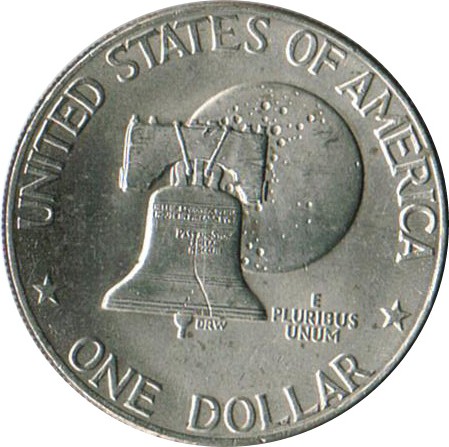
- To mark the nation's Bicentennial, Congress authorized temporary new reverses for the quarter, half dollar, and dollar, all dual-dated 1776–1976 — the Eisenhower dollar carried the dual date on coins struck in both 1975 and 1976 (Wikipedia). The dollar's new reverse, the Liberty Bell superimposed over the moon, was designed by 22-year-old art student Dennis R. Williams, selected through a national design competition (Numismatic News; GovMint).
- Circulation strikes are copper-nickel clad, while special 40% silver versions were produced at San Francisco for collectors in both proof and uncirculated finishes (Numismatic News; Wikipedia). The silver pieces were sold directly to collectors — proofs in a brown box, uncirculated pieces in a blue envelope — and each contains 0.3162 troy oz of silver (GreatCollections; Wikipedia).
- Two reverse varieties exist: Variety 1 (Type 1) shows block-style letters with closed E's and straight-tailed R's, while Variety 2 (Type 2) shows contoured letters with open E's and curved-tailed R's, the result of design tweaks for high-speed production; the price gap between the two is relatively small (Numismatic News).
What is it worth
- Value driver #1: silver content — the 40% silver issues contain 0.3162 troy oz of silver, giving them a melt floor that clad pieces lack (Wikipedia).
- Circulation-grade copper-nickel bicentennial dollars are common and generally worth face value; premium examples are high-grade or certified pieces (Numismatic News).
What drives the premium
- The 40% silver issues contain 0.3162 troy oz of silver, giving them a melt floor that clad pieces lack (Wikipedia)
- Value driver #2: the Type 1 vs Type 2 reverse varieties — Type 1 has block-style letters with closed E's and straight-tailed R's; Type 2 has contoured letters with open E's and curved-tailed R's (Numismatic News). The premium between them is relatively small (Numismatic News).
How to identify the valuable variety
- The 40% silver collector versions were struck only at San Francisco and sold directly to collectors — proofs in a brown box, uncirculated pieces in a blue envelope; circulation copper-nickel pieces came from Philadelphia (no mintmark) and Denver, plus clad proofs from San Francisco for regular proof sets (Numismatic News; GreatCollections; Money Metals).
- Coins struck in both 1975 and 1976 carry the 1776–1976 dual date; no 1975-dated dollars exist (Wikipedia)
Specifications
- Composition: Circulation strikes: copper-nickel clad — outer layers 75% copper/25% nickel over a pure copper core (91.67% copper, 8.33% nickel overall). Collector strikes: 40% silver clad — outer layers 80% silver with a 20.9% silver core (aggregate 60% copper, 40% silver), containing 0.3162 troy oz silver (Wikipedia)
- Weight: Copper-nickel clad: ≈22.68 g; silver clad: ≈24.624 g (Wikipedia)
- Diameter: 38.1 mm (Wikipedia)
- Edge: Reeded (Wikipedia)
- Alignment: Not verified in consulted references
- Designers: Obverse: Frank Gasparro (Eisenhower portrait); Bicentennial reverse: Dennis R. Williams (Liberty Bell over the moon) (Wikipedia; Numismatic News)
- Mint: Philadelphia (no mintmark), Denver (D), San Francisco (S); 40% silver collector issues are San Francisco only (Wikipedia; Money Metals)
Collector notes
- Type 1 shows block-style letters with closed E's and straight-tailed R's, while Type 2 shows contoured letters with open E's and curved-tailed R's (Numismatic News)
Market check
Compare live listings for this coin on eBay:
Search eBay for 1976 Bicentennial Eisenhower Dollar
As an eBay Partner, The Coin Wiki may earn from qualifying purchases.