
Specifications
- Denomination
- 1 dollar
- Series
- Trade dollar — proof only
- Designer
- William Barber
- Years of issue
- 1884
- Composition
- 90% Silver, 10% Copper
- Weight
- 27.2 g
- Diameter
- 38.1 mm
- Edge
- Reeded
- KM
- PCGS 7064
- Mintage
- 10
- Key mintages
- 10 proofs struck (PCGS CoinFacts). Absent from official Mint records; existence discovered 1908 (Wikipedia). Heritage lists 27.22 g vs PCGS 27.20 g — minor catalog discrepancy.
Melt value: $32.44
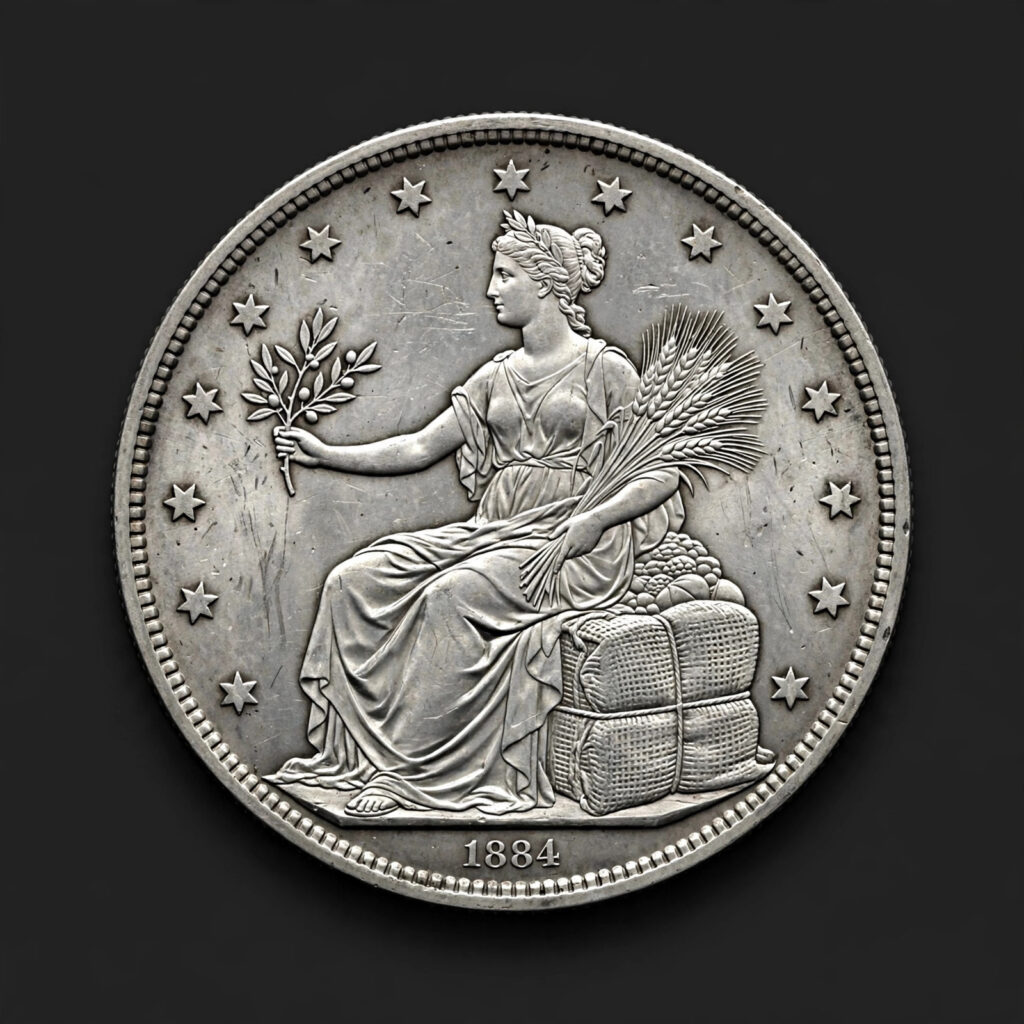
10 proofs struck at Philadelphia — a proof-only rarity absent from official Mint records and unknown to collectors until the early 20th century.
History
- The 1884 trade dollar is a proof-only rarity with a mintage of 10 pieces, struck at Philadelphia (PCGS CoinFacts, accessed 2026-09-16).
- The 1884 and 1885 trade dollars do not appear in official Mint records; their existence became known only later — Wikipedia notes that ten 1884 proofs and five 1885 proofs were discovered in 1908, with no record of when they were created (Wikipedia: Trade dollar, accessed 2026-09-16).
- Heritage describes the ten 1884 pieces as properly prepared and receipted, treating the issue as legitimate, while other historical accounts have called the 1884 and 1885 strikings clandestine (Heritage Auctions; CoinWeek, accessed 2026-09-16).
- All known examples trace back to Philadelphia coin dealer William K. Idler, after whose death in 1901 the coins began surfacing on the market (Finest Known; CoinWeek, accessed 2026-09-16).
- Context: business-strike trade dollar production ended in 1878 after the standard silver dollar returned; from 1879 to 1883 the trade dollar continued only as a proof issue struck for collectors, before the mysterious 1884 and 1885 proofs (CoinWeek; Numismatic News, accessed 2026-09-16).
- The trade dollar was designed by William Barber, the fifth chief engraver of the U.S. Mint, as a heavier silver dollar intended to compete with the Mexican peso in the China trade (Finest Known, accessed 2026-09-16).
Key dates and varieties
- 1884 (Philadelphia, no mintmark; proof only) — mintage 10; one of the most mysterious and valuable issues in American numismatics (PCGS CoinFacts; Heritage Auctions).
- 1885 (proof only, mintage 5) is the companion rarity, even rarer than the 1884 (Wikipedia; CoinWeek).
Specifications
- alignment
- composition
- designers
- diameter
- edge
- mint
- weight
Collector notes
- No published diagnostics found in consulted references — certification recommended.
- Survival estimates vary by source and should not be confused with certified populations: PCGS data shows six examples in all grades, while Heritage has described ten examples as extant and maintains a ten-coin roster (PCGS CoinFacts; Heritage Auctions). No current certification-table population is verified — population is left null.
- Weight note: PCGS lists 27.20 g while Heritage lists 27.22 g for the issue; the discrepancy is a catalog-level rounding/publication difference, not a variety marker (PCGS CoinFacts; Heritage Auctions).
- No freely licensed photograph of an 1884 trade dollar was located in consulted references; auction and grading-service images are copyrighted and cannot be used. An illustration will be used.
Market check
Compare live listings for this coin on eBay:
Search eBay for 1884 Trade Dollar
As an eBay Partner, The Coin Wiki may earn from qualifying purchases.
Related Coins
Live on eBay
Live asking prices — not sale records.
 Photo:J C Kennedy Dollar Doctors Medicine Trade Mark 1884 Trademark Print$13.49View on eBay
 Canada 1984 Beaverton Centennial Trade Dollar 1884 – 1984$5.33View on eBay
As an eBay Partner, The Coin Wiki may earn from qualifying purchases.
FREE DOWNLOAD
Before you spend that coin, check it.
The Pocket Change Key-Date Checklist covers the cents, nickels, dimes, quarters and halves still hiding in circulation — including the 1943 and 1983 errors worth five figures. One page to print, a lifetime of jars to check.