
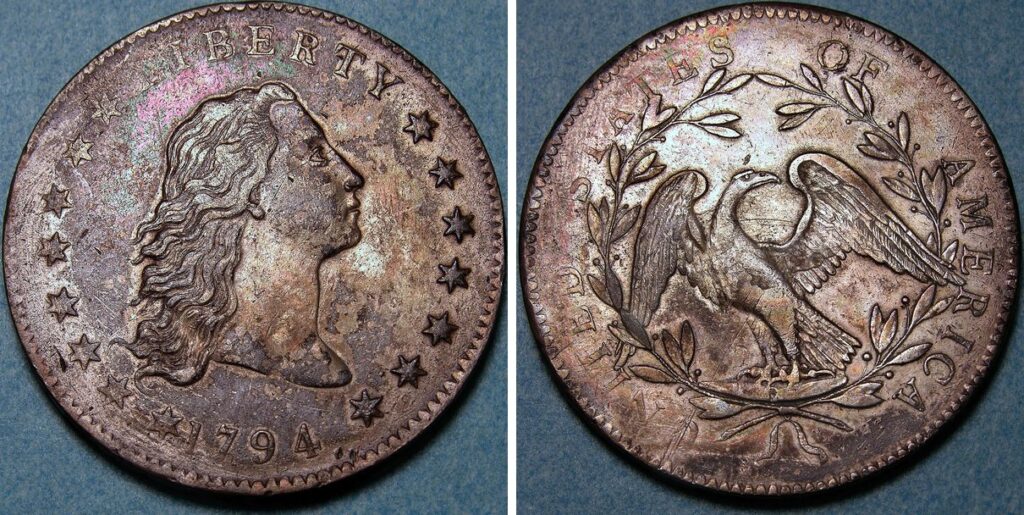
Specifications
- Denomination
- 1 dollar
- Series
- Flowing Hair dollar
- Designer
- Robert Scot
- Engraver
- Robert Scot
- Years of issue
- 1794
- Weight
- 26.96 g
- Edge
- Lettered
- Mintage
- 1758
- Key mintages
- 1,758 delivered October 15, 1794; single die pair (Wikipedia; Goldberg Auctions).
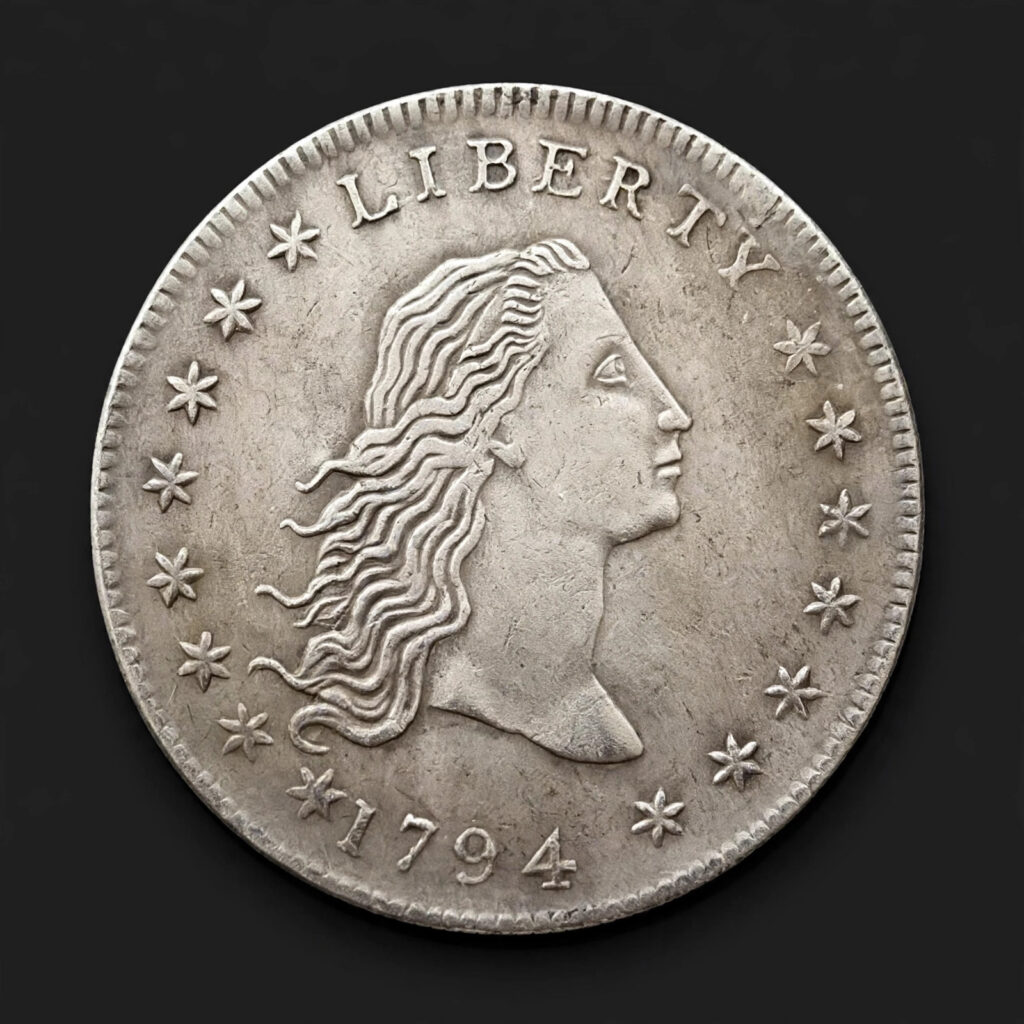
1,758 struck October 15, 1794 — the first silver dollar ever issued by the U.S. Mint; the finest known sold for $10,016,875 in 2013.
History
- The first federal silver dollars were struck October 15, 1794, when 1,758 coins were delivered to the U.S. Mint — the first silver dollar struck for circulation in American history (Wikipedia; Goldberg Auctions, accessed 2026-09-16).
- Designed and engraved by Chief Engraver Robert Scot; the portrait of Liberty faces right with flowing hair, and the reverse shows a naturalistic eagle perched on a rock within a laurel wreath (Wikipedia; EIN News, accessed 2026-09-16).
- The Mint used a screw press intended for smaller coins, so many 1794 dollars are weakly struck, particularly at the centers (EIN News; Wikipedia, accessed 2026-09-16).
- A ‘silver plug’ variety exists: some underweight planchets were corrected by inserting an ~8mm silver plug before striking, making each plug coin essentially a unique piece (Wikipedia, accessed 2026-09-16).
- On January 24, 2013, the finest known 1794 dollar (ex-Lord Saint Oswald, graded PCGS SP66) sold for $10,016,875 — then the highest price ever paid for a coin (Numismatic News, accessed 2026-09-16).
Key dates and varieties
- 1794 (Philadelphia, no mintmark) — 1,758 delivered October 15, 1794; first year of issue; all genuine coins came from ONE die pair (TF Numismatics; Wikipedia).
- Silver Plug variety — struck from underweight planchets corrected with a silver plug; among the most desirable early U.S. coins (Wikipedia).
- No other varieties exist: 1795 and later years have multiple die pairs, but all 1794 dollars share one pair (TF Numismatics).
Specifications
- composition
- weight
- diameter
- edge
- alignment
- designers
- mint
Collector notes
- FINENESS NUANCE: The Coinage Act of 1792 prescribed a standard of 1,485 parts silver per 1,664 (~.8924 fine). According to Wikipedia’s Flowing Hair dollar article, Mint assayer Albion Cox found the .892 standard hard to produce and recommended striking at .900 fine while keeping the 416-grain (26.96 g) weight — meaning the coins were struck contrary to statute at .900. The French Wikipedia infobox reports 89.2% silver / 10.8% copper (the statutory standard). Do not assert a single fineness without noting this discrepancy.
- Authentication markers (TF Numismatics / published diagnostics): ALL genuine 1794 dollars were struck from a single die pair — check exact star positions, denticle spacing, and edge lettering against known die photos; a cast counterfeit may show seams, granular surfaces, or wrong edge lettering; altered-date fakes made from 1795 dollars show tooling around the ‘4’ in the date.
- Genuine coins weigh 26.96 g (±0.5 g tolerance per TF Numismatics) and are 39–40 mm across; the silver plug variety has an ~8mm plug visible on the coin.
- Given the enormous value, certification is essential — this is one of the most counterfeited coins in American numismatics.
Market check
Compare live listings for this coin on eBay:
Search eBay for 1794 Flowing Hair Dollar
As an eBay Partner, The Coin Wiki may earn from qualifying purchases.
Related Coins
Live on eBay
Live asking prices — not sale records.
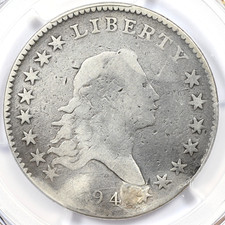 1794 Flowing Hair Half Dollar 50C Coin – Certified PCGS Good Details – Rare Date$3,643.25View on eBay
 1794 Flowing Hair Silver Dollar Medal .999 Fine Silver in OGP w/COA$275.00View on eBay
 1794 Flowing Hair Half Dollar 50C Coin – NGC – VG Details$5,950.00View on eBay
As an eBay Partner, The Coin Wiki may earn from qualifying purchases.
FREE DOWNLOAD
Before you spend that coin, check it.
The Pocket Change Key-Date Checklist covers the cents, nickels, dimes, quarters and halves still hiding in circulation — including the 1943 and 1983 errors worth five figures. One page to print, a lifetime of jars to check.