Specifications
- Denomination
- 1 double florin
- Series
- Jubilee double florin
- Designer
- Joseph Edgar Boehm (obverse); Leonard Charles Wyon (reverse)
- Years of issue
- 1887
- Composition
- 92.5% Silver, 7.5% Copper
- Weight
- 22.6207 g
- Diameter
- 36 mm
- KM
- KM-763
- Mintage
- 483000
- Key mintages
- KM763, S-3923. 1887 circulation total ~483,000 covering both Arabic-1 and Roman-I date varieties (Britannia Coin Co. cites 483,347 for the combined 1887 figure; NGC lists 483,000 against the Roman I line). Two date-punch varieties: Arabic '1' and Roman 'I'.
Melt value: $43.35
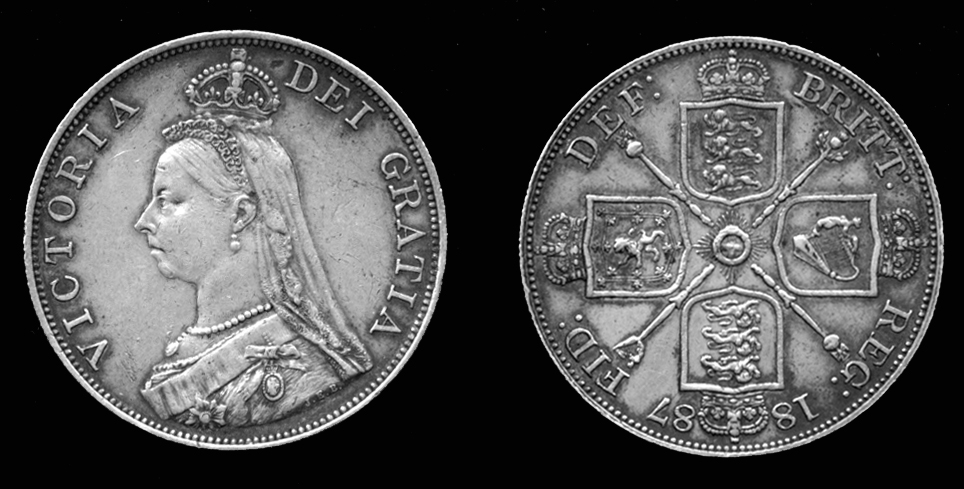
The four-shilling 'Barmaid's Ruin' — Victoria's short-lived 1887 double florin, abandoned after drinkers confused it with the five-shilling crown.
History
- The double florin, or four-shilling piece, was a British coin produced by the Royal Mint between 1887 and 1890, and is one of the shortest-lived of all British coin denominations, struck in only four years (Wikipedia, accessed 2026-09-16).
- It was introduced as part of the 1887 Golden Jubilee coinage redesign, intended to replace portraits of Victoria that had changed little since her youth and to reduce dependence on the expensive-to-strike gold half sovereign (Wikipedia, accessed 2026-09-16).
- When issued in June 1887, the double florin was criticised because it was close in size to the five-shilling crown and neither coin was inscribed with its denomination, causing confusion — said to be particularly acute in pubs, where barmaids accepted it believing it to be a crown, giving it the nicknames ‘Barmaid’s Ruin’ or ‘Barmaid’s Grief’ (Wikipedia, accessed 2026-09-16).
- Complaints were widespread and minting ceased in August 1890 after scarcely more than three years; in February 1891 a Royal Mint design committee appointed by the Chancellor of the Exchequer agreed unanimously that it was undesirable to keep two large coins so nearly similar in size and value, recommending the double florin’s withdrawal (British Numismatic Society, G.P. Dyer, accessed 2026-09-16).
- Upon full decimalisation in 1971 the double florin was not demonetised and technically remains legal tender for 20p (£0.20) (Wikipedia, accessed 2026-09-16; Britannia Coin Company, accessed 2026-09-16).
- The 1887 circulation mintage was 483,347; small numbers of 1887 proof double florins were also struck for inclusion in the scarce 1887 Golden Jubilee proof sets (Britannia Coin Company, accessed 2026-09-16).
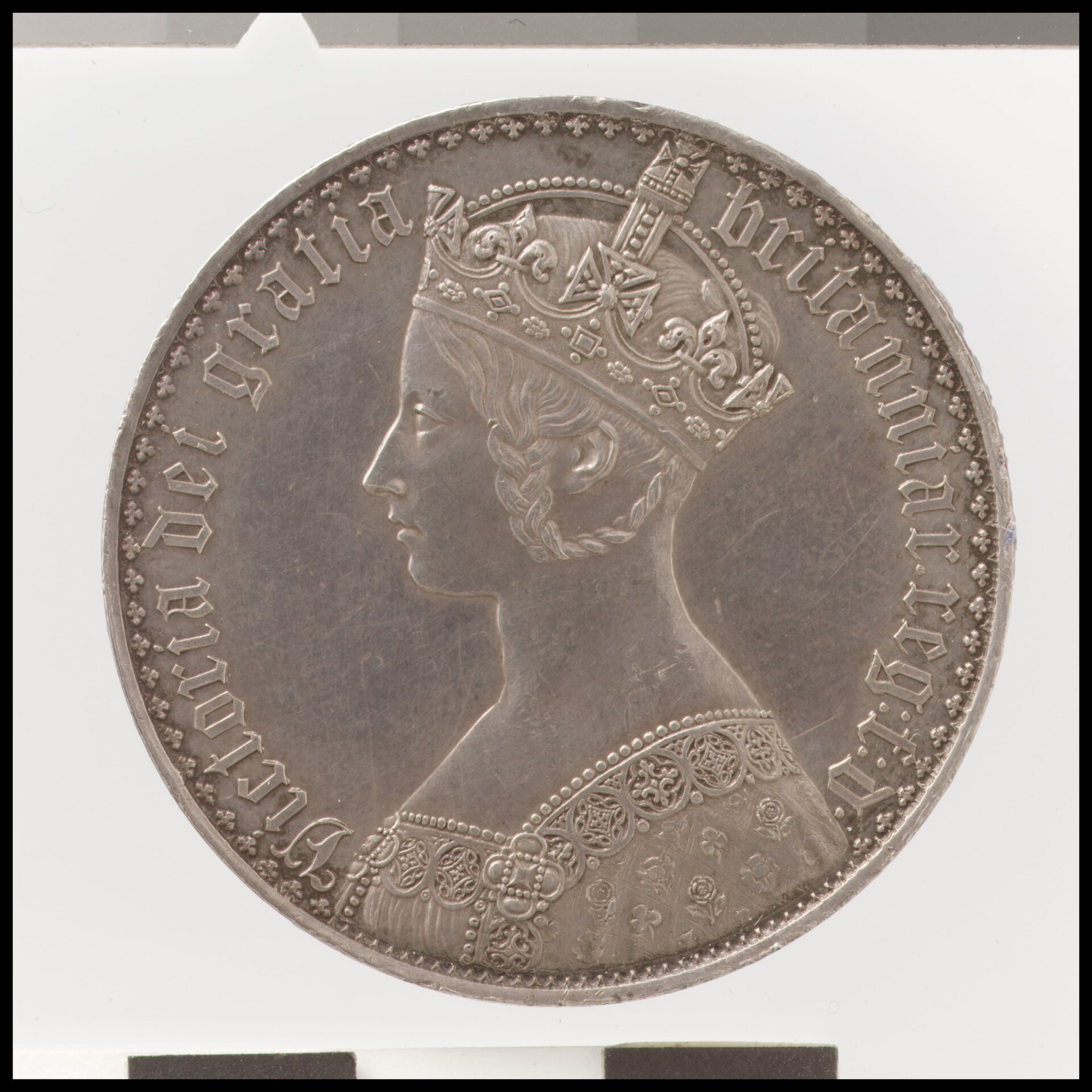
- The obverse, designed by Joseph Boehm and engraved by Leonard Charles Wyon, shows Queen Victoria’s Jubilee Head with a small crown, widow’s veil and pearl necklace; the reverse by Wyon shows four crowned cruciform shields with sceptres, based on the coinage of Charles II (Wikipedia, accessed 2026-09-16).
- The type’s full circulation mintages were 1888: 243,340, 1889: 1,185,111, and 1890: 782,145, making 1889 the most common date and 1888 the scarcest circulation issue (Britannia Coin Company, accessed 2026-09-16).
Key dates and varieties
- 1887 — first year of issue, mintage 483,347; proof strikes exist in Golden Jubilee proof sets (Britannia Coin Company, accessed 2026-09-16)
- 1888 — mintage 243,340, the scarcest circulation date of the type (Britannia Coin Company, accessed 2026-09-16)
- 1889 — mintage 1,185,111, the most common date; includes the ‘Inverted 1 for I in Victoria’ variety (Britannia Coin Company; Cointrust, accessed 2026-09-16)
- 1890 — final year, mintage 782,145 (Britannia Coin Company, accessed 2026-09-16)
Specifications
- composition
- designers
- diameter
- edge
- weight
Collector notes
- Authenticate by weight (22.6 g), diameter (36 mm) and 92.5% silver content — heavily worn examples should still be near full silver weight (Wikipedia, accessed 2026-09-16).
- Check the reverse date for the 1889 ‘Inverted 1 for I in Victoria’ variety, a collected die variety of the short series (Cointrust, accessed 2026-09-16).
- Many circulated examples were cleaned or polished at some point; for a series this short and popular, pay the premium for original, problem-free surfaces.
- Because the 1888 issue had the lowest circulation mintage, demand a clear date and full legends when buying it.
- Beware coins passed off as ‘proof’: genuine 1887 proofs come from Jubilee proof sets; ordinary circulation strikes with shiny surfaces are usually polished.
Market check
Compare live listings for this coin on eBay:
Search eBay for 1887 Double Florin
As an eBay Partner, The Coin Wiki may earn from qualifying purchases.