
Specifications
- Denomination
- 1 penny
- Series
- Pre-decimal penny — George VI
- Designer
- Thomas Humphrey Paget (obverse); George Kruger Gray (reverse)
- Years of issue
- 1946
- Composition
- 97% Copper, 2.5% Zinc, 0.5% Other
- Weight
- 9.45 g
- Diameter
- 30.8 mm
- Edge
- Plain
- KM
- KM 36
- Mintage
- 240000
- Key mintages
- Melbourne; 240,000 per Heritage/uCoin. allcoinvalues cites approx. 363,000 — figures conflict; Krause-line sources use 240,000.
Melt value: $0.11
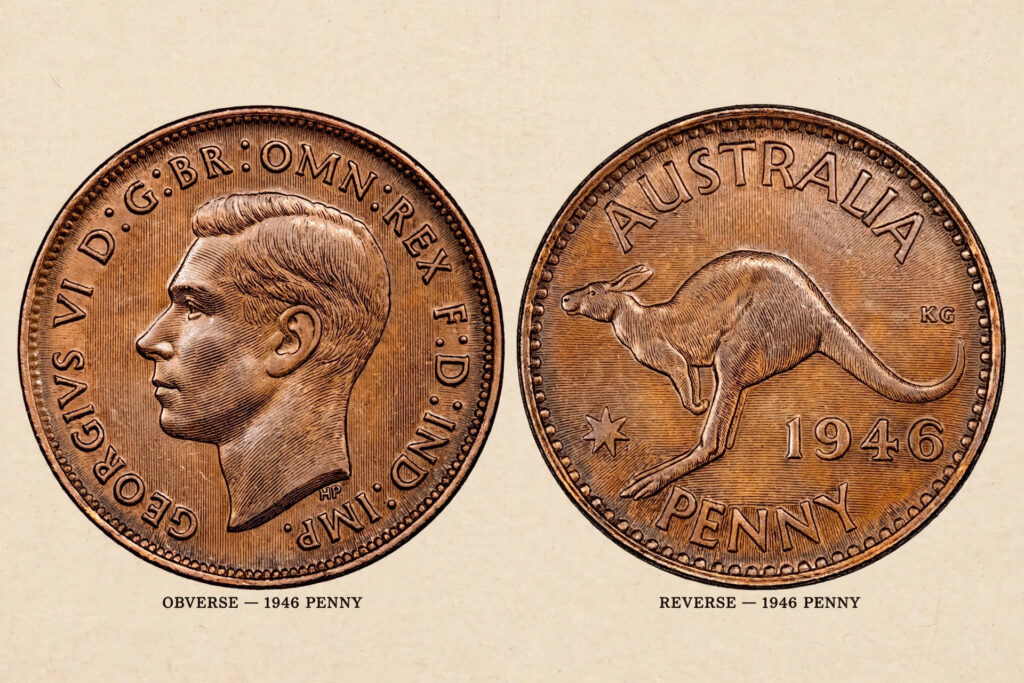
The sleeper key date of the George VI penny series — a tiny post-war mintage at the Melbourne Mint.
History
- The 1946 Australian penny is a low-mintage George VI key date: Heritage Auctions and uCoin list the mintage at 240,000, struck at Melbourne with no mintmark (Heritage Auctions; uCoin, accessed 2026-09-16).
- The scarcity reflects the post-war wind-down of penny production: after huge wartime outputs (21.2 million in 1942 and 53.2 million in 1943), Melbourne output collapsed to 15.2 million in 1945 and then just 240,000 in 1946 (Wikipedia — Penny (Australian coin), accessed 2026-09-16).
- The obverse is the bare head of George VI facing left by Thomas Humphrey Paget (initials HP); the reverse is George Kruger Gray’s bounding kangaroo facing left with AUSTRALIA above, PENNY below and the date below the tail (thepurplepenny.com.au; allcoinvalues.com, accessed 2026-09-16).
- The 1946 penny is frequently targeted by counterfeiters — ‘many fakes around’ — so authentication matters even on circulated examples (allcoinvalues.com, accessed 2026-09-16).
- Some sources cite a higher figure of around 363,000 minted (allcoinvalues.com); the Krause-line figure of 240,000 is used here (Heritage Auctions; uCoin, accessed 2026-09-16).
- In circulated grades it remains collectible-affordable: lower-grade 1925 and 1946 pennies can still be obtained for under $150 (Wikipedia — Penny (Australian coin), accessed 2026-09-16).
Key dates and varieties
- 1946 (Melbourne) — 240,000 minted; some sources cite ~363,000 (Heritage Auctions; uCoin; allcoinvalues.com)
- 1946 is the scarcest of the 1944–1948 George VI pennies (1944: 16M, 1945: 15.2M, 1947: 5.5M, 1948: 16.6M — Wikipedia)
Specifications
- Composition: Bronze: 97% copper, 2.5% zinc, 0.5% tin (coinsandaustralia.com — pre-decimal bronze penny formula)
- Designers: Obverse: Thomas H. Paget (initials HP); reverse: George Kruger Gray (initials KG) (thepurplepenny.com.au; coinscatalog.net KM36)
- Diameter: 30.8 mm (Heritage Auctions; thepurplepenny.com.au)
- Edge: Plain (smooth) (coinsandaustralia.com — pre-decimal bronze penny formula)
- Weight: 9.45 g (thepurplepenny.com.au; coinsandaustralia.com — pre-decimal bronze penny formula)
Collector notes
- Counterfeits are common on this date — check for re-engraved dates (1945 and 1948 are the usual donors) and compare die detail against certified examples (allcoinvalues.com).
- All genuine 1946 pennies are from Melbourne with no mintmark; any mintmark is an immediate red flag.
- Verify weight (9.4–9.45 g) and non-magnetic bronze; off-weight examples should be rejected.
- The reverse kangaroo’s tail position relative to the date is worth checking against reference images when authenticating.
- Buy certified for high-grade examples; circulated examples are inexpensive enough to be worth the assurance anyway.
Market check
Compare live listings for this coin on eBay:
As an eBay Partner, The Coin Wiki may earn from qualifying purchases.
Related Coins
Live on eBay
Live asking prices — not sale records.
 1946-S LINCOLN WHEAT (1c) CENT RED W/MINT LUSTER BU UNCIRCULATED$5.99View on eBay
 1946 Lincoln Wheat Small Cent BN Bronze Business Strike Philadelphia$350.00View on eBay
 1946P Lincoln Wheat Small Cent PCI MS67+ Plus Red Rd$285.00View on eBay
As an eBay Partner, The Coin Wiki may earn from qualifying purchases.
FREE DOWNLOAD
Before you spend that coin, check it.
The Pocket Change Key-Date Checklist covers the cents, nickels, dimes, quarters and halves still hiding in circulation — including the 1943 and 1983 errors worth five figures. One page to print, a lifetime of jars to check.