
Specifications
- Denomination
- 1 crown (5 shillings)
- Series
- Pre-decimal crown — George VI
- Designer
- Thomas Humphrey Paget (obverse); George Kruger Gray (reverse)
- Years of issue
- 1937–1938
- Composition
- 92.5% Silver, 7.5% Copper
- Weight
- 28.28 g
- Diameter
- 38.5 mm
- Edge
- Reeded
- KM
- KM 34
- Mintage
- 1008000
- Key mintages
- Melbourne, no mintmark. ~100 proofs. Renniks 1965 lists circulation mintage 1,800,000 — modern sources use 1,008,000.
Melt value: $34.58
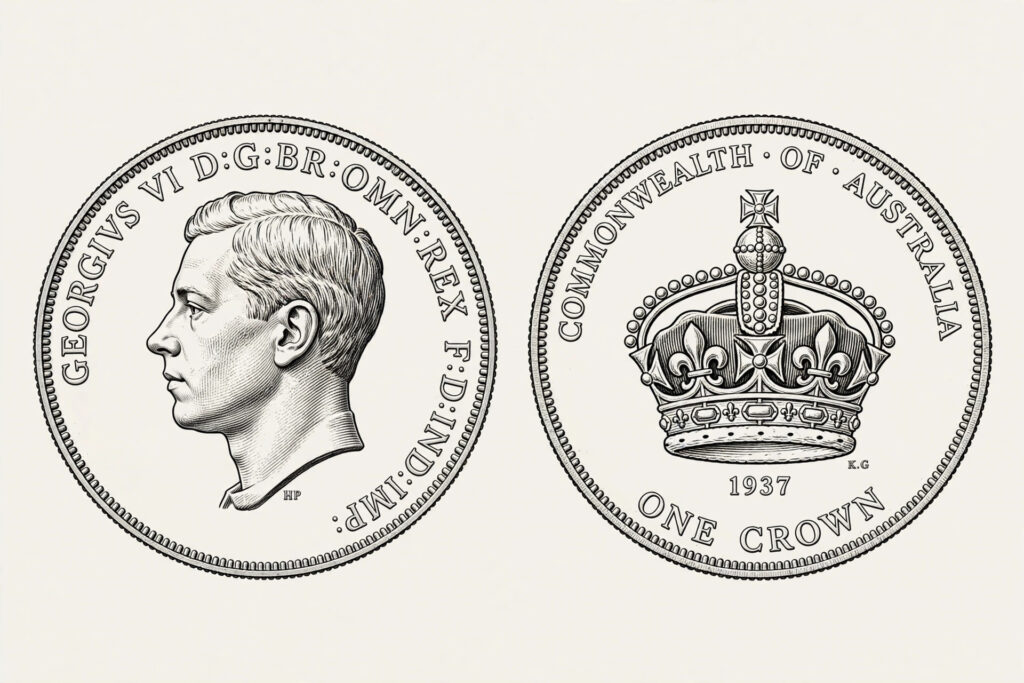
Australia's first crown — a hefty sterling-silver five-shilling piece struck for the coronation of George VI.
History
- The Australian crown was struck in 1937 to commemorate the coronation of King George VI; it had originally been intended for the ascension of Edward VIII, but his abdication changed the plans (Wikipedia — Crown (Australian coin), accessed 2026-09-16).
- It was Australia’s first circulating crown denomination and remains the country’s largest circulating coin ever produced (oldcoinonline.com, accessed 2026-09-16).
- A total of 1,008,000 crowns were minted in 1937 at the Melbourne Mint, along with about 100 proof examples (Heritage Auctions; onlinecoin.club, accessed 2026-09-16).
- The crown was worth five shillings — one quarter of an Australian pound — but proved too large and heavy for everyday use, so it circulated little and many were hoarded as souvenirs (onlinecoin.club, accessed 2026-09-16).
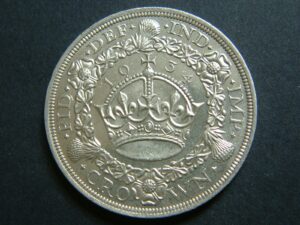
- The obverse shows the bare head of George VI facing left by Thomas Humphrey Paget (initials HP below the truncation); the reverse shows the royal crown by George Kruger Gray with the date 1937 below, COMMONWEALTH OF AUSTRALIA above and ONE CROWN below (Wikipedia — Crown (Australian coin); rarecoinsmelbourne.com.au, accessed 2026-09-16).
- A second issue followed in 1938 with a mintage of only 101,600, making the 1938 crown far scarcer — the 1937 is the common date of the pair (Wikipedia — Crown (Australian coin), accessed 2026-09-16).
- The crown was withdrawn from circulation with decimalisation in 1966 but was never formally demonetised and is still legal tender (onlinecoin.club, accessed 2026-09-16).
Key dates and varieties
- 1937 — 1,008,000 minted at Melbourne; the common date of the two crown issues (Heritage Auctions; Wikipedia)
- 1937 proof — about 100 struck (Heritage Auctions; onlinecoin.club)
- 1937 uniface proof — unknown mintage (onlinecoin.club)
Specifications
- Composition: 92.5% silver, 7.5% copper — sterling silver (Wikipedia — Crown (Australian coin))
- Designers: Obverse: Thomas H. Paget (initials HP); reverse: George Kruger Gray (initials K·G) (Wikipedia — Crown (Australian coin))
- Diameter: 38.5 mm (Wikipedia — Crown (Australian coin))
- Edge: Milled/reeded (Wikipedia — Crown (Australian coin); rarecoinsmelbourne.com.au)
- Weight: 28.28 g (Wikipedia — Crown (Australian coin); Heritage Auctions)
Collector notes
- The 1938 crown is the key date of the two-coin type — don’t overpay for a 1937 thinking it is the rare one.
- At 0.841 oz ASW the coin carries a silver floor; weigh it (28.28 g) — counterfeits are often off-weight.
- Check the milled edge and the K·G initials at lower right of the crown on the reverse; cleaned or polished examples are common and worth less.
- Proofs (only ~100 struck) should be bought certified — business strikes are frequently offered as ‘proofs’ by hopeful sellers.
- The coin is still legal tender, but spending one at face value would be a very expensive mistake.
Market check
Compare live listings for this coin on eBay:
As an eBay Partner, The Coin Wiki may earn from qualifying purchases.
Related Coins
Live on eBay
Live asking prices — not sale records.
 1937 Great Britain 1 Crown$40.00View on eBay
 Silver England 1937 Half Crown Coin$20.00View on eBay
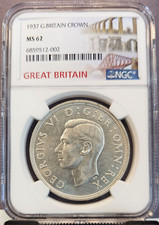 1937 GREAT BRITAIN SILVER 1 CROWN KING GEORGE VI NGC MS 62 BEAUTIFUL COIN$149.95View on eBay
As an eBay Partner, The Coin Wiki may earn from qualifying purchases.
FREE DOWNLOAD
Before you spend that coin, check it.
The Pocket Change Key-Date Checklist covers the cents, nickels, dimes, quarters and halves still hiding in circulation — including the 1943 and 1983 errors worth five figures. One page to print, a lifetime of jars to check.