
Specifications
- Denomination
- 1 florin (2 shillings)
- Series
- Pre-decimal florin — commemorative (Canberra)
- Designer
- Sir Edgar Bertram Mackennal (obverse); George Kruger Gray (reverse)
- Years of issue
- 1927
- Composition
- 92.5% Silver, 7.5% Copper
- Weight
- 11.31 g
- Diameter
- 28.5 mm
- Edge
- Reeded
- KM
- KM 31
- Mintage
- 2000000
- Key mintages
- Melbourne. 2,000,000 circulation strikes + 400 proofs (Heritage). Many hoarded as souvenirs.
Melt value: $13.86

Australia's first commemorative coin — two million florins struck for the opening of Parliament House in Canberra.
History
- The 1927 Canberra florin was issued on 9 May 1927 for the opening of Parliament House in Canberra by the Duke of York — Australia’s first commemorative coin (Wynyard Coin Centre; Alamy caption, accessed 2026-09-16).
- Melbourne had been the seat of government since Federation; the Canberra site was chosen as a compromise between the rivalries of Sydney and Melbourne, and the new Parliament House marked the capital’s coming of age (Wynyard Coin Centre, accessed 2026-09-16).
- Two million coins were struck at the Melbourne Mint for circulation, plus 400 proofs (Heritage Auctions, accessed 2026-09-16).
- The obverse is Sir Edgar Bertram Mackennal’s crowned bust of George V — this was the only commemorative use of that crowned obverse design (Wynyard Coin Centre, accessed 2026-09-16).
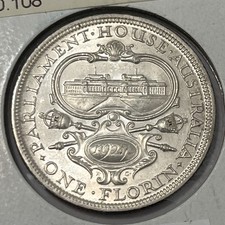
- The reverse, by George Kruger Gray (initials K·G), shows Parliament House within an oval frame above crossed sceptres, with a raised oval bearing the incuse date 1927 superimposed on the sceptres (moruzzi.it; onlinecoin.club, accessed 2026-09-16).
- Because many were hoarded as souvenirs of the ceremony, high-grade examples are common relative to the regular 1927 florin — the coin was a success of public demand rather than a circulation workhorse (Wynyard Coin Centre, accessed 2026-09-16).
- The strike quality varies and is judged by the Parliament House steps: a fully struck coin shows three steps in front of the portico, while weak strikes show two (thepurplepenny.com.au, accessed 2026-09-16).
Key dates and varieties
- 1927 — 2,000,000 minted at Melbourne for circulation (Heritage Auctions; Wynyard Coin Centre)
- 1927 proof — 400 struck; struck on a heavier planchet (Heritage Auctions)
Specifications
- Composition: 92.5% silver, 7.5% copper — sterling silver (thepurplepenny.com.au)
- Designers: Obverse: Sir Edgar Bertram Mackennal; reverse: George Kruger Gray (initials K·G) (Wynyard Coin Centre; moruzzi.it)
- Diameter: 28.5 mm (thepurplepenny.com.au; Heritage Auctions)
- Edge: Milled/reeded (thepurplepenny.com.au)
- Weight: 11.31 g (Heritage Auctions; thepurplepenny.com.au)
Collector notes
- Count the steps on Parliament House: 3 visible steps means a strong strike and commands a premium; 2 steps is a weak strike (thepurplepenny.com.au).
- Because most were hoarded, mint-state examples are plentiful — grade and strike quality are what separate a $50 coin from a $500 one.
- The 400 proofs are rare and expensive; business strikes with mirrored fields are not proofs — buy certified proof claims.
- Check for cleaning and hairlines, especially on higher-grade examples; the open fields show marks easily.
- The reverse initials K·G (Kruger Gray) in the field are a useful authentication check against casts and copies.
Market check
Compare live listings for this coin on eBay:
Search eBay for 1927 Parliament House Florin
As an eBay Partner, The Coin Wiki may earn from qualifying purchases.
Related Coins
Live on eBay
Live asking prices — not sale records.
 1927 Australia Silver One 1 Florin Parliament House Nice Detail -950-$28.00View on eBay
 1927 Australia One 1 Florin Silver Parliament House Commem. Nice Detail! -951-$30.00View on eBay
 AUSTRALIA 1927 Florin UNC Parliament House Silver Coin$94.22View on eBay
As an eBay Partner, The Coin Wiki may earn from qualifying purchases.
FREE DOWNLOAD
Before you spend that coin, check it.
The Pocket Change Key-Date Checklist covers the cents, nickels, dimes, quarters and halves still hiding in circulation — including the 1943 and 1983 errors worth five figures. One page to print, a lifetime of jars to check.