
Specifications
- Denomination
- 5 cents
- Series
- Jefferson nickel
- Designer
- Felix Schlag
- Years of issue
- 1942–1945
- Weight
- 5 g
- Diameter
- 21.2 mm
- Edge
- Plain
- Mint marks
- P, D, S
- Key mintages
- Type-level total not compiled; 1943-P reported at 271,165,000 by Numismatic News and Greysheet.
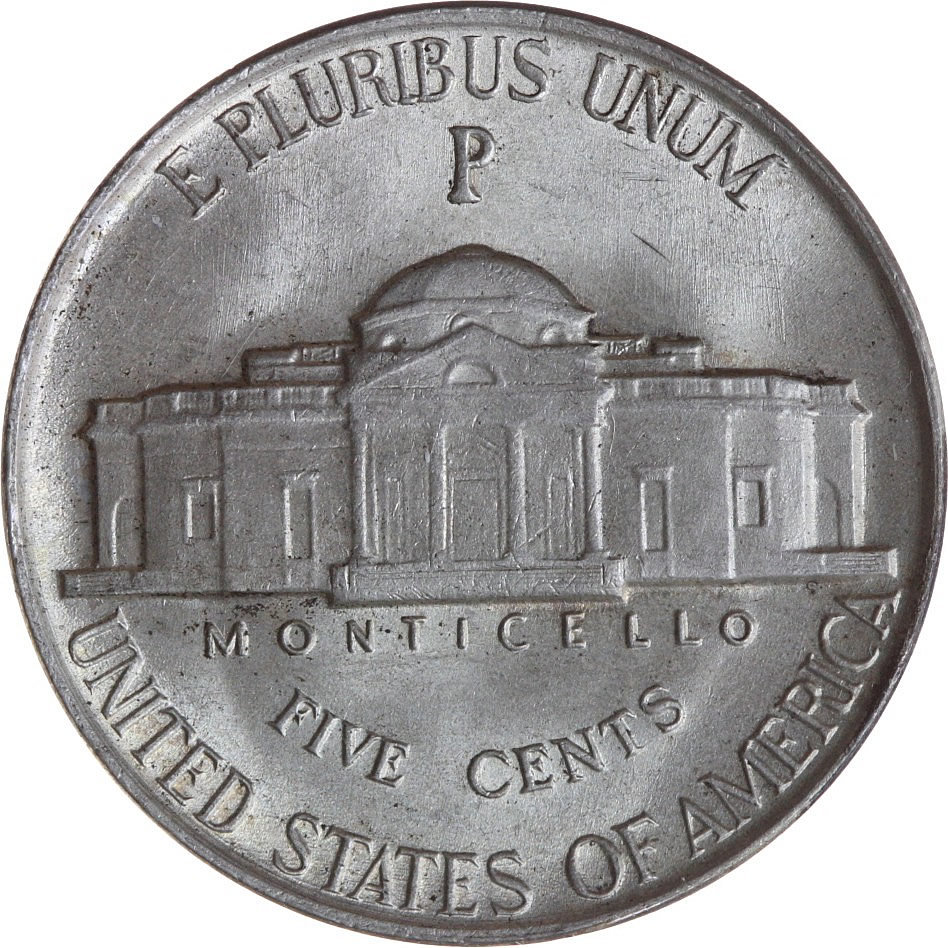
Nickel was needed for the war, so these Jefferson nickels were struck in silver — spot the big mintmark over Monticello.
History
- With nickel a critical wartime material, the Mint adopted an emergency alloy of 56% copper, 35% silver, and 9% manganese after testing alternatives; the manganese helped the new coins work in vending machines that had accepted the earlier copper-nickel pieces (CoinWeek — 1945-P War Nickel).
- The silver alloy began late in 1942 — the first examples appeared in October 1942 — so not every 1942 nickel is silver; Philadelphia and Denver had struck regular copper-nickel pieces earlier that year (Numismatic News — With New Composition Came Mintmark Changes; CoinWeek — 1945-P War Nickel). The large mintmark above Monticello is the practical way to identify a war nickel (Numismatic News — With New Composition Came Mintmark Changes).
- To mark the change, the Mint enlarged the mintmark and placed it above Monticello's dome, and for the first time on a U.S. coin, Philadelphia pieces bore a 'P' mintmark (Numismatic News — With New Composition Came Mintmark Changes; CoinWeek — 1945-P War Nickel). From 1943 through 1945, all three operating mints — Philadelphia, Denver, and San Francisco — produced the emergency alloy (CoinWeek — 1945-P War Nickel).
- Both sides were designed by Felix Schlag, the original Jefferson nickel designer (Greysheet — 1943-P Silver Nickel; U.S. Mint — Nickel History).
What is it worth
- 1942-P and 1942-S — first wartime silver issues, struck late in 1942; the large mintmark identifies the silver alloy (Numismatic News — With New Composition Came Mintmark Changes)
- Silver content is 0.0563 troy ounce (Greysheet — 1943-P Silver Nickel), so the base value follows melt — 0.0563 times the current silver spot price — with collector premiums for condition and recognized varieties.
What drives the premium
- 1945-P FS-801 doubled die reverse — recognized wartime variety (CoinWeek — 1945-P War Nickel)
- Recognized varieties carry collector premiums beyond the melt floor — e.g., the 1945-P FS-801 doubled die reverse (CoinWeek — 1945-P War Nickel).
How to identify the valuable variety
- The large mintmark over Monticello is the identifier: if there is no mintmark above Monticello on a 1942 nickel, it is the regular copper-nickel transition issue, not a war nickel (Numismatic News — With New Composition Came Mintmark Changes).
Specifications
- Composition: 56% copper, 35% silver, 9% manganese (CoinWeek — 1945-P War Nickel; Greysheet — 1943-P Silver Nickel)
- Weight: 5.0 g (Greysheet — 1943-P Silver Nickel)
- Diameter: 21.2 mm (Greysheet — 1943-P Silver Nickel)
- Edge: Plain (Numista — Jefferson Wartime Nickel)
- Alignment: Not verified in consulted references
- Designers: Felix Schlag (Greysheet — 1943-P Silver Nickel; U.S. Mint — Nickel History)
- Mint: Philadelphia (P), Denver (D), San Francisco (S) — large mintmark above Monticello on the reverse (CoinWeek — 1945-P War Nickel; Greysheet — 1943-P Silver Nickel)
Collector notes
- 1943-P — reported mintage of 271,165,000 (Numismatic News — 1943-P Nickel Is Affordable Wartime Reminder; Greysheet — 1943-P Silver Nickel)
- Philadelphia's large 'P' was the first use of a Philadelphia 'P' mintmark on a U.S. coin (Numismatic News — With New Composition Came Mintmark Changes; CoinWeek — 1945-P War Nickel).
- Authentication caution: genuine examples of certain dates struck in copper-nickel are known to exist, so composition and the mintmark are both worth confirming (Numista — Jefferson Wartime Nickel).
Market check
Compare live listings for this coin on eBay:
Search eBay for 1942–1945 Silver War Nickels
As an eBay Partner, The Coin Wiki may earn from qualifying purchases.
Related Coins
FREE DOWNLOAD
Before you spend that coin, check it.
The Pocket Change Key-Date Checklist covers the cents, nickels, dimes, quarters and halves still hiding in circulation — including the 1943 and 1983 errors worth five figures. One page to print, a lifetime of jars to check.