
Specifications
- Denomination
- 1 penny
- Series
- Pre-decimal penny — George V
- Designer
- Sir Bertram Mackennal (obverse); W.H.J. Blakemore (reverse)
- Years of issue
- 1930
- Composition
- 97% Copper, 2.5% Zinc, 0.5% Other
- Weight
- 9.4 g
- Diameter
- 30.8 mm
- Edge
- Plain
- KM
- KM 23
- Key mintages
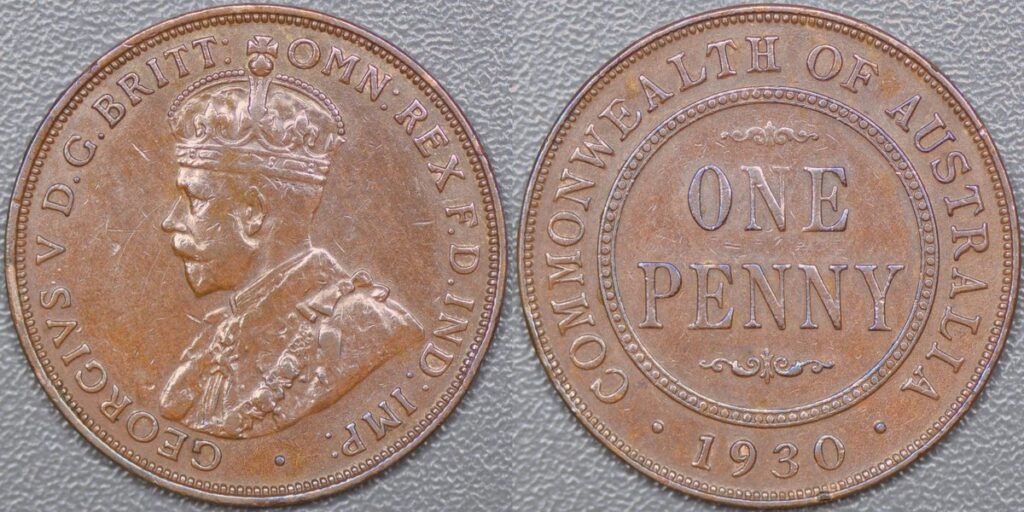
- Mintage unknown — dealer/press estimates 1,600–3,000 struck. Only 3 English-obverse examples known; 6 proofs struck for museums.
Melt value: $0.11
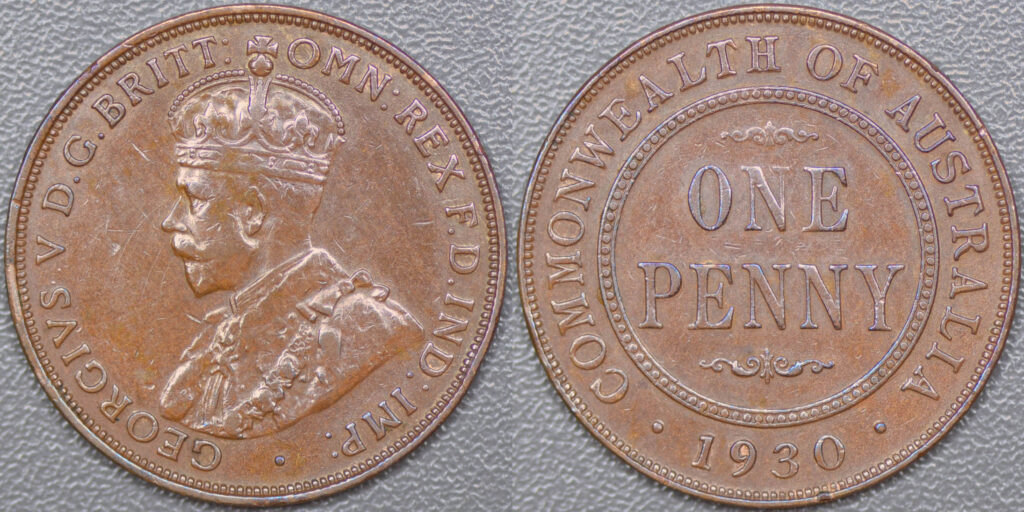
The ‘King of Australian Coins’ — a Great Depression die-testing accident that became Australia’s most famous rarity.
History
- In 1929, at the start of the Great Depression, Australia’s shrinking economy meant the Melbourne Mint received no orders from the Commonwealth Government to strike new 1930-dated coins (Lloyds Auctions via AAP, accessed 2026-09-16).
- Even without an order, the new 1930-dated dies were tested: on 13 August 1930 twelve specimens were struck using a 1930 reverse die paired with an Indian obverse die, and further experimental strikes with 1930 dies were made in August 1931 (Sterling & Currency, accessed 2026-09-16).
- Museums Victoria’s account agrees: 1930 dies were tested on bronze halfpenny and penny planchets with no order in hand, and the small trial-run output was stored with the 1929 coins and released with them in 1931 when the next bronze order arrived (Museums Victoria, accessed 2026-09-16).
- Six proof pennies and six proof halfpennies were specially prepared and sent to the major public numismatic collections — the National Gallery of Victoria, the Art Gallery of South Australia, and the British Museum (Museums Victoria, accessed 2026-09-16).
- The coin first came to collectors’ notice in the 1940s after Sydney collector Fritz Schaefer discovered one between 1940 and 1944, and it has remained Australia’s best-known rare coin ever since (Wikipedia — Penny (Australian coin), accessed 2026-09-16).
- The true mintage is unknown: Wikipedia’s minting figures list 1930 as ‘unknown (usually estimated around 1600)’, Downies says ‘perhaps 3,000’ were struck, and Lloyds says about 3,000 were produced with roughly 1,500 reaching circulation (Wikipedia; Downies; Lloyds via AAP, accessed 2026-09-16).
- Two obverse types exist: the common Indian obverse and the extraordinarily rare English obverse, of which only three examples have surfaced (LastDodo, accessed 2026-09-16).
- Six known proof 1930 pennies exist; two were officially released by the museums that held them and are now the most valuable Australian coins among collectors (Museums Victoria, accessed 2026-09-16).
Key dates and varieties
- 1930 (Indian obverse) — the ‘normal’ type; mintage unknown, usually estimated at 1,500–3,000 struck (Wikipedia; Downies; Lloyds via AAP)
- 1930 (English obverse) — only three examples known, the rarest variety (LastDodo; Sterling & Currency)
- 1930 proofs — six specially struck for the major public collections (Museums Victoria)
Specifications
- Composition: Bronze: 97% copper, 2.5% zinc, 0.5% tin (coinsandaustralia.com)
- Designers: Obverse: Sir Bertram Mackennal (initials B.M.); reverse: W.H.J. Blakemore (Museums Victoria item 56556)
- Diameter: 30.8 mm (Museums Victoria item 56556)
- Edge: Plain (Museums Victoria item 56556)
- Weight: 9.4 g (Heritage Auctions); Museums Victoria measured its example at 9.407 g
Collector notes
- Genuine 1930 pennies are almost always well worn — they circulated as ordinary pennies after release in 1931 — so a mint-state-looking example demands extreme scrutiny.
- Counterfeits are common and high quality; compare the obverse die (Indian vs English type) against documented references such as Sharples (1987) and Mullett (1991).
- Auctioneers cite the ‘partial diamond and six pearls’ detail on George V’s crown band as a check point on genuine examples (Lloyds via AAP).
- All six known proofs are accounted for in museums or their officially released sales — any new ‘proof 1930’ claim should be treated as suspect until certified.
- Buy certified (PCGS/NGC) or from established Australian dealers; never clean a 1930 penny — original surfaces are a major part of the coin’s value.
Market check
Recent eBay sales


Confirmed realized sales only — our monitor records a sale when a live eBay listing’s available quantity drops. Never asking prices.
Compare live listings for this coin on eBay:
As an eBay Partner, The Coin Wiki may earn from qualifying purchases.
Related Coins
Live on eBay
Live asking prices — not sale records.
 1930 S Lincoln Wheat Cent / Penny AVE CIRCULATED **FREE SHIPPING**$2.16View on eBay
 1930-P LINCOLN CENT. MS/ BU/ RD. ORIGINAL. COLLECTORS CHOICE.$85.00View on eBay
 1930 S Lincoln Cent Good – Very Good (G-VG) Circulated Condition Copper Penny$4.44View on eBay
As an eBay Partner, The Coin Wiki may earn from qualifying purchases.
FREE DOWNLOAD
Before you spend that coin, check it.
The Pocket Change Key-Date Checklist covers the cents, nickels, dimes, quarters and halves still hiding in circulation — including the 1943 and 1983 errors worth five figures. One page to print, a lifetime of jars to check.