
Specifications
- Denomination
- penny
- Series
- George V penny (scroll reverse)
- Designer
- Sir Bertram MacKennal (obverse); W.H.J. Blakemore (reverse)
- Years of issue
- 1920
- Weight
- 9.45 g
- Diameter
- 30.8 mm
- Edge
- Plain
- Key mintages
- Not recorded by variety; 1920 mintage was split across Melbourne and Sydney strikes (PCGS; Museums Victoria).
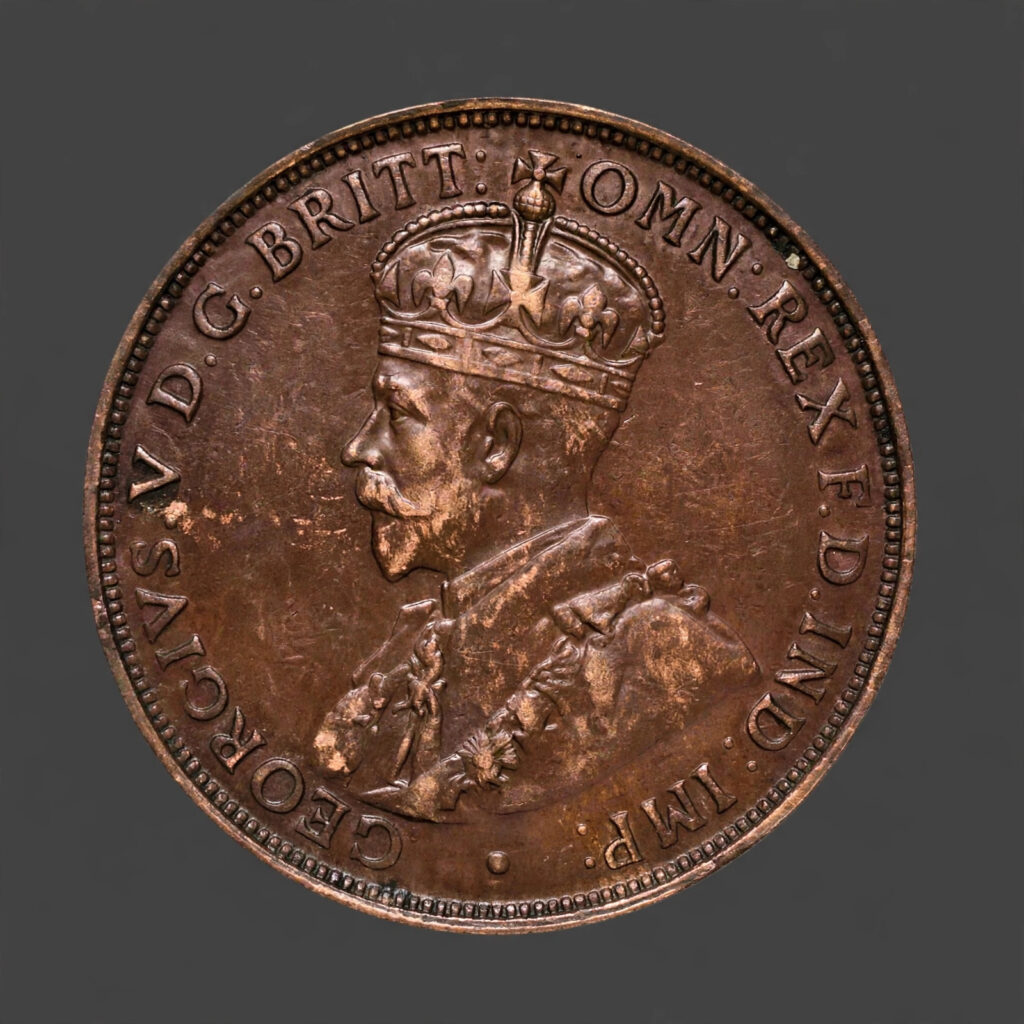
Seven varieties exist; the 1920 dot-below-lower-scroll (London obverse) struck at Melbourne is the key penny variety.
History
- The dots on 1919 and 1920 pennies were part of a Melbourne Mint series of die-steel tests; dies were supplied to Sydney from Melbourne (Museums Victoria, accessed 2026-09-16).
- PCGS documents seven 1920 penny varieties: dot-below-scroll reverses were produced at the Melbourne Mint with both English (London) and Indian obverse dies, and the Melbourne issue with the English obverse is the rarity (PCGS, accessed 2026-09-16).
- The London/English obverse is separated from the Indian/Bombay obverse by the second upstroke of the N in OMN — falling between two denticles on English dies, but lining up with a denticle on Indian dies (PCGS, accessed 2026-09-16).
- The no-dots variety derives from the ceremonial Sydney Mint strike of October 1920 (coins struck for dignitaries); the dots-above-and-below arrangement is also attributed to Sydney production (PCGS, accessed 2026-09-16).
- Low-grade ‘no dot’ coins are often just the product of filled dies or circulation wear erasing the dot, and typically trade at heavy discounts (PCGS; Top End Coins, accessed 2026-09-16).
Key dates and varieties
- 1920 dot below lower scroll, London (English) obverse — the key variety (PCGS)
- 1920 dot below lower scroll, Indian obverse — scarcer, but not the key (PCGS)
- 1920 dot above bottom scroll / dots above and below — Sydney issues (PCGS; NumisBid)
Specifications
- alignment
- composition
- designers
- diameter
- edge
- mint
- weight
Collector notes
- KEY DIAGNOSTIC MARKERS: the key coin combines a small dot BELOW the lower scroll on the reverse (Melbourne) WITH the London/English obverse: on the obverse, the second upstroke of the N in OMN falls BETWEEN two rim denticles (London die); on the Indian/Bombay die that upstroke lines up WITH a denticle (PCGS). Sydney coins instead show a dot ABOVE the bottom scroll, dots above AND below, or no dots (PCGS; NumisBid).
- Correction: no consulted source confirms a ‘dot above the upper scroll’ Calcutta variety for 1920; the documented Sydney reverse markers are the dot above the bottom scroll and the above-and-below pair (PCGS; NumisBid).
- Value/fakes: on worn coins the dots can vanish through circulation or grease-filled dies, so attribution must rest on the obverse N-in-OMN diagnostic, not the dot alone (PCGS; Top End Coins). Uncertified ‘no dot’ examples trade at steep discounts.
Market check
Compare live listings for this coin on eBay:
Search eBay for 1920 Dot (London Die) Australia Penny
As an eBay Partner, The Coin Wiki may earn from qualifying purchases.
Related Coins
FREE DOWNLOAD
Before you spend that coin, check it.
The Pocket Change Key-Date Checklist covers the cents, nickels, dimes, quarters and halves still hiding in circulation — including the 1943 and 1983 errors worth five figures. One page to print, a lifetime of jars to check.