
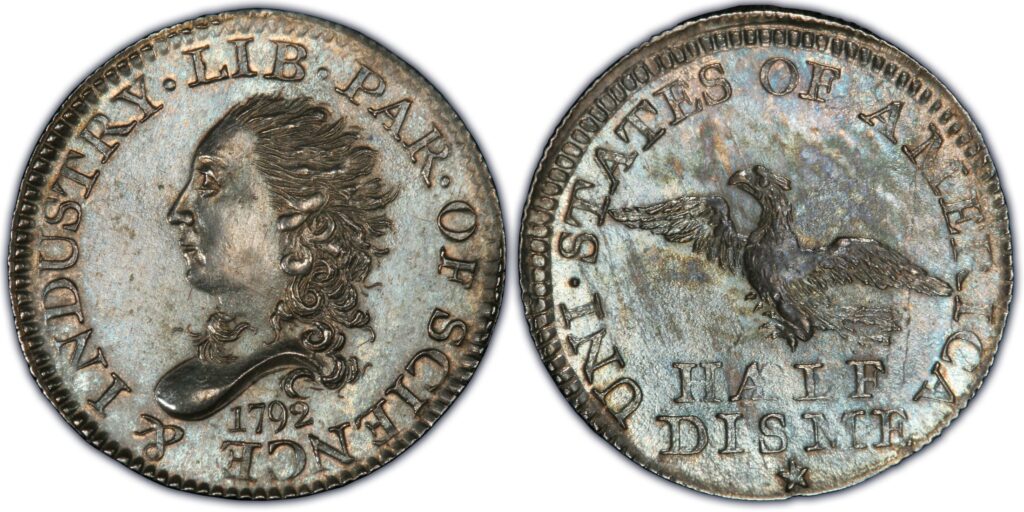
The first U.S. coinage struck under the Mint Act of 1792 — about 1,500 struck in July 1792 before the Philadelphia Mint even opened (Wikipedia; ANA).
History
- Widely (though not universally) considered the first United States coinage struck under the authority of the Coinage Act of April 2, 1792 (Wikipedia, accessed 2026-09-16).
- The half dismes were struck in or around July 1792 in the private workshop of Philadelphia sawmaker John Harper at 6th and Cherry Streets — under the auspices of official Mint personnel, since the Mint’s buildings and machinery were not yet ready. Mint Director David Rittenhouse oversaw the work; Adam Eckfeldt built the screw press and is believed to have made the dies and operated the press to strike the pieces (Wikipedia; Wikipedia — Adam Eckfeldt; Heritage Auctions, accessed 2026-09-16).
- Secretary of State Thomas Jefferson’s memorandum book records that he provided ’75 (Mexican) Silver Dollars’ on July 11, 1792 and received the first 1,500 half dismes on July 13; he then spent the coins on his trip home to Monticello (Wikipedia; Numismatic News, accessed 2026-09-16).
- The famous Washington anecdotes — that the portrait depicts Martha Washington and that the silver came from the Washington household’s melted silverware — have ‘no solid evidence’ behind them; folklore held both, but Jefferson’s memorandum book documents the actual silver source (Wikipedia; Heritage Auctions, accessed 2026-09-16).
- President Washington did take a direct interest: he discussed the coins in his November 6, 1792 address to Congress, calling it ‘a small beginning in the coinage of half dismes’ (Heritage Auctions; Wikipedia, accessed 2026-09-16).
- The die maker is not definitively recorded: Adam Eckfeldt is the traditional attribution (Wikipedia); the ANA credits designers Robert Birch and Joseph Wright with Jacob Perkins likely producing the dies; Numismatic News notes Birch, Henry Voigt, and Eckfeldt have all been proposed (ANA; Numismatic News, accessed 2026-09-16).
- Total production is believed at 2,000–3,500 (researchers cite a possible second striking in October 1792); roughly 250–400 survive, and the issue is ranked #12 in Garrett & Guth’s 100 Greatest U.S. Coins (Wikipedia; Heritage Auctions; CoinNews, accessed 2026-09-16).
Key dates and varieties
- 1792 — single-year issue; the only circulating half disme (Wikipedia)
- Judd-7 — catalog number for the silver issue; a unique copper pattern (Judd-8) is also known (Wikipedia; Numista)
Specifications
- composition
- designers
- diameter
- edge
- mint
- weight
Collector notes
- KEY DIAGNOSTIC MARKERS: research by Augsburger, Orosz, and Smith confirmed all known pieces were struck from the same obverse die (CoinWorld). Obverse: bust of Liberty left with ‘LIB. PAR. OF SCIENCE & INDUSTRY’ (a motto attributed to Benjamin Franklin) and date 1792; reverse: eagle in flight with ‘HALF DISME’ and a star, legend ‘UNI. STATES OF AMERICA’ (Numismatic News; Wikipedia).
- Edge is reeded — obliquely reeded on examined specimens (Greysheet; Heritage Auctions).
- Value factors: most survivors show circulation wear or damage, so condition is everything — a PCGS MS67 specimen strike from the Starr Collection sold for $1,322,500 in 2006 and an NGC MS68 for $1,500,000 by private treaty in 2007 (Wikipedia).
- The copper Judd-8 pattern is unique; silver Judd-7 examples are cataloged as patterns (R.4) but are collected as the first federal issue (Heritage Auctions; Greysheet).
Market check
Compare live listings for this coin on eBay:
Search eBay for 1792 Half Disme
As an eBay Partner, The Coin Wiki may earn from qualifying purchases.
Related Coins
FREE DOWNLOAD
Before you spend that coin, check it.
The Pocket Change Key-Date Checklist covers the cents, nickels, dimes, quarters and halves still hiding in circulation — including the 1943 and 1983 errors worth five figures. One page to print, a lifetime of jars to check.