
Specifications
- Denomination
- 50 cents
- Series
- Decimal fifty cents — round type
- Designer
- Arnold Machin (obverse); Stuart Devlin (reverse)
- Years of issue
- 1966
- Composition
- 80% Silver, 20% Copper
- Weight
- 13.28 g
- Diameter
- 31.51 mm
- Edge
- Reeded
- Key mintages
- One-year issue (1966 only). RAM reports ~36.5 million produced; ~14 million reached circulation; the rest were never released or were melted.
Melt value: $14.09
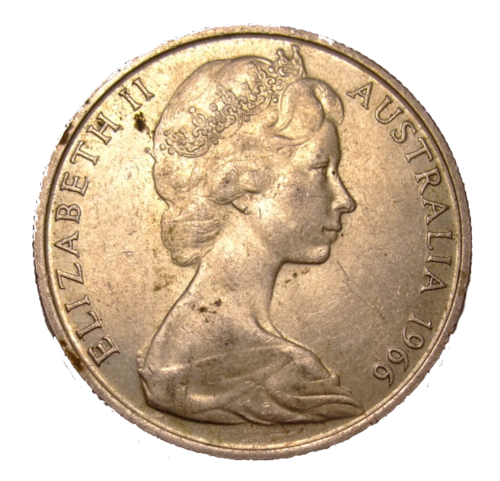
The one-year wonder: an 80%-silver round fifty-cent piece killed by the rising silver price after a single year.
History
- The round fifty-cent coin was introduced on 14 February 1966 with decimalisation — the highest denomination and largest diameter coin of the new Australian decimal series (Wikipedia — Australian round fifty-cent coin, accessed 2026-09-16).
- It contained 80% silver and 20% copper, but the silver price rose so quickly after issue that the bullion value exceeded the 50c face value, forcing its withdrawal from circulation (Wikipedia — Australian round fifty-cent coin, accessed 2026-09-16).
- A total of about 36.45 million coins were minted; the Royal Australian Mint’s own circulating-coin page reports 36,500,000 produced in 1966, with only about 14 million actually put into circulation (Wikipedia; currencyaustralia-cca.com.au citing RAM, accessed 2026-09-16).
- Because of its high silver content, 1966 was the only year the round 50c was minted; it was replaced in 1969 by the twelve-sided 50-cent coin in cupronickel, which kept Stuart Devlin’s coat of arms reverse (Wikipedia — Australian round fifty-cent coin, accessed 2026-09-16).
- The obverse carries Arnold Machin’s portrait of Queen Elizabeth II and the reverse the Australian Coat of Arms by Stuart Devlin (Wikipedia — Australian round fifty-cent coin, accessed 2026-09-16).
- The coins were struck by the Royal Australian Mint in Canberra (Trade Me / Auction Kings listing; currencyaustralia-cca.com.au, accessed 2026-09-16).
- Round 50-cent coins are still legal tender, but their precious-metal value greatly exceeds face value, so they are rarely used as payment (Wikipedia — Australian round fifty-cent coin, accessed 2026-09-16).
Key dates and varieties
- 1966 (round) — the only round 50c issue; ~36.45 million minted, ~14 million circulated (Wikipedia; RAM)
- No other dates exist for the round type — any ‘1967’ or later round 50c claim is false (Wikipedia)
Specifications
- Composition: 80% silver, 20% copper (Wikipedia — Australian round fifty-cent coin)
- Designers: Obverse: Arnold Machin; reverse: Stuart Devlin (Wikipedia — Australian round fifty-cent coin)
- Diameter: 31.51 mm (Wikipedia — Australian round fifty-cent coin)
- Edge: Milled (Wikipedia — Australian round fifty-cent coin)
- Weight: 13.28 g; 0.3416 oz silver (Wikipedia — Australian round fifty-cent coin; Trade Me listing)
Collector notes
- Weigh it: 13.28 g. Counterfeits of this high-silver piece exist, and an off-weight coin is the first red flag.
- The coin is non-magnetic; a magnet test is a quick screen (coinsandaustralia.com lists silver decimal coins as non-magnetic).
- Don’t confuse it with the twelve-sided 1969+ 50c — different shape, different metal (cupronickel, no silver).
- Uncirculated examples carry a strong premium over melt; circulated pieces trade mainly on their 0.34 oz of silver.
- Check for rim knocks and cleaning — original lustre on the Machin portrait is a key value driver.
Market check
Compare live listings for this coin on eBay:
Search eBay for 1966 Round 50 Cent
As an eBay Partner, The Coin Wiki may earn from qualifying purchases.
Related Coins
FREE DOWNLOAD
Before you spend that coin, check it.
The Pocket Change Key-Date Checklist covers the cents, nickels, dimes, quarters and halves still hiding in circulation — including the 1943 and 1983 errors worth five figures. One page to print, a lifetime of jars to check.