
Specifications
- Denomination
- 5 cents
- Series
- Buffalo Nickel
- Designer
- James Earle Fraser
- Years of issue
- 1913–1938
- Composition
- 75% Copper, 25% Nickel
- Weight
- 5 g
- Diameter
- 21.2 mm
- Edge
- Plain
- KM
- KM-134
Melt value: $0.05
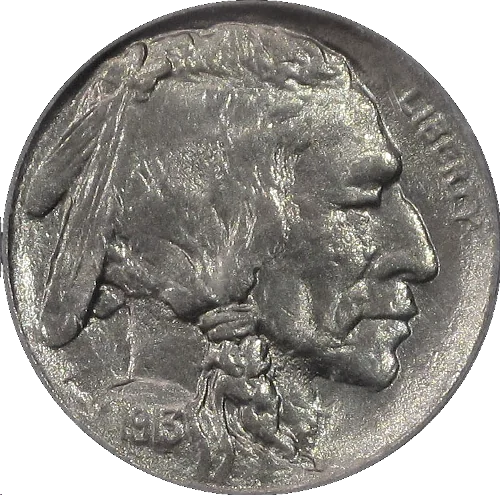
Fraser's sculpted portrait of a Native American and a Bronx Zoo bison — the coin that taught a generation the date wears off first.
History
- Designed by sculptor James Earle Fraser to replace the Liberty Head nickel (in use since 1883); production began at Philadelphia on February 17, 1913 (CoinWeek, accessed 2026-09-16).
- The obverse is a composite portrait modeled from life on three Native American subjects — Iron Tail and Two Moons among them; the reverse bison was modeled on Black Diamond, a bison at the Bronx Zoo in New York (Wikipedia, Buffalo nickel; Stack’s Bowers, accessed 2026-09-16).
- Two reverse types exist in 1913: Type 1 shows the bison on a raised mound with FIVE CENTS on the mound; Type 2 (introduced mid-year) sinks the denomination into a recessed area because the raised letters wore away in circulation (CoinWeek, accessed 2026-09-16).
- The date was also placed high in the relief and never corrected, so heavily circulated examples routinely lost their dates — ‘dateless’ Buffalos are ubiquitous (Stack’s Bowers, accessed 2026-09-16).
- Struck 1913–1938 at Philadelphia, Denver, and San Francisco (mint mark under FIVE CENTS on the reverse); the Jefferson nickel replaced it in 1938 (Wikipedia, Buffalo nickel, accessed 2026-09-16).
- Proofs were struck in matte finish 1913–1916 (both 1913 types exist as proofs, mintages near 1,250–1,500 each) and again in satin/brilliant finishes in 1936–1937 (Stack’s Bowers, accessed 2026-09-16).
Key dates and varieties
- 1913-S Type 2 — mintage of just 1,209,000; the first recessed-ground issue to reach circulation and far tougher than its mintage suggests because dates wore off (Numismatic News, accessed 2026-09-16).
- 1921-S, 1924-S, 1926-S — the classic low-mintage San Francisco regular-issue keys; PCGS lists them among the series’ key dates (PCGS Buffalo Nickel guide, accessed 2026-09-16).
- 1918/7-D overdate — the series’ only overdate; scarce in all grades and a major rarity in uncirculated (Stack’s Bowers, accessed 2026-09-16).
- 1916 doubled-die obverse — sharply doubled date, one of the most famous Buffalo varieties (PCGS Buffalo Nickel guide, accessed 2026-09-16).
- 1937-D ‘3-legged’ — the famous over-polished-die variety missing the bison’s front leg (PCGS Buffalo Nickel guide, accessed 2026-09-16).
- 1936-D ‘3½-legged’ — the lesser-known but even more valuable over-polished variety (PCGS Buffalo Nickel guide, accessed 2026-09-16).
Specifications
- Weight: 5.00 grams (77.16 grains) (Stack’s Bowers, accessed 2026-09-16).
- Composition: 75% copper, 25% nickel (Stack’s Bowers, accessed 2026-09-16).
- Diameter: 21.2 mm (Stack’s Bowers, accessed 2026-09-16).
- Edge: Plain (Stack’s Bowers, accessed 2026-09-16).
- Designers: James Earle Fraser, obverse and reverse (Pristine Auction / PCGS data, accessed 2026-09-16).
Collector notes
- Grading quirk: strike quality varies wildly — branch-mint issues of the late 1910s–1920s are often softly struck on the bison’s horn and the Indian’s braid; learn to separate weak strike from wear (Stack’s Bowers, accessed 2026-09-16).
- Dateless coins: the date is the highest point of the obverse; tilt raw coins under raking light — a ghost of the date can sometimes be read (Stack’s Bowers, accessed 2026-09-16).
- The 1937-D 3-legged variety is one of the most faked U.S. coins — buy it certified, and check for the telltale die-polishing lines and the ‘moth-eaten’ look of the missing leg area.
- Type 1 (1913 only) is the affordable one-year type coin; it is typically well struck with satiny luster and comes cheap even in Mint State (David Hall via eBay catalog data, accessed 2026-09-16).
- Most later dates (1934–1938) are common and inexpensive in circulated grades — assemble the set from the back forward, and budget the key dates first.
Market check
Compare live listings for this coin on eBay:
Search eBay for Buffalo Nickel (1913–1938)
As an eBay Partner, The Coin Wiki may earn from qualifying purchases.
Related Coins
Live on eBay
Live asking prices — not sale records.
 1913 Buffalo Nickel Type 2 MS 63 NGC$125.00View on eBay
 1937 Buffalo Nickel ~ BU/Uncirculated ~ Better Date!$17.65View on eBay
 (1) Buffalo Nickel VF-XF Very Fine-Extremely Fine Estate Fine$7.89View on eBay
As an eBay Partner, The Coin Wiki may earn from qualifying purchases.
FREE DOWNLOAD
Before you spend that coin, check it.
The Pocket Change Key-Date Checklist covers the cents, nickels, dimes, quarters and halves still hiding in circulation — including the 1943 and 1983 errors worth five figures. One page to print, a lifetime of jars to check.