
Specifications
- Denomination
- ducat (zecchino)
- Series
- Venetian trade coinage
- Years of issue
- 1284–1797
- Weight
- 3.5 g
- Diameter
- 21 mm
- Edge
- Plain
- Mint marks
- None
- Key mintages
- Not recorded
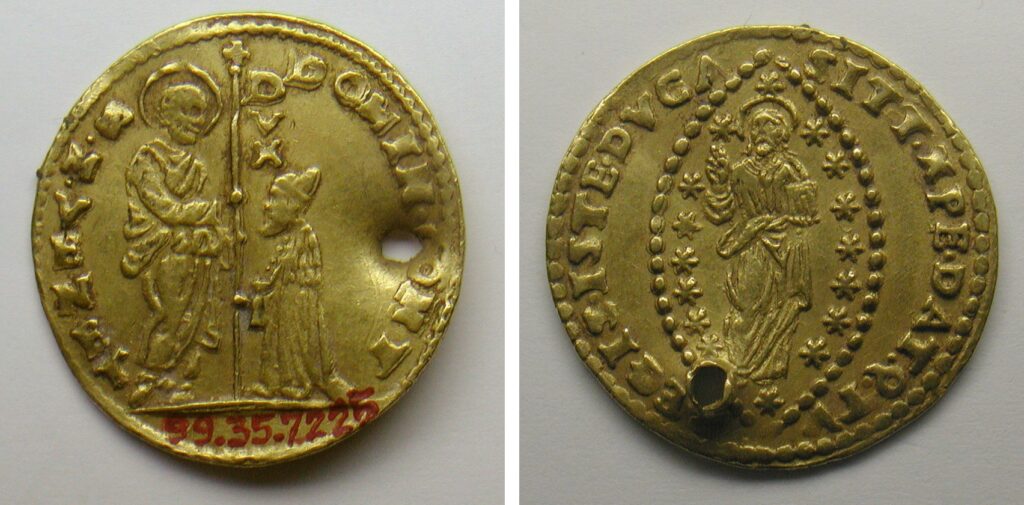
The ~3.5 g high-purity gold coin of Venice, struck 1284–1797 with an essentially unchanged design — the Doge kneeling before St. Mark / Christ in a star-lined mandorla — the Mediterranean’s standard trade coin for five centuries.
History
- In 1284 the Great Council of Venice authorized a gold ducat under Doge Giovanni Dandolo, responding to the debasement of the Byzantine hyperpyron after Emperor Michael VIII Palaiologos backed the revolt of the Sicilian Vespers in 1282. (Wikipedia — Venetian ducat, accessed 2026-09-27)
- Venice modeled the size and weight of the ducat on the Florentine florin (1252, 3.5 g of 98.6% fine gold); the Venetian ducat contained 3.545 grams of 99.47% fine gold, described as the highest purity medieval metallurgy could produce — the article’s lede summarizes the type as about 3.5 g of 98.6% fine gold. (Wikipedia — Venetian ducat, accessed 2026-09-27)
- The obverse shows the Doge of Venice kneeling before St. Mark, the city’s patron saint; St. Mark holds the gospel (his usual attribute) and presents a gonfalone (banner) to the doge, with the legend identifying the saint as S M VENET and the doge’s name plus DVX in the field. (Wikipedia — Venetian ducat, accessed 2026-09-27)
- The reverse shows Christ standing among a field of stars in an oval frame (mandorla), with the Latin hexameter legend SIT TIBI CHRISTE DATUS QUEM TU REGIS ISTE DUCATUS (‘Christ, let this duchy that you rule be given to you’) — the same legend Roger II of Sicily used on his 12th-century ducats. (Wikipedia — Venetian ducat, accessed 2026-09-27)
- The design remained essentially unchanged for over 500 years, from the first issue in 1284 to Napoleon’s takeover of Venice in 1797; succeeding doges changed only their own name on the obverse, and the coins were struck without dates. (Wikipedia — Sequin (coin); Wikipedia — Venetian ducat, accessed 2026-09-27)
- Originally called simply the ducat, the gold coin was renamed from 1543 the ‘zecchino’ (ducato de zecca, ducat of the mint) after the Zecca of Venice; the mint’s name ultimately derives from Arabic sikka, a coin mould or die — ‘sequin’ is the English corruption. (Wikipedia — Sequin (coin), accessed 2026-09-27)
- The last gold ducats were issued under the final doge, Ludovico Manin, in 1796, ending a run of more than five centuries. (Wikipedia — Coinage of the Republic of Venice, accessed 2026-09-27)
- The ducat was initially valued at 2.4 lire piccole or 18 silver grossi; by 1470 it had risen to 6.2 lire (124 soldi), and 16th-century silver debasement pushed the gold coin above the 124-soldi accounting ducat — the split that produced the distinct name ‘zecchino’ for the gold piece. (Wikipedia — Venetian lira; Wikipedia — Venetian ducat, accessed 2026-09-27)
- The coin’s prestige made it the most imitated gold coin of the medieval Mediterranean: copies were struck by the Byzantine basilikon (c. 1304), the Ottoman Empire (1478), the Knights Hospitaller (1535), the Roman Senate (a senator kneeling before St. Peter), and Genoese traders at Chios. (Wikipedia — Sequin (coin); Wikipedia — Venetian ducat, accessed 2026-09-27)
- Leonardo Loredan added a half ducat and later doges struck quarters and multiples up to 105 ducats, all keeping the design and weight standard of the original 1284 issue. (Wikipedia — Venetian ducat, accessed 2026-09-27)
- In some regions the coins were stitched onto women’s clothing and headdresses — the origin of the modern word ‘sequins’ for small shiny circular decorations. (Wikipedia — Sequin (coin), accessed 2026-09-27)
Key dates and varieties
- 1284: first Venetian gold ducats struck under Doge Giovanni Dandolo, modeled on the Florentine florin, after the Byzantine hyperpyron’s debasement. (Wikipedia — Venetian ducat, accessed 2026-09-27)
- 1543: the gold ducat takes the name ‘zecchino’ after the Zecca (mint) of Venice, distinguishing it from the silver accounting ducat. (Wikipedia — Sequin (coin), accessed 2026-09-27)
- 1659–1775: the photographed specimen’s type issue — a zecchino of Doge Domenico Contarini (Met object 188487). (Metropolitan Museum of Art, accessed 2026-09-27)
- 1796–1797: last issues under Doge Ludovico Manin; Napoleon ends the Venetian Republic in 1797. (Wikipedia — Coinage of the Republic of Venice; Wikipedia — Sequin (coin), accessed 2026-09-27)
Specifications
- Composition: Gold — about 3.5 g of 98.6% fine gold per the type summary; the article body reports 3.545 g at 99.47% fine (‘the highest purity medieval metallurgy could produce’); the Commons Zecchino category gives 3.494–3.559 g at 997‰. (Wikipedia — Venetian ducat; Wikimedia Commons — Zecchino, accessed 2026-09-27)
- Weight: ~3.5 g (~0.11 troy oz). (Wikipedia — Venetian ducat, accessed 2026-09-27)
- Diameter: ~21 mm (the article’s illustrated specimen: AV, 21 mm, 3.50 g; the Met’s Contarini specimen is 22 mm). (Wikipedia — Venetian ducat; Metropolitan Museum of Art, accessed 2026-09-27)
- Edge: Plain. (research standard, 2026-09-27)
- Obverse: The Doge kneeling before St. Mark, who presents the gonfalone; legends S M VENET + the doge’s name + DVX. (Wikipedia — Venetian ducat, accessed 2026-09-27)
- Reverse: Christ standing among stars in an oval mandorla; legend SIT TIBI CHRISTE DATUS QUEM TU REGIS ISTE DUCATUS. (Wikipedia — Venetian ducat, accessed 2026-09-27)
- Denominations: Ducat (zecchino); halves, quarters and multiples up to 105 ducats all kept the same design and weight standard. (Wikipedia — Venetian ducat, accessed 2026-09-27)
- Dating: None — struck without dates; issues are identified by the doge’s name on the obverse. (Wikipedia — Venetian ducat, accessed 2026-09-27)
Collector notes
- No mintages are recorded for these issues — no production figures are verifiable, so this entry lists type milestones rather than mintage data. (research standard, 2026-09-27)
- Each issue is identified by the reigning doge’s name in the obverse legend; the design itself is constant, making this one of the longest-running coin designs in history at over 500 years. (Wikipedia — Sequin (coin), accessed 2026-09-27)
- The photographed specimen is a genuine but holed zecchino of Doge Domenico Contarini (1659–75) from the Met; the piercing and the red inventory number are that museum specimen’s condition, not features of the type. (Metropolitan Museum of Art object 188487, accessed 2026-09-27)
- Genuine Venetian issues are distinguished from Levant copies (e.g. Chios imitations) by finer workmanship and the correct doge’s legend; the copies were often debased and were melted when Venice encountered them. (Wikipedia — Venetian ducat, accessed 2026-09-27)
- Report figures for weight and fineness vary slightly by source: Wikipedia’s Venetian ducat article gives 3.545 g at 99.47% fine in the body (and ~3.5 g of 98.6% fine in the lede), while the Commons Zecchino category gives a 3.494–3.559 g range at 997‰; the ~3.5 g standard is consistent across all sources. (Wikipedia — Venetian ducat; Wikimedia Commons — Zecchino, accessed 2026-09-27)
Market check
Compare live listings for this coin on eBay:
Search eBay for Venetian Gold Ducat (Zecchino)
As an eBay Partner, The Coin Wiki may earn from qualifying purchases.
FREE DOWNLOAD
Before you spend that coin, check it.
The Pocket Change Key-Date Checklist covers the cents, nickels, dimes, quarters and halves still hiding in circulation — including the 1943 and 1983 errors worth five figures. One page to print, a lifetime of jars to check.