
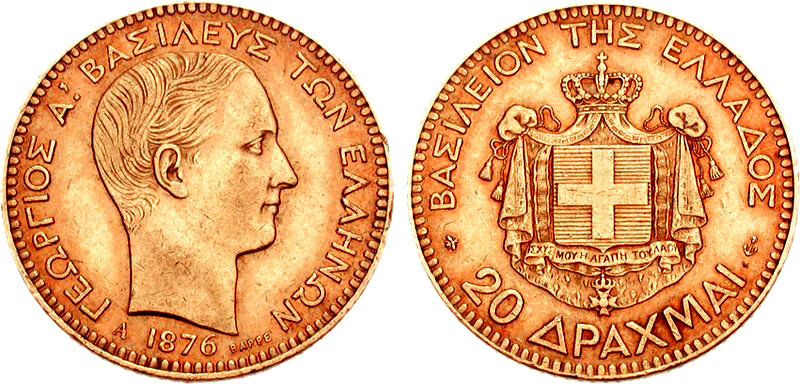
Greece’s only circulating gold coinage — the 1876 and 1884 20 Drachmai of George I, struck in Paris to the Latin Monetary Union’s 6.4516 g, .900 fine, 21 mm standard, with mintages of just 37,000 and 550,000.
History
- George I of Denmark took the Greek throne in 1863, beginning the modern Greek kingdom’s coinage era (Wikipedia, accessed 2026-09-28)
- Greece joined the Latin Monetary Union in 1868, committing its coinage to the union standard — the 20-drachma gold piece became the exact twin of the French 20-franc Napoléon (Wikipedia; NGC, accessed 2026-09-28)
- With no gold-capable mint of its own, Greece struck both gold issues at the Paris mint — hence the ‘A’ mint mark under the king’s portrait (NGC; Wikipedia, accessed 2026-09-28)
- The first issue, dated 1876 (KM#49), shows a young George I, engraved by Désiré-Albert Barre (NGC; Wikipedia, accessed 2026-09-28)
- A second and final type was struck in 1884 (KM#56), showing the king as an older man, engraved by Jean-Auguste Barre (NGC; Wikipedia, accessed 2026-09-28)
- The Barre family were the leading French mint engravers of the era — Jean-Auguste and his son Désiré-Albert also designed the Napoleon gold types for France (Wikipedia, accessed 2026-09-28)
- Greece stayed on the Latin Monetary Union standard until the union’s collapse in 1927 (Wikipedia, accessed 2026-09-28)
- All gold and silver Greek coinage was demonetized in 1929 as the drachma suffered hyperinflation; the modern drachma was introduced the same year (Wikipedia, accessed 2026-09-28)
- These two issues are Greece’s only circulating gold coins — everything else Greek gold is patterns or later commemoratives (Wikipedia, accessed 2026-09-28)
- An 1869 20-drachma piece (KM-E11) exists only as a pattern — the 1876 is the first true circulation issue (Coinfacts; NGC, accessed 2026-09-28)
Key dates and varieties
- 1876-A (KM#49) — first circulation issue, mintage only 37,000; the rare date, with the young-portrait type (NGC; Wikipedia, accessed 2026-09-28)
- 1884-A (KM#56) — mintage 550,000; the older-portrait type, the obtainable date of the two (NGC; Wikipedia, accessed 2026-09-28)
- 1869 (KM-E11) — pattern only, a recognized major rarity (Coinfacts, accessed 2026-09-28)
Specifications
- Standard: 6.4516 g, .900 fine gold; 5.8064 g pure = 0.1867 troy oz actual gold weight (NGC; Wikipedia, accessed 2026-09-28)
- Diameter: 21 mm; edge reeded (NGC, accessed 2026-09-28)
- Obverse: head of George I (young portrait 1876, older 1884); legend ΓΕΩΡΓΙΟΣ Α’! ΒΑΣΙΛΕΥΣ ΤΩΝ ΕΛΛΗΝΩΝ; ‘A’ mint mark and BAPPE signature under the bust (NGC; Wikipedia, accessed 2026-09-28)
- Reverse: crowned and mantled royal arms of Greece; denomination 20 ΔΡΑΧΜΑΙ (NGC; Wikipedia, accessed 2026-09-28)
- Mint: Paris only, ‘A’ mint mark; Latin Monetary Union standard (NGC; Wikipedia, accessed 2026-09-28)
- Catalog: KM#49 (1876), KM#56 (1884); pattern 1869 KM-E11 (Coinfacts; NGC, accessed 2026-09-28)
Collector notes
- There are exactly two circulation types — don’t pay ‘rare date’ money for an 1884 unless the grade or toning warrants it; the 1876 is the genuinely scarce one at 37,000 mintage (NGC, accessed 2026-09-28)
- Struck to the identical standard as the French 20-franc Napoléon (6.4516 g, .900, 21 mm) — they are interchangeable as bullion, but Greek examples carry a strong numismatic premium (NGC, accessed 2026-09-28)
- Both types were struck at Paris (‘A’) — a Greek 20 Drachmai without the Paris mint mark and Barre signature should be examined carefully (NGC; Wikipedia, accessed 2026-09-28)
- The pictured coin is the rare first issue: an 1876-A 20 Drachmai, KM#49, obverse and reverse (CNG photo, CC BY-SA 3.0, via Wikimedia Commons; accessed 2026-09-28)
Market check
Compare live listings for this coin on eBay:
Search eBay for Greek 20 Drachmai Gold
As an eBay Partner, The Coin Wiki may earn from qualifying purchases.
FREE DOWNLOAD
Before you spend that coin, check it.
The Pocket Change Key-Date Checklist covers the cents, nickels, dimes, quarters and halves still hiding in circulation — including the 1943 and 1983 errors worth five figures. One page to print, a lifetime of jars to check.