
Specifications
- Denomination
- 1 ducat
- Series
- Dutch gold ducats
- Designer
- Johan Willem Marmé (historic knight); Royal Dutch Mint designer (2018 recreation)
- Engraver
- Johan Willem Marmé, die cutter for the Utrecht mint 1763–1795
- Years of issue
- 1586–present
- Weight
- 3.494 g
- Diameter
- 21 mm
- Edge
- Reeded
- Key mintages
- 2017 bicentennial proofs: 2,501 single / 836 double ducats (by order); historic circulation runs reached millions (NGC lists 1.4M–2.1M for 1800–1803 Utrecht issues)
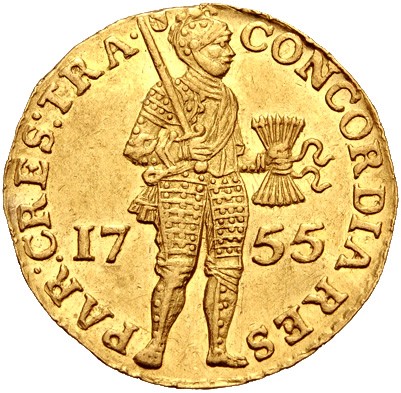
The Netherlands' famous trade coin, struck since 1586 with an essentially unchanged armored-knight design — about 3.494 g of .983 fine gold at 21 mm — and still officially minted today by the Royal Dutch Mint.
History
- Holland struck the first “modern Netherlands” ducats in 1583, based on Hungarian ducat designs and weights; the first truly Dutch ducat was produced in 1586 by several provincial mints (Provident Metals, accessed 2026-09-27)
- The Royal Dutch Mint dates the golden ducat to 4 August 1586; it grew into one of the world’s most trusted trading currencies, valued for consistent gold content (Royal Dutch Mint, accessed 2026-09-27)
- The obverse knight holds a sword on his shoulder and a bundle of seven arrows with the legend CONCORDIA RES PARVAE CRESCUNT (“Union makes small things grow”); the reverse plaque decree reads “A coin of the provinces of the United Netherlands according to the law of the Empire” (JM Bullion, accessed 2026-09-27)
- The design has never changed in over 400 years — from the 1586 provincial issues through the modern bullion and proof versions (JM Bullion, accessed 2026-09-27)
- Provincial mints identified themselves with abbreviations at the end of the obverse legend: ZEEL for Zeeland, FRIS for Friesland, TRAN for Overijssel, and others (Provident Metals, accessed 2026-09-27)
- From 1586 to 1816 the ducat held 3.515 g of .986 gold; in 1817 the weight was lowered to 3.454 g and fineness to .983, with no further changes since (JM Bullion, accessed 2026-09-27)
- The ducat’s global popularity made it one of the most imitated coins in the world — Russia and others issued copies of Dutch ducats (Wikipedia, accessed 2026-09-27)
- Utrecht ducats dated 1788, 1795, 1800 and 1802 were also struck at the Stuttgart mint in Germany, and a soldier-payment issue of 1812 was only recently discovered (NGC, accessed 2026-09-27)
- The coin is still produced today by the Royal Dutch Mint, but as bullion and proof coins only (Provident Metals, accessed 2026-09-27)
- In 2017 the 200th anniversary of the ducat’s current (1817) design was marked with bicentennial proofs — 2,501 single ducats and 836 double ducats, mintages set by orders received (Numismatic News, accessed 2026-09-27)
- In 2018, after 32 years, the obverse was remade recreating the historic knight of Johan Willem Marmé, Utrecht’s die cutter from 1763 to 1795 — including his accurately positioned buttons, an 18th-century anti-counterfeiting measure (Numismatic News, accessed 2026-09-27)
Key dates and varieties
- 1583 — Holland’s first proto-ducats, based on Hungarian ducat designs and weights (Provident Metals, accessed 2026-09-27)
- 1586 — the first true Dutch ducats from the provincial mints; the design’s birth year (Provident Metals, accessed 2026-09-27)
- 1817 — the new standard (3.454 g / .983 fine) and current design; the basis of all modern issues (JM Bullion, accessed 2026-09-27)
- 1788 / 1795 / 1800 / 1802 — Utrecht ducats also struck at the Stuttgart mint (NGC, accessed 2026-09-27)
- 2017 — bicentennial proof single and double ducats (2,501 / 836 struck) (Numismatic News, accessed 2026-09-27)
- 2018 onward — the redesigned-knight series launched with the Marmé recreation (Numismatic News, accessed 2026-09-27)
Specifications
- Modern single ducat: 21.00 mm, 3.494 g, .983 fine gold (Numismatic News, accessed 2026-09-27)
- Historic standard: 1586–1816 at 3.515 g / .986 fine; from 1817 at 3.454 g / .983 fine (JM Bullion, accessed 2026-09-27)
- Double ducat: 26.00 mm, 6.988 g, .983 fine gold (Numismatic News, accessed 2026-09-27)
- Actual gold weight of the modern single ducat: about 0.1104 oz (NGC, accessed 2026-09-27)
- Edge: reeded (NGC, accessed 2026-09-27)
- Obverse: armored standing knight with sword resting on the shoulder and a bundle of seven arrows in the left hand, the date divided either side of the figure (NGC, accessed 2026-09-27)
- Catalog: KM 50.1 for the 1817 single ducat (Numismatic News, accessed 2026-09-27)
Collector notes
- The pictured coin is a 1755 ducat; the source page does not identify its issuing province — province varieties are collected by the legend abbreviations (ZEEL, FRIS, TRAN, etc.) (Wikimedia Commons file page; Provident Metals, accessed 2026-09-27)
- Contemporary Russian and other imitations exist — verify weight and fineness carefully before buying historic pieces (Wikipedia, accessed 2026-09-27)
- Current Royal Dutch Mint products are bullion and proof strikes only; no modern circulation issues (Provident Metals, accessed 2026-09-27)
- The double ducat shares the same design at twice the weight (26 mm, 6.988 g, .983 fine) (Numismatic News, accessed 2026-09-27)
Market check
Compare live listings for this coin on eBay:
Search eBay for Dutch Gold Ducat
As an eBay Partner, The Coin Wiki may earn from qualifying purchases.
FREE DOWNLOAD
Before you spend that coin, check it.
The Pocket Change Key-Date Checklist covers the cents, nickels, dimes, quarters and halves still hiding in circulation — including the 1943 and 1983 errors worth five figures. One page to print, a lifetime of jars to check.