
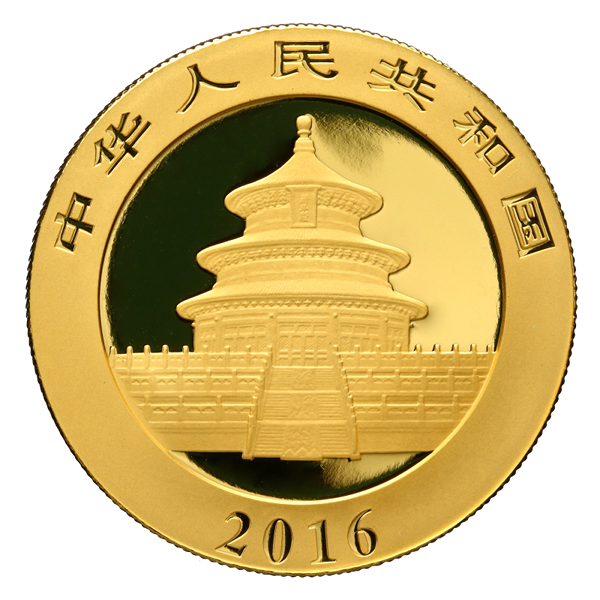
Specifications
- Series
- Chinese Gold Pandas
- Designer
- Varies by year (annual design change)
- Composition
- 100% Gold
- Weight
- 31.1035 g
- Diameter
- 32 mm
- Edge
- Reeded
- Key mintages
- No series-wide total; 1992 small date: 41,120 (JM Bullion).
Melt value: $3,533.94
China's flagship gold bullion: the Gold Panda changed its design every year from 1982 — 1 oz through 2015, then 30 g from 2016.
History
- China first issued Gold Panda bullion coins in 1982 in 1 oz, 1/2 oz, 1/4 oz, and 1/10 oz sizes, with the 1 oz carrying a 100-yuan face value from 1982 to 2000 and 500 yuan from 2001 to 2015 (JM Bullion; goldbarsworldwide.com).
- The obverse always shows Beijing's Temple of Heaven; the reverse carries a new giant-panda design every year, which is the series' signature feature (JM Bullion; Provident Metals).
- In 2016 China switched the series from troy ounces to metric weights: the large coin became a 30 g piece (0.9645 oz) instead of a full troy ounce (Provident Metals).
- Pandas were struck at the Shanghai, Shenyang, and Shenzhen Guobao mints, with no mint marks published on the coins (goldbarsworldwide.com).
What is it worth
- Melt value = 1.0000 × the current gold spot price per troy ounce for the 1982–2015 one-ounce issues; 0.9645 × spot for the 30 g issues from 2016 (JM Bullion; Provident Metals). Most dates trade at a small premium over melt (Summit Metals).
- The 1982 first-year issue and low-mintage dates such as the 1992 small date (41,120 minted) carry collector premiums (JM Bullion).
What drives the premium
- Value drivers: one troy ounce of pure gold (1982–2015) sets the floor; first-year and low-mintage dates, popular reverse designs, and original mint packaging set the premium (JM Bullion; Summit Metals).
What to check before you buy
- Verify the weight system: 1982–2015 one-ounce coins weigh 31.1035 g; from 2016 the large coin is 30 g (0.9645 oz) — they are different products (JM Bullion; Provident Metals).
- Counterfeits are a known risk in the Panda series: buy graded or from reputable dealers, and verify the 32 mm diameter and reeded edge on the one-ounce format (JM Bullion).
- Check the fineness marking: the series is .999 fine, with .9999 marked from 2014 — both are full gold content, but the marking differs by year (JM Bullion; goldbarsworldwide.com).
Specifications
- Composition: .999 fine gold (.9999 from 2014) (goldbarsworldwide.com; JM Bullion)
- Weight: 31.1035 g (1 oz, 1982–2015); 30 g (2016–present) (JM Bullion; Provident Metals)
- Gold content: 1.0000 troy oz AGW (1982–2015); 0.9645 troy oz (30 g issues, 2016–) — melt value = fine oz × the current gold spot price (JM Bullion; Provident Metals)
- Diameter: 32 mm (one-ounce format) (JM Bullion; goldbarsworldwide.com)
- Edge: Reeded (JM Bullion)
- Design: Obverse: Temple of Heaven; reverse: new giant-panda design each year (JM Bullion)
- Mints: Shanghai, Shenyang, Shenzhen Guobao — no mint marks on the coins (goldbarsworldwide.com)
- Years: 1982–present (one-ounce format 1982–2015; 30 g format 2016–) (goldbarsworldwide.com; Provident Metals)
Collector notes
- The annual design change makes Pandas one of the most collected modern bullion series; sealed mint sheets and first-year 1982 coins draw the strongest premiums (Summit Metals; JM Bullion).
- See also the World Gold Coins hub for more classic gold issues.
Market check
Compare live listings for this coin on eBay:
Search eBay for Chinese Gold Panda
As an eBay Partner, The Coin Wiki may earn from qualifying purchases.
FREE DOWNLOAD
Before you spend that coin, check it.
The Pocket Change Key-Date Checklist covers the cents, nickels, dimes, quarters and halves still hiding in circulation — including the 1943 and 1983 errors worth five figures. One page to print, a lifetime of jars to check.