
Specifications
- Denomination
- Guinea (21 shillings)
- Series
- British gold coinage
- Designer
- Various — John Croker (Anne, George I); Richard Yeo and Lewis Pingo (George III)
- Engraver
- Lewis Pingo (spade-guinea portrait); varies by reign
- Years of issue
- 1663–1813
- Weight
- 8.385 g
- Diameter
- 25 mm
- Key mintages
- 1813 Military Guinea: 80,000 struck; 1774 recoinage melted ~20 million worn William III/Anne guineas
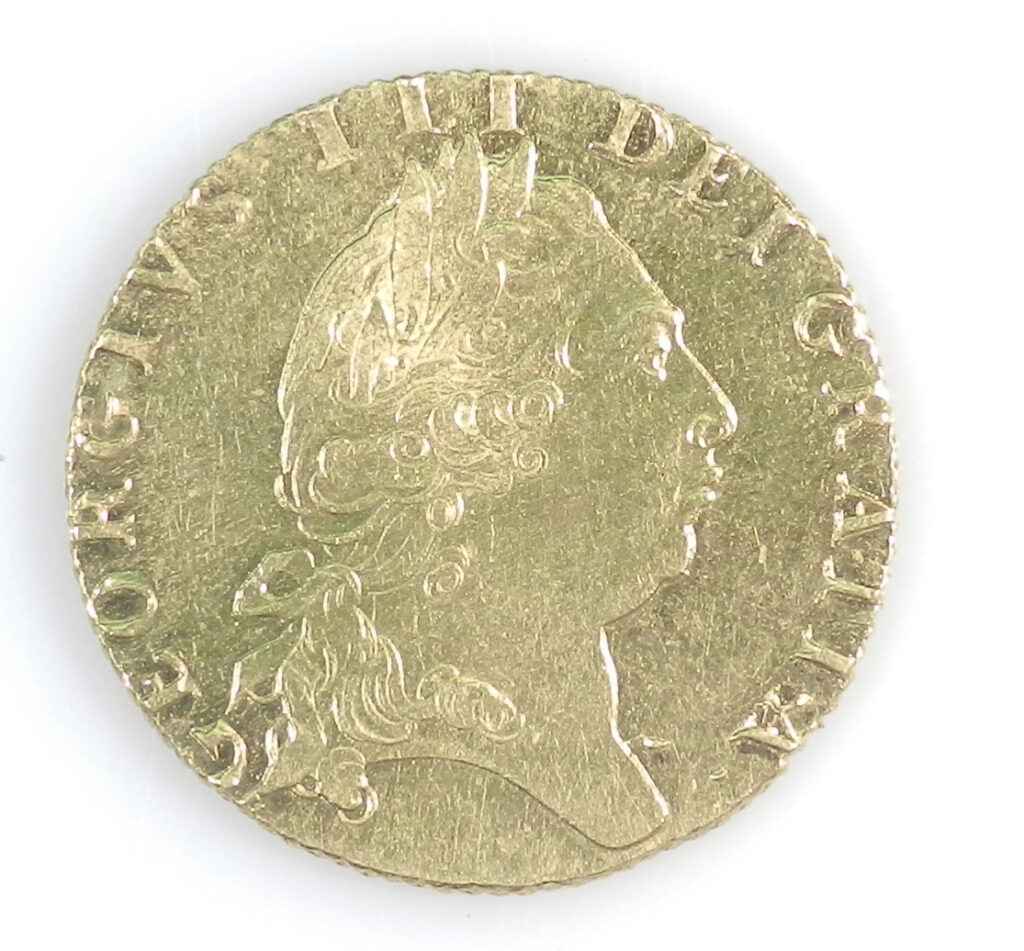
Britain's 21-shilling gold coin, struck 1663–1813 at 22-karat (.9167) gold — about 8.4 g containing nearly a quarter-ounce of pure gold — and named for the West African Guinea coast its early gold came from.
History
- The first guinea was produced on 6 February 1663, and a proclamation of 27 March 1663 made the coins legal currency (Wikipedia, accessed 2026-09-27)
- It was the first English machine-struck gold coin, replacing hand-hammered coinage as Charles II rebuilt trust in British currency after the Civil War (Change Checker, accessed 2026-09-27)
- One troy pound of 11/12 fine gold was coined into 44½ guineas, so each theoretically weighed 129.438 grains — 8.385 g of crown gold containing 7.688 g (0.24719 oz) of fine gold (Wikipedia, accessed 2026-09-27)
- Originally valued at 20 shillings (£1), rising gold prices pushed the market value higher — Samuel Pepys recorded 24–25 shillings in his diary in June 1667 (Wikipedia, accessed 2026-09-27)
- “Guinea” was never the official name; it came from the Guinea region of West Africa (largely modern Ghana), the source of much of the early gold (Wikipedia, accessed 2026-09-27)
- An elephant (1663–1665, 1668) or elephant-and-castle (from 1674/1675) beneath the monarch’s head identified gold imported by the Royal African Company (Wikipedia, accessed 2026-09-27)
- In 1717 Britain adopted the gold standard, and a royal proclamation that December fixed the guinea at 21 shillings — £1.05 (Wikipedia, accessed 2026-09-27)
- In 1774 almost 20 million worn guineas of William III and Queen Anne were melted down and recoined as guineas and half-guineas (Wikipedia, accessed 2026-09-27)
- Gold drained by the French Revolutionary Wars made gold scarce; guinea production was halted in 1799, though half- and third-guineas continued (Wikipedia, accessed 2026-09-27)
- In 1813, 80,000 guineas were struck to pay the Duke of Wellington’s army in the Pyrenees — the “Military Guinea,” with a unique crowned-shield-in-Garter reverse — and this was the last issue of guineas minted (Wikipedia, accessed 2026-09-27)
- The Great Recoinage of 1816 demonetized the guinea, replacing it with the 20-shilling gold sovereign; “guinea” survived as a unit of account in professional fees, horse racing and art sales, implying a 5% commission over the pound (Wikipedia, accessed 2026-09-27)
Key dates and varieties
- 1663 — first issue of guineas, produced 6 February and made legal currency by proclamation of 27 March (Wikipedia, accessed 2026-09-27)
- 1703 VIGO — gold captured at the Battle of Vigo Bay was struck into coins marked “VIGO” under the monarch’s bust by royal warrant issued to Mint Master Isaac Newton (Numismatic News, accessed 2026-09-27)
- 1714 — first George I guineas, notable for declaring him Prince Elector of the Holy Roman Empire (Wikipedia, accessed 2026-09-27)
- 1721, 1722, 1726 — the elephant-and-castle Royal African Company provenance mark recurs under George I (Wikipedia, accessed 2026-09-27)
- 1787–1799 — the “spade guinea” with a spade-shaped shield reverse and a modern-style portrait by Lewis Pingo, the last guinea type issued for general circulation (London Mint Office, accessed 2026-09-27)
- 1813 — the Military Guinea, the final guinea issue, struck for Wellington’s army with a one-year-only Garter reverse design (Wikipedia, accessed 2026-09-27)
Specifications
- Weight: ~8.4 g — 8.385 g of crown gold per the 44½-guineas-per-troy-pound standard, containing 7.688 g (0.24719 oz) of fine gold (Wikipedia, accessed 2026-09-27)
- Fineness: 22-carat crown gold, 0.9167 pure gold by weight (Wikipedia, accessed 2026-09-27)
- Diameter: 1 inch (25 mm) under Charles II; roughly 24–25 mm across the series (Wikipedia, accessed 2026-09-27)
- Face value: 21 shillings (£1.05) from 1717 until demonetization in 1816 (Wikipedia, accessed 2026-09-27)
- Edge: milled — George I guineas carry diagonally milled edges (Wikipedia, accessed 2026-09-27)
- Catalog reference: the pictured 1798 spade guinea is listed as Spink 3729 in the Standard Catalogue of British Coins (York Museums Trust file description, Wikimedia Commons, accessed 2026-09-27)
- Design: laureate bust of the monarch on the obverse; shield reverse (spade-shaped shield from 1787) quartered with the arms of England/Scotland, France, Ireland and Hanover (Wikipedia, accessed 2026-09-27)
Collector notes
- Brass gaming tokens marked “IN MEMORY OF THE GOOD OLD DAYS” are common imitations of spade guineas, often holed for watch chains — minimal value, and not produced to deceive (Numista, accessed 2026-09-27)
- Identify the 1813 military guinea by its unique reverse: a crowned shield within a Garter inscribed HONI SOIT QUI MAL Y PENSE, unlike any other guinea issue (Wikipedia, accessed 2026-09-27)
- eBay search tip: “gold guinea” alone can pull Papua New Guinea material — use “british gold guinea” for clean results (collector practice, accessed 2026-09-27)
Market check
Compare live listings for this coin on eBay:
Search eBay for British Gold Guinea
As an eBay Partner, The Coin Wiki may earn from qualifying purchases.
FREE DOWNLOAD
Before you spend that coin, check it.
The Pocket Change Key-Date Checklist covers the cents, nickels, dimes, quarters and halves still hiding in circulation — including the 1943 and 1983 errors worth five figures. One page to print, a lifetime of jars to check.