
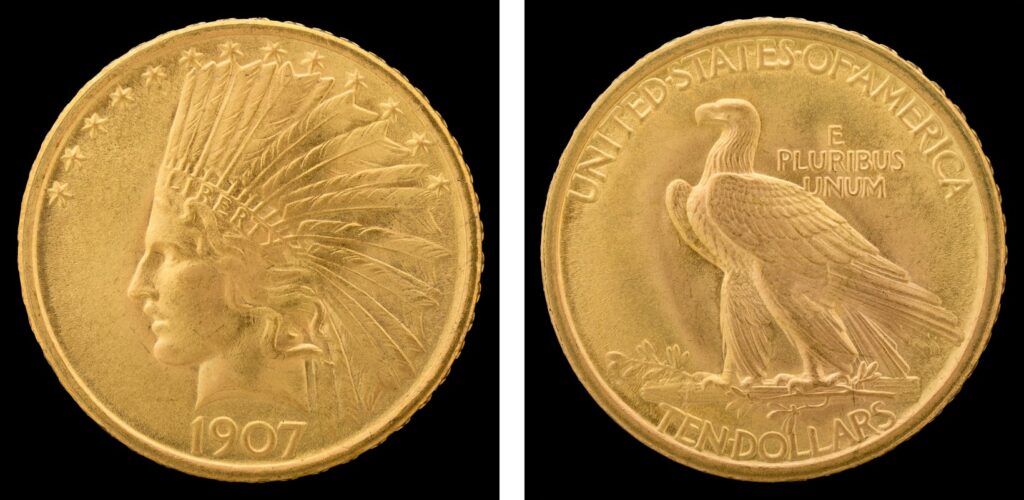
The 1907 Rolled Edge $10 Indian Eagle: 31,500 struck, nearly all melted — and one Satin Finish proof just set a $2.4 million auction record.
History
- In 1907, Augustus Saint-Gaudens’ new $10 gold design was struck too high — the coins wobbled and wouldn’t stack. Chief Engraver Charles Barber’s fix was to cut a rounded rim into the working hubs: the Rolled Edge.
- 31,500 Rolled Edge eagles were struck — and then a newer model arrived from the sculptor’s studio. The Mint melted nearly all of them. About 50 survived.
- Two of the survivors were struck as Satin Finish proofs — the only two traced. One sat in the personal collection of Mint Director Frank A. Leach, who acquired it in 1907.
- After Leach’s death in 1929, the coin remained in his family for nearly a century — unknown to the numismatic community until it appeared in Heritage’s 2011 FUN auction, where it caused a sensation and brought $2,185,000 (purchased by Laura Sperber, bidding for renowned collector Bob R. Simpson).
The $2.4 million specimen
- 1907 $10 Rolled Edge, JD-1, R.8, PR67 PCGS, Satin Finish — one of two proof specimens traced, struck with the same irregular stars edge collar as the patterns in the Smithsonian.
- On October 2, 2026, it sold for $2.4 million on the first day of Heritage’s GACC U.S. Coins Signature Auction (lot 3166) — held with the Great American Coin and Collectibles Show in Rosemont, Illinois — shattering its own $2.185 million record from 2011.
- It had been held in private hands ever since the 2011 sale. Heritage’s GACC U.S. Coins auction totaled $15,631,669 across October 2–5.
Specifications
- Denomination: $10 (eagle)
- Composition: .900 fine gold (.48375 troy oz AGW)
- Weight: 16.718 grams
- Diameter: 27 mm
- Edge: 46 raised stars; the Rolled Edge variety shows a rounded, rolled rim (vs. the sharp fin of the Wire Edge strikes)
- Designer: Augustus Saint-Gaudens (obverse Liberty in feathered headdress; reverse perched eagle)
- Mintage: 31,500 (about 50 survivors traced)
Collector notes
- The Rolled Edge is a one-year, one-variety issue — every survivor traces to the single 1907 production run, and high-grade examples are vanishingly rare.
- The two Satin Finish proofs are the ultimate prize: the Leach specimen’s back-to-back records ($2.185M in 2011, $2.4M in 2026) make it the most valuable Indian eagle ever sold.
- See the coin’s record moment: The $2.4M Rolled Edge Indian Eagle on Caps Coins & Treasures.
Photographs: reference photos of the 1907 Indian eagle design (Smithsonian NNC, public domain) — not the record-setting specimen itself.
Frequently Asked Questions
What is a Rolled Edge Indian Eagle?
A 1907 $10 Indian Head eagle struck from hubs in which Chief Engraver Charles Barber cut a rounded rim — the “rolled edge” — to fix Saint-Gaudens’ original high-relief design, whose coins wobbled and wouldn’t stack. 31,500 were struck before the Mint melted nearly all of them.
How many 1907 Rolled Edge eagles survive?
About 50 examples are believed to survive from the original 31,500 struck — the rest were melted when a newer hub model arrived from the sculptor’s studio. Just two Satin Finish proofs are traced.
What is the most expensive Rolled Edge Indian Eagle ever sold?
A $2.4 million auction record, set October 2, 2026, when the PR67 PCGS Satin Finish specimen (JD-1, R.8) — once in Mint Director Frank A. Leach’s personal collection — sold on the first day of Heritage’s GACC U.S. Coins Signature Auction. It topped its own $2.185 million record from 2011.
Why was the Rolled Edge created?
Augustus Saint-Gaudens’ 1907 $10 gold design was struck too high — the coins wobbled and wouldn’t stack. Chief Engraver Charles Barber’s fix was to cut a rounded rim into the working hubs, creating the Rolled Edge variety.
What does JD-1, R.8 mean?
JD-1 is the variety’s number in John Dannreuther’s reference on U.S. proof gold coinage. R.8 is its rarity rating on the Sheldon scale — meaning just 2–3 examples are known (two Satin Finish proofs are traced).
How do you tell a Rolled Edge from a regular 1907 Indian eagle?
Look at the rim: the Rolled Edge shows a rounded, rolled rim, while the earlier Wire Edge (Wire Rim) strikes show a sharp, knife-like fin. The record-setting proof was also struck with the distinctive irregular stars edge collar seen on the Smithsonian’s pattern pieces.
Related Coins
FREE DOWNLOAD
Before you spend that coin, check it.
The Pocket Change Key-Date Checklist covers the cents, nickels, dimes, quarters and halves still hiding in circulation — including the 1943 and 1983 errors worth five figures. One page to print, a lifetime of jars to check.