
Specifications
- Denomination
- Three-cent piece
- Designer
- James Barton Longacre
- Years of issue
- 1851–1873 (1873 proof only)
- Weight
- 0.8 g
- Diameter
- 14 mm
- Edge
- Plain
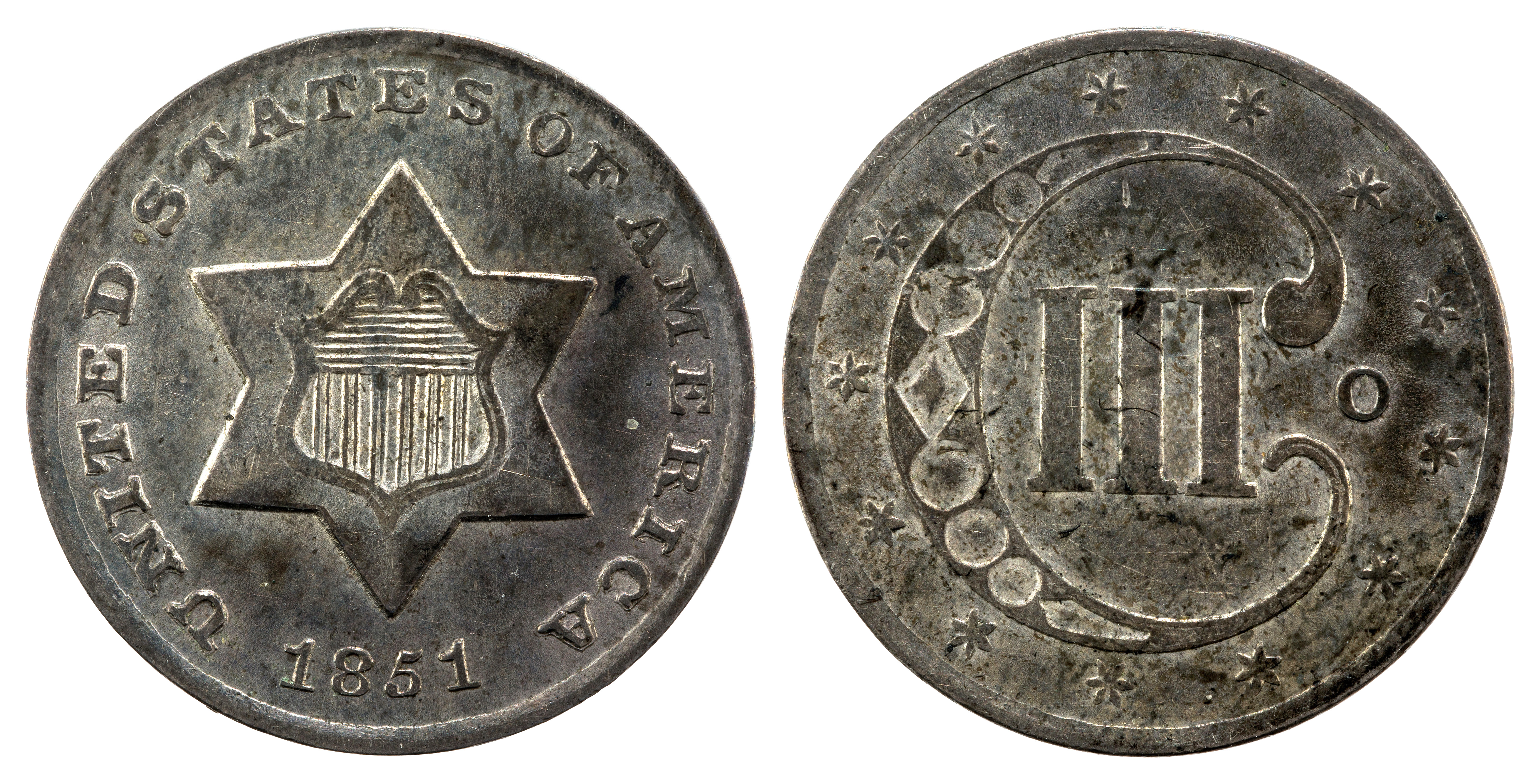
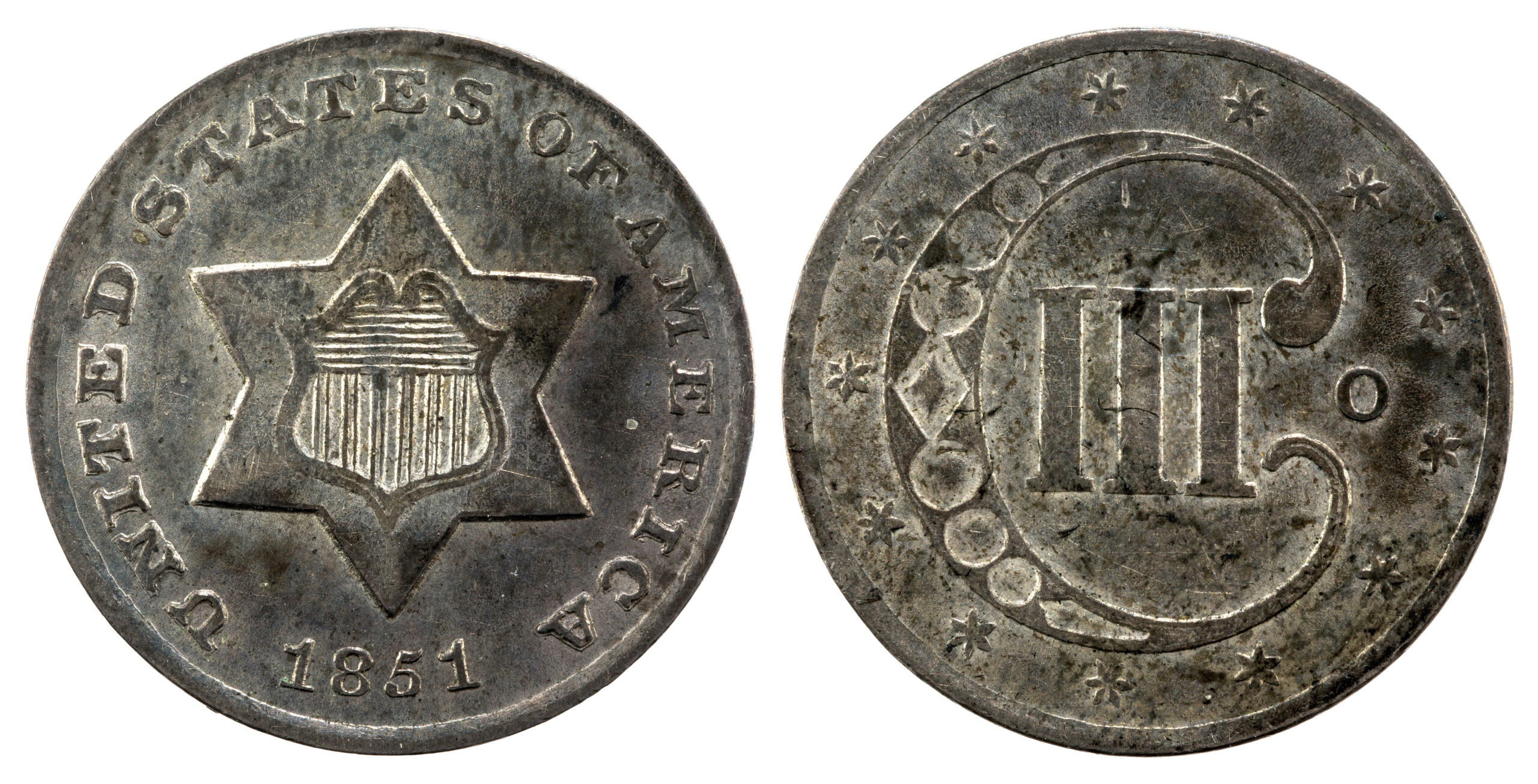
The 1851–1873 three-cent silver “trime” — America’s smallest silver coin, born to buy 3-cent postage stamps, with three design types and a low-mintage Civil War tail.
History
- Congress cut the first-class postage rate from five cents to three cents effective July 1, 1851, and the country suddenly needed a coin to buy stamps. The three-cent silver piece — officially the “trime” — was the answer: tiny, low in silver, and distributed in part directly through post offices (ANA).
- James Barton Longacre, the Mint’s chief engraver, designed the coin: a six-pointed star bearing a Union shield on the obverse, and the Roman numeral III inside an ornate, bejeweled C — for “cent” — ringed by 13 stars on the reverse (Greysheet).
- The design changed three times. Type 1 (1851–1853) shows the plain star with no extra outlines, struck in .750 fine silver at 0.8 grams. In 1854 the silver content was raised to .900 fine (0.75 grams) and the star gained two added outlines, with an olive sprig over arrows and an olive branch added around the III — Type 2 (1854–1858). Type 3 (1859–1873) removed one outline and refined the lettering for cleaner strikes (ANA; Wikipedia).
- The first 1851 coins were struck at both Philadelphia (5,447,400 pieces) and New Orleans (720,000) — the only New Orleans issue of the denomination and its undisputed key date (ANA).
- When silver coins vanished from circulation during the Civil War, fractional currency replaced them and trime mintages collapsed to the low thousands. The Coinage Act of 1873 ended the denomination; 1873 was struck in proof only (ANA).
What is it worth
- Type 1 common dates are the affordable entry point — circulated examples retail in the $50–$80 range (APMEX), while the 1851-O key and the low-mintage 1863–1873 issues are the expensive dates (ANA).
- Type 2 and Type 3 dates carry premiums by date and mintage; proofs exist for many later years, including a mintage of 550 for the 1862 proof, and the 1863/2 overdate proof is a famous rarity (PCGS).
- Value is driven by type, date, strike quality, grade, and proof-versus-business-strike status — check the PCGS price guide for per-date figures (PCGS).
What drives the premium
- Type: Type 1 coins are the most available; Type 2 (1854–1858) and Type 3 dates bring premiums, especially in high grade (ANA).
- Mint mark: the 1851-O is the only branch-mint issue and the series key (ANA).
- Late-date scarcity: business strikes from 1863 through 1872 number in the low thousands (e.g., 4,000 for 1867, 3,500 for 1868, 4,500 for 1869), so original survivors are rare (ANA).
- Strike: these tiny coins are often weakly struck; sharp, fully detailed examples earn premiums (PCGS).
Specifications
- Composition: 1851–1853: 75% silver, 25% copper; 1854–1873: 90% silver, 10% copper (Wikipedia)
- Weight: 0.80 g (1851–1853); 0.75 g (1854–1873) (Wikipedia)
- Diameter: 14 mm — the smallest U.S. silver coin ever struck (Wikipedia; APMEX)
- Edge: Plain (Wikipedia)
- Designer: James Barton Longacre (Wikipedia; PCGS)
- Mints: Philadelphia; New Orleans in 1851 only (ANA)
- Years: 1851–1873 (1873 proof only) (Wikipedia)
Collector notes
- Learn the three types before you buy: the star outlines and the reverse ornamentation around the III are the diagnostics (ANA).
- Handle with care — at 14 mm these are easy to lose and were often pierced or damaged in circulation; problem-free examples are worth the premium (PCGS).
- Many survivors are dark or porous from their low silver content in the early years; look for original, even toning (PCGS).
- The trime pairs naturally with its copper-nickel successor, the three-cent nickel (1865–1889), for a two-coin odd-denomination set (PCGS).
Market check
Compare live listings for this coin on eBay:
Search eBay for Three-Cent Silver Trimes
As an eBay Partner, The Coin Wiki may earn from qualifying purchases.
Sources
- ANA — Three Cent Silver Legacy presentation: http://mccc.anaclubs.org/presentations/Three_Cent_Silver_Legacy.pdf
- Wikipedia — Three-cent piece: https://en.wikipedia.org/wiki/Three-cent_piece
- PCGS CoinFacts — Three-Cent Silver: https://www.pcgs.com/coinfacts/category/three-cent-silver-1851-1873/3663
- PCGS CoinFacts — 1862 three-cent silver: https://www.pcgs.com/coinfacts/coin/1862-3cs/3711
- Greysheet — three-cent silver design: https://www.greysheet.com/coin-prices/series/us/three-cent-silver-1851-73
- APMEX — 1851 three-cent silver product page: https://www.apmex.com/product/230597/1851-three-cent-silver-ms-66-pcgs