Specifications
- Denomination
- multiple
- Series
- Mint error types
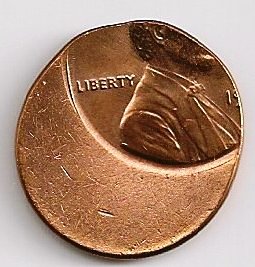
An off-center coin was struck once with the planchet misaligned, leaving a crescent of blank metal and part of the design missing. Examples that still show a full date and are struck 10% or more off-center carry the strongest premiums — early half dollars have brought $5,405 to $11,162.50 at Heritage.
What it is
- An off-center strike is a striking-stage error: the coin was struck only once, but the planchet was not centered between the dies, so part of the design never landed on the metal (Wikipedia — Mint-made errors; accessed 2026-09-17).
- The result is a non-circular coin with part of the design missing and a smooth crescent of blank planchet showing (Wikipedia — Mint-made errors; accessed 2026-09-17).
How it happens
- The planchet is misfed into the coining chamber, landing out of position between the dies before the strike (Wikipedia — Mint-made errors; accessed 2026-09-17).
- Alternatively, the hammer die itself is misaligned over the anvil die; when that happens, the result is usually an off-center obverse paired with a centered reverse (Wikipedia — Mint-made errors; accessed 2026-09-17).
- The press still strikes once with full force, so the portion of the design that does land on the planchet is fully and crisply struck (Wikipedia — Mint-made errors; accessed 2026-09-17).
How to identify
- Look for the hallmark combination: a smooth crescent of unstruck planchet plus a fully struck remaining design (Wikipedia — Mint-made errors; accessed 2026-09-17).
- The error is measured as the percentage of the design that is missing (Wikipedia — Mint-made errors; accessed 2026-09-17).
- A full, readable date is a major plus: coins that still show the complete date are consistently more desirable and more expensive than examples where the date is partially or fully off the planchet (Wikipedia — Mint-made errors; Coin World — What an off-center 1803 Draped Bust half sells for; Dr. Sol Taylor (The Signal) — What is a Mint Error Worth?; accessed 2026-09-17).
- Note the percentage: on early U.S. coins, 3 to 5 percent off-center turns up occasionally, but strikes 10 percent or more off-center are much harder to come by (Coin World — What an off-center 1803 Draped Bust half sells for; accessed 2026-09-17).
Real error vs. post-mint damage
- A genuine off-center coin shows normal mint surfaces and a clean strike on the portion of the design that landed on the planchet; the coin is non-circular because of the strike, not because of abuse (Wikipedia — Mint-made errors; accessed 2026-09-17).
- Post-mint damage only mimics errors: bent, scraped, gouged, flattened, or corroded coins look scraped, smeared, or mutilated rather than struck (Wikipedia — Mint-made errors; accessed 2026-09-17).
Notable examples
- 1811 Capped Bust half dollar, struck 25% off-center, Fine 12 NGC, sold $11,162.50 at Heritage (Coin World — Striking 1811 Capped Bust half dollar error tops $11,000; accessed 2026-09-17).
- 1803 Draped Bust half dollar, struck 10% off-center, VF-35 NGC, sold $5,405 at Heritage (Coin World — What an off-center 1803 Draped Bust half sells for; accessed 2026-09-17).
- 1848 Coronet cent, struck 65% off-center (Coin World — What an off-center 1803 Draped Bust half sells for; accessed 2026-09-17).
What drives value
- How far off-center the strike is — 10%+ examples carry the strongest premiums on early coins (Coin World — What an off-center 1803 Draped Bust half sells for; accessed 2026-09-17).
- Whether the full date is visible — examples with a complete, readable date command a clear premium over those with the date partially or fully missing (Dr. Sol Taylor (The Signal) — What is a Mint Error Worth?; accessed 2026-09-17).
- Denomination and age: lower-denomination errors are generally less expensive than higher-denomination errors simply because more such coins are minted; the coin’s age and condition also move the price (Wikipedia — Mint-made errors; accessed 2026-09-17).
- Honest floor: minor modern off-centers — a cent missing just a sliver of design — are minor errors worth only a little over face value (Wikipedia — Mint-made errors; Dr. Sol Taylor (The Signal) — What is a Mint Error Worth?; accessed 2026-09-17).
Market check
Compare live listings for this error type on eBay:
Search eBay for Off-Center Strike Error Coins
As an eBay Partner, The Coin Wiki may earn from qualifying purchases.
Specifications
- Alignment: Not verified in consulted references
- Composition: Varies by host coin
- Designers: Not applicable — error type
- Diameter: Varies by host coin
- Edge: Varies by host coin
- Mint: U.S. Mint (Philadelphia/Denver/San Francisco)
- Weight: Varies by host coin
Sources
- Wikipedia — Mint-made errors (accessed 2026-09-17)
- Coin World — What an off-center 1803 Draped Bust half sells for (accessed 2026-09-17)
- Coin World — Striking 1811 Capped Bust half dollar error tops $11,000 (accessed 2026-09-17)
- Dr. Sol Taylor (The Signal) — What is a Mint Error Worth? (accessed 2026-09-17)