
Most state quarters are worth 25 cents, but a handful of errors and top-pop condition rarities trade from tens of dollars into five figures — led by the 1999-P Georgia struck on an experimental Sacagawea-dollar planchet ($9,775 at Heritage, 2006).
History
- The 50 State Quarters Program ran from 1999 through 2008, five designs per year from the Philadelphia, Denver, and San Francisco Mints (Numismatic News).
- Billions were struck, so ordinary examples — even uncirculated — carry no premium. Value lives in two places: dramatic mint errors and ultra-high-grade condition rarities (Numismatic News; BullionSharks).
- The 1999 Delaware “Spitting Horse,” 2004-D Wisconsin “Extra Leaf,” and 2005-P Kansas “Speared Bison” have their own dedicated Coin Wiki pages; they are summarized below rather than duplicated.
The valuable ones, coin by coin
1999-P Georgia struck on an experimental planchet
In preparation for the 2000 Sacagawea dollar, the Philadelphia Mint experimented in 1999 with golden-dollar compositions using state quarter dies; four compositions are documented — gold-colored or greenish, each with or without a copper core (Heritage Auctions; Numismatic News). Approximately 20 examples are known across all five 1999 states, with reported sales as high as $15,000 (Mike Byers, the group’s discoverer). Documented auctions: a Pennsylvania example at $9,775 (Heritage, October 2006), a Delaware example at $3,450 (Heritage, May 2007), and four 2003–2004 examples at $3,000–$6,000 (Numismatic News). Diagnostics: overweight at 5.9–6.3 grams (versus 5.67 g normal), slightly thicker, with a golden or greenish hue (Mike Byers).
1999-P Connecticut broadstruck and feeder-finger errors
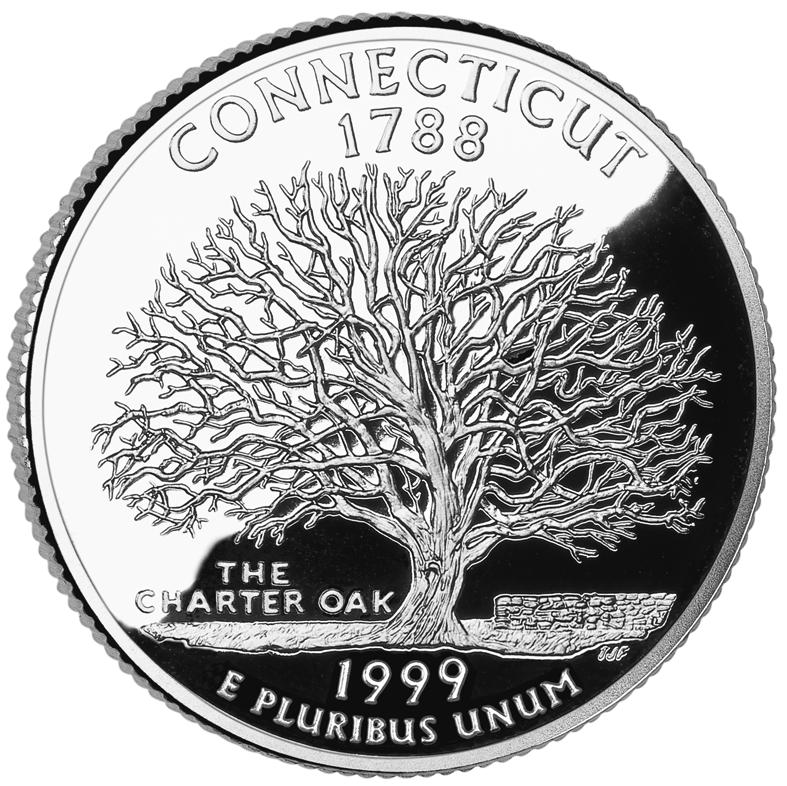
The 1999-P Connecticut quarter (the Charter Oak issue) is known with broadstrike errors — struck outside the retaining collar, leaving an expanded, rimless coin — and with feeder-finger damage from planchet-feeding machinery jams (BullionSharks; CoinTales). Dramatic examples have been reported as worth hundreds to several thousand dollars, but specific realized prices were not documented in the consulted references (BullionSharks).
2000-P South Carolina off-center strikes
A 2000-P struck 5% off-center and graded MS62 by PCGS was listed at $45 (L&C Coins); an ungraded uncirculated off-center sold for $20 at a December 2022 iCollector auction; and a Heritage-offered broadstruck MS64 (NGC) carried a Numismedia wholesale reference of just $6.50. Minor off-centers are affordable — only dramatic, full-date examples command real money.
Top-population high-grade condition rarities
For common dates, condition is the value: a 2000-P South Carolina graded MS69 sold for $3,525 at auction per PCGS price data (Kicks99, June 2023). Intricate early Philadelphia designs are notoriously hard to find clean and fully struck, so top-pop examples routinely trade in the hundreds and up (CoinTales). Current PCGS populations were not verified in the consulted references.
The “big three” — covered on their own pages
1999 Delaware “Spitting Horse” (die crack from the horse’s mouth); 2004-D Wisconsin Extra Leaf (High Leaf and Low Leaf, with cited auction records of $2,530 in MS66 and $6,000 in MS67 — BullionSharks); 2005-P Kansas “Speared Bison” (die gouge through the bison). Full diagnostics and values for all three are on their dedicated Coin Wiki pages.
What is it worth
Benchmarks: the 1999-P Georgia experimental planchet tops the series ($3,450–$9,775 at Heritage, 2006–2007; reported sales to $15,000). A 2000-P South Carolina in MS69 brought $3,525 (PCGS price data via Kicks99, 2023). Minor off-centers trade around $20–$45 certified (L&C Coins; iCollector; Heritage). Circulated examples without errors: face value. Many specific prices were not documented in the consulted references — compare live listings below.
What drives the premium
- Error severity: a dramatic, full-date off-center or wrong-planchet strike beats a minor clip every time (Heritage; Numismatic News).
- Authentication: the five-figure Georgia planchet errors are all PCGS-certified; certification separates genuine rarities from altered coins (Heritage; Numismatic News).
- Grade: for common dates, MS68/MS69 top-pop examples are the entire game — one point can multiply value several times (Kicks99, citing PCGS).
- Novelty vs. substance: gold-plated TV-shopping quarters are plated after leaving the Mint, not experimental planchets — worth little (Numismatic News).
Specifications
- Composition: Copper-nickel clad — 75% copper, 25% nickel outer layers bonded to a pure copper core (L&C Coins).
- Weight: 5.67 grams (Heritage Auctions; L&C Coins).
- Diameter: 24.3 mm (L&C Coins).
- Edge: Reeded.
- Obverse designer: John Flanagan (Washington portrait) (L&C Coins).
- Reverse designers: Various, by state (L&C Coins).
- Mints: Philadelphia (P), Denver (D), San Francisco (S, proofs) (Numismatic News).
Collector notes
- If your quarter is gold-colored, weigh it first: a genuine 1999 experimental planchet weighs 5.9–6.3 grams; a gold-plated novelty weighs the normal 5.67 grams (Mike Byers; Numismatic News).
- For any error worth more than a few dollars, PCGS/NGC attribution is worth the fee — the market discounts raw “error” claims heavily (APMEX).
- 2000-P South Carolina mintage was 742,576,000: only the error or the grade creates value (L&C Coins).
Market check
Compare live listings for this coin on eBay:
Search eBay for Most Valuable State Quarters: What’s Your Quarter Worth?
As an eBay Partner, The Coin Wiki may earn from qualifying purchases.
FREE DOWNLOAD
Before you spend that coin, check it.
The Pocket Change Key-Date Checklist covers the cents, nickels, dimes, quarters and halves still hiding in circulation — including the 1943 and 1983 errors worth five figures. One page to print, a lifetime of jars to check.