
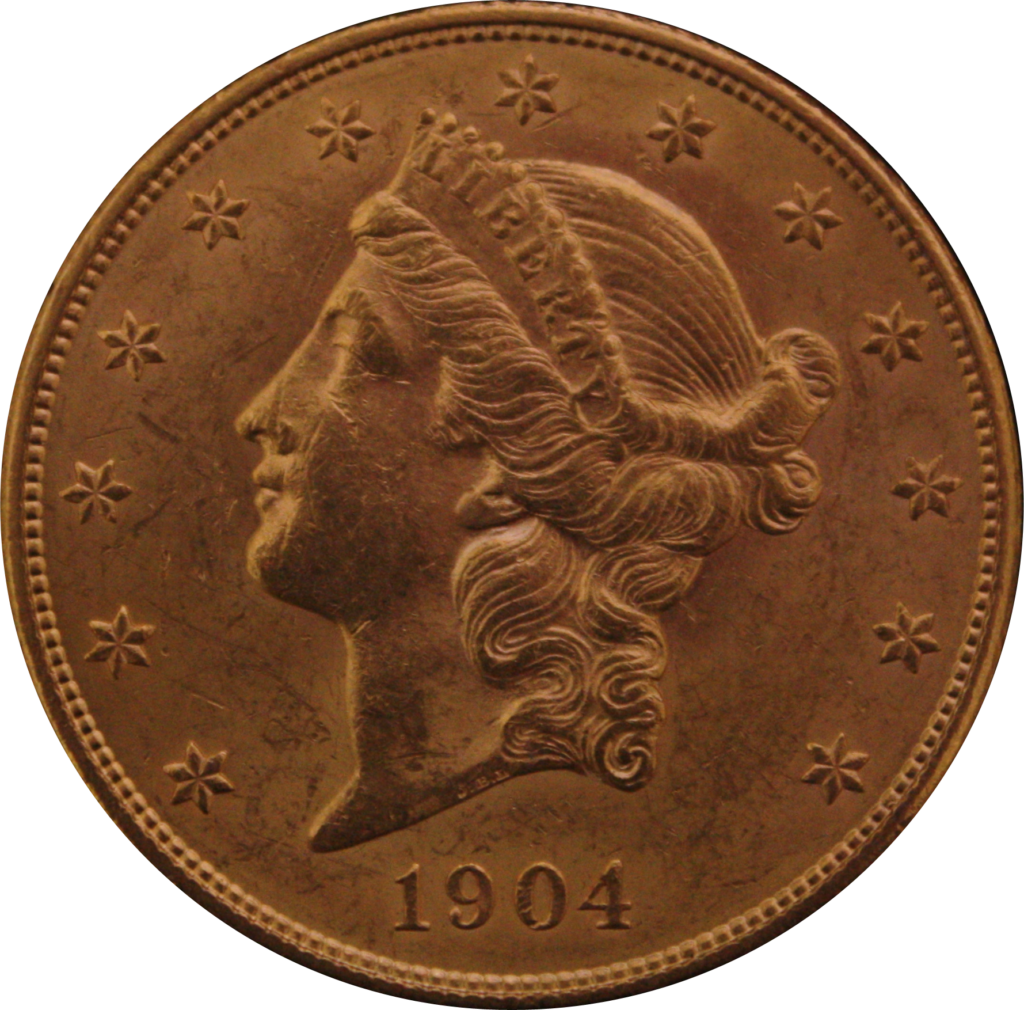
Specifications
- Denomination
- Double eagle
- Series
- Liberty Head double eagle
- Designer
- James Barton Longacre
- Years of issue
- 1850–1907 (1849 pattern)
- Weight
- 33.436 g
- Diameter
- 34 mm
- Edge
- Reeded
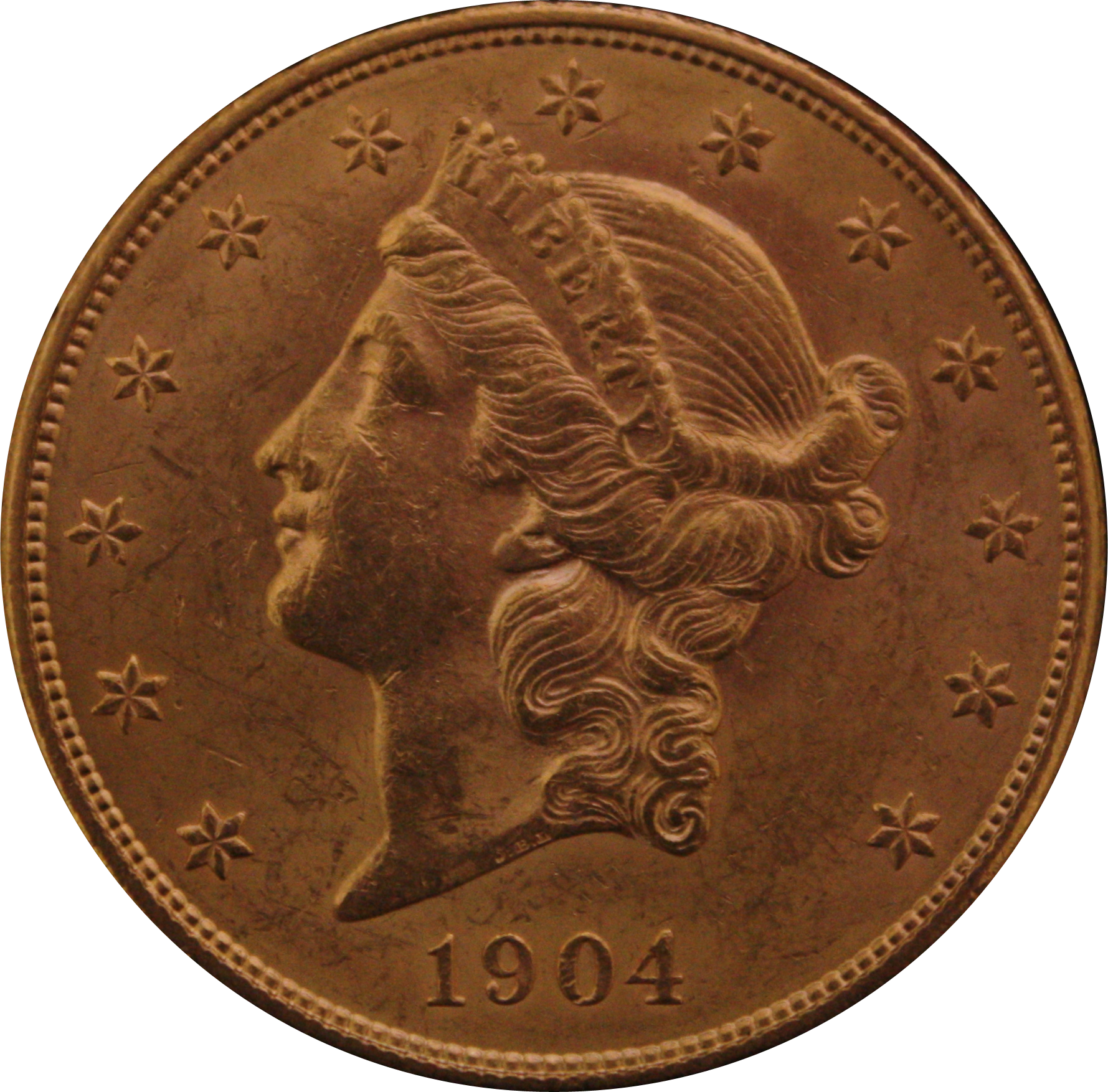
The 1850–1907 Liberty Head double eagle — America’s $20 gold workhorse of the Gold Rush era, with nearly a full ounce of gold in every coin and three distinct types.
History
- The double eagle was born of the California Gold Rush: with the San Francisco Mint not yet open, vast quantities of California gold had to be coined, and Congress responded with the Coinage Act of March 3, 1849, authorizing the $20 gold piece — the largest U.S. denomination to that point. A pattern was struck in 1849, and regular production began in 1850 at Philadelphia and New Orleans (Stack’s Bowers).
- James Barton Longacre, the Mint’s chief engraver, designed the coin. The obverse shows Liberty facing left wearing a pearl-studded coronet inscribed LIBERTY, framed by 13 stars. The reverse carries the heraldic eagle with an arc of rays above, enclosed by stars and the inscriptions around the rim (Stack’s Bowers).
- San Francisco began striking double eagles in 1854, and Carson City joined in 1870, cementing the coin’s role as the West’s great trade and banking coin (Stack’s Bowers).
- There are three types. Type 1 (1850–1866) has no motto on the reverse. Type 2 (1866–1876) added IN GOD WE TRUST and abbreviated the denomination as TWENTY D. Type 3 (1877–1907) spelled out TWENTY DOLLARS in full (Stack’s Bowers).
- In 1907 the series ended as Augustus Saint-Gaudens’ celebrated design took over — that successor is covered in the site’s Saint-Gaudens double eagle entry (Stack’s Bowers; The Coin Wiki).
What is it worth
- Every Liberty Head double eagle contains 0.9675 troy oz of pure gold, so common circulated Type 3 dates track the gold market closely; scarcer dates carry numismatic premiums on top (Stack’s Bowers; Wikipedia).
- Scarcer dates and high-grade survivors command strong numismatic premiums well above melt — choice Mint State Type 1 and Type 2 coins are the series’ trophies (Stack’s Bowers).
Key dates in the series
- Completing a date-and-mintmark set is “daunting,” with the 1879-O, 1885, 1886, and 1891 standing as the principal obstacles to completion (Stack’s Bowers).
- Early San Francisco and Carson City issues from the 1850s–1870s are conditionally rare in high grade because so many were melted or exported (Stack’s Bowers).
- Type 1 no-motto coins (1850–1866) are the oldest and most historic, and survivors in original high grade are the series’ trophies (Stack’s Bowers).
What drives the premium
- Gold content sets the floor: with nearly a full ounce of pure gold, melt value dominates common-date pricing and moves with the gold market (Stack’s Bowers; Wikipedia).
- Date and mint scarcity: New Orleans, Carson City, and low-mintage Philadelphia dates carry the strongest premiums (Stack’s Bowers).
- Type and condition: original Mint State coins, especially Type 1 and Type 2, are far scarcer than their mintages suggest and bring multiples of melt (Stack’s Bowers).
- Originality: uncleaned coins with original luster sell for more than the many examples that were polished, mounted in jewelry, or cleaned (Stack’s Bowers).
Specifications
- Denomination: $20 (Wikipedia)
- Composition: 90% gold, 10% copper (Stack’s Bowers)
- Weight: 33.436 g (Stack’s Bowers)
- Gold content: 0.9675 troy oz AGW (Stack’s Bowers)
- Diameter: 34 mm (Wikipedia)
- Edge: Reeded (Stack’s Bowers)
- Designer: James Barton Longacre (Stack’s Bowers)
- Mints: Philadelphia, New Orleans, San Francisco, Carson City, Denver (Stack’s Bowers)
- Years: 1850–1907 (1849 pattern) (Stack’s Bowers)
Collector notes
- Check the reverse wording to identify the type at a glance: motto with TWENTY D. is Type 2; TWENTY DOLLARS spelled out is Type 3; no motto at all is Type 1 (Stack’s Bowers).
- Many survivors were used in international trade and show bag marks or light cleaning — original, unmolested coins are worth seeking out (Stack’s Bowers).
- Counterfeits exist, including deceptive gold fakes of common dates; buy certified for any significant purchase (Stack’s Bowers).
- For a type set, a single Type 3 in AU or better captures the design at a fraction of the cost of the earlier types (Stack’s Bowers).
Market check
Compare live listings for this coin on eBay:
Search eBay for Liberty Head Double Eagles
As an eBay Partner, The Coin Wiki may earn from qualifying purchases.
Sources
- Stack’s Bowers — Liberty Head double eagle: https://stacksbowers.com/coin-resource-center/us-coins/gold-double-eagles/liberty-head-20/type-3-twenty-dollars/type-3-twenty-dollars-circulation-strike/
- Wikipedia — Double eagle: https://en.wikipedia.org/wiki/Double_eagle
- The Coin Wiki — Saint-Gaudens double eagle: https://thecoinwiki.co/usa/saint-gaudens-double-eagle/
FREE DOWNLOAD
Before you spend that coin, check it.
The Pocket Change Key-Date Checklist covers the cents, nickels, dimes, quarters and halves still hiding in circulation — including the 1943 and 1983 errors worth five figures. One page to print, a lifetime of jars to check.