
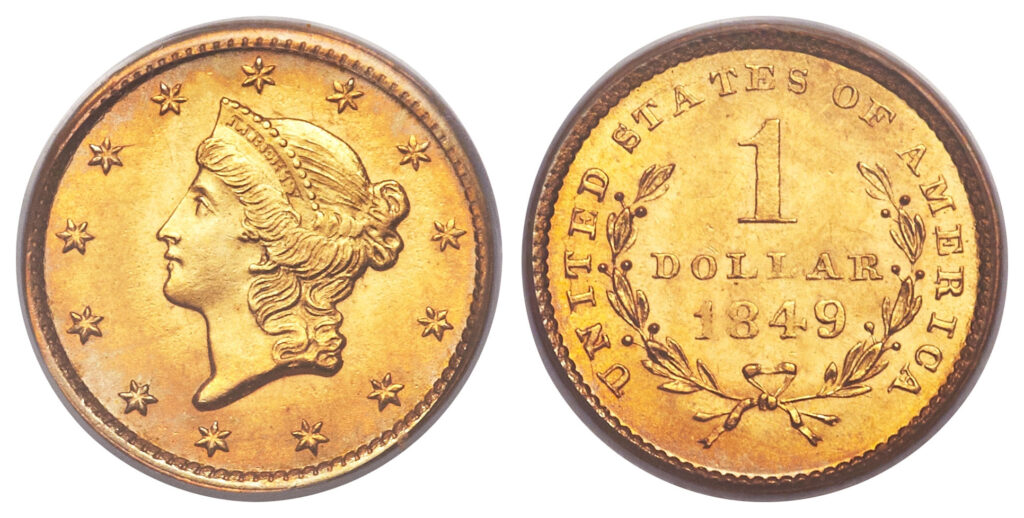
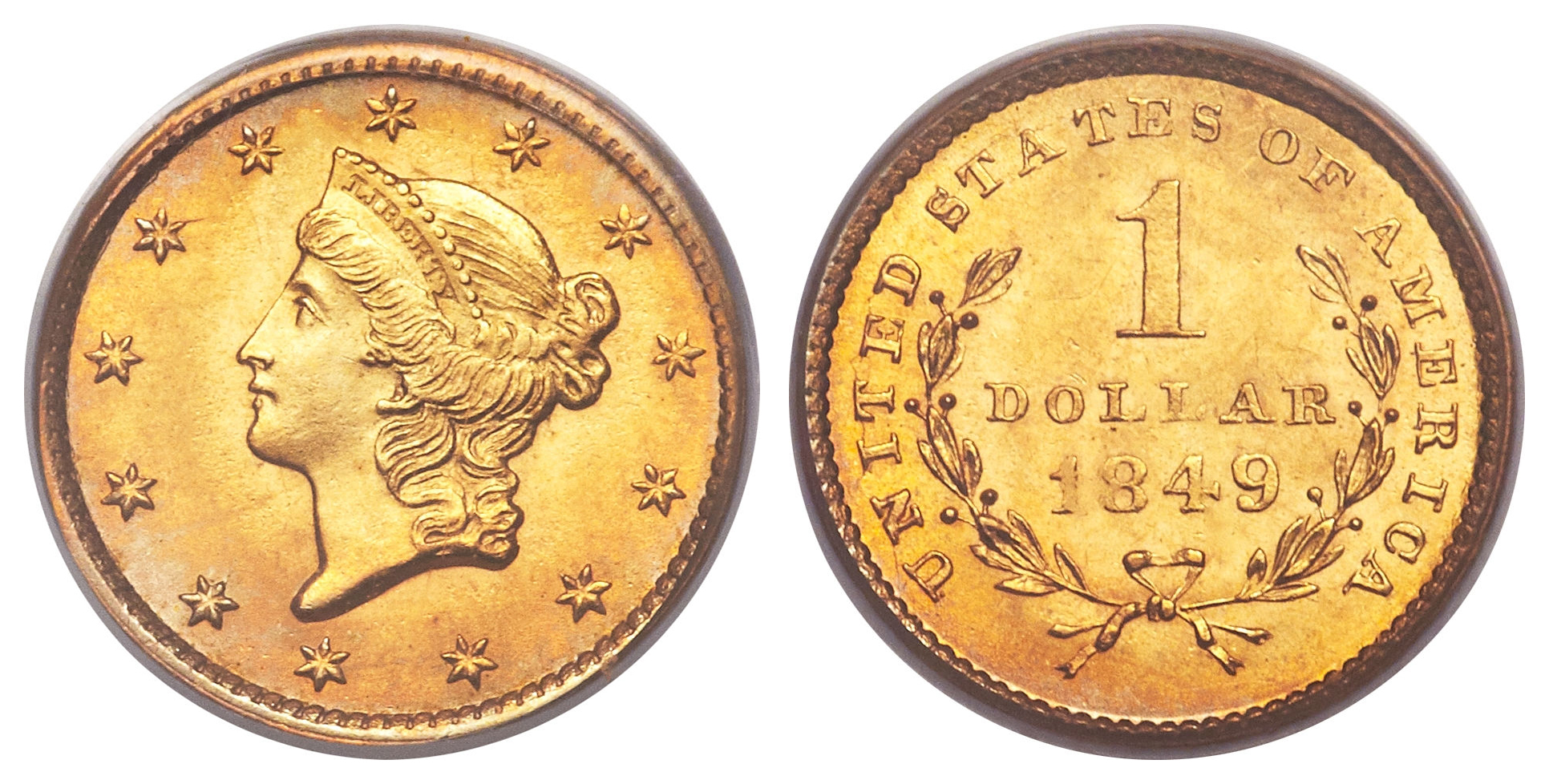
The gold dollar (1849–1889) was America’s smallest gold coin — and a completely different animal from the modern “golden dollar.” Issued in three design types across 40 years, it holds some of the great Southern branch-mint rarities.
History
Congress authorized the gold dollar on March 3, 1849, just as California Gold Rush metal began flooding the economy. Chief Engraver James B. Longacre designed it, and it became the smallest gold denomination the United States ever issued. It was struck in three distinct types: Type 1 (1849–1854), the Liberty Head or “Coronet” design, at a mere 13 millimeters — the smallest circulation coin ever produced by the U.S. Mint; Type 2 (1854–1856), the “Indian Princess” with a small head, widened to about 15 mm but notorious for weak strikes; and Type 3 (1856–1889), the Indian Princess with a larger, flattened head designed to strike up more cleanly. Five mints produced gold dollars: Philadelphia (no mark), Charlotte (C), Dahlonega (D), New Orleans (O), and San Francisco (S).
Type 1 dollars were coined in enormous numbers — nearly 12 million in total, with roughly 10 million Philadelphia pieces from 1851 to 1853 alone — but between 1859 and 1861, about 8 million Liberty Head dollars were melted down for recoinage, meaning two-thirds of all Type 1 coins disappeared within a single decade. Type 2 pieces, struck for only three years in relatively low numbers, are all rare. The series ended in 1889 after four decades.
What is it worth
Values ride on gold and on rarity, so treat any fixed number as a snapshot. The PCGS Price Guide (consulted September 2026) lists common late Type 3 dates like the 1859 and 1861 at guide values starting around $395 in MS30 — a reasonable baseline for a common, circulated example. Key dates go much higher: scarce dates such as the 1855-D, 1856-D, 1860-D, and 1875 bring four-figure prices even in Fine 12, and an NGC MS63 1849-C sold for $493,500 at a Heritage Auctions event in April 2015. Every example also carries a melt floor of 0.0484 troy ounce of pure gold, so even a common date is worth a meaningful fraction of spot gold.
What drives the premium
Three things move the needle: type, mint, and rarity. Southern branch-mint pieces (Charlotte, Dahlonega) carry big premiums — some Dahlonega issues have mintages under 2,000 coins, making them among the rarest of all regular U.S. issues. Condition is brutal on value because these tiny coins saw hard circulation; a genuinely mint-state branch-mint piece can be worth multiples of a circulated one. And the Type 1 meltdown of 1859–1861 means surviving Type 1 pieces, especially from Charlotte and Dahlonega, are far scarcer than their mintage figures suggest.
How to identify the valuable variety
First, identify the type. Type 1 shows a small Liberty Head (coronet) with 13 stars, 13 mm across; Types 2 and 3 show Liberty in a feathered headdress (the “Indian Princess”), about 15 mm, with Type 3’s head larger and flatter. On Type 1 reverses, check the wreath: on the 1849-C, the “Open Wreath” variety — the rarest gold dollar of all — has the wreath open at the top, while the “Closed Wreath” joins. The 1849-C Open Wreath had a mintage of just 11,634. Key mint-date targets: 1849-C Open Wreath, 1861-D (its mintage was kept small by the Civil War), and the 1855-D, 1856-D, and 1860-D issues.
And don’t confuse these with the modern “golden dollar.” Sacagawea and Presidential dollars are manganese-brass clad over copper with no gold content at all, and at 26.5 mm they’re nearly twice the diameter of a real gold dollar. A genuine gold dollar is tiny — noticeably smaller than a dime.
Specifications
Weight: 1.67 grams (0.0484 oz pure gold). Composition: 90% gold, 10% copper and silver. Diameter: 13 mm (Type 1), about 15 mm (Types 2 and 3). Edge: reeded. Mint mark: on the reverse, below the wreath. Designer: James B. Longacre.
Collector notes
Type 2 dollars are the hardest type to find well struck — expect flatness on the portrait even in uncirculated grades, and pay accordingly rather than assuming wear. The 1853 Philadelphia Type 1 is among the most counterfeited dates, so buy key dates certified. For a type set, a common Type 1, any Type 2, and a common Type 3 make an affordable three-coin set; a date-and-mint set is a lifetime pursuit, since the Charlotte and Dahlonega pieces are six-figure coins in high grade.
Market check
Compare live listings for this coin on eBay:
Search eBay for Gold Dollar (1849–1889)
As an eBay Partner, The Coin Wiki may earn from qualifying purchases.
FREE DOWNLOAD
Before you spend that coin, check it.
The Pocket Change Key-Date Checklist covers the cents, nickels, dimes, quarters and halves still hiding in circulation — including the 1943 and 1983 errors worth five figures. One page to print, a lifetime of jars to check.