Specifications
- Denomination
- Silver dollar
- Series
- Draped Bust dollar
- Designer
- portrait by Gilbert Stuart; engraved by Robert Scot
- Weight
- 27 g
- Diameter
- 40 mm
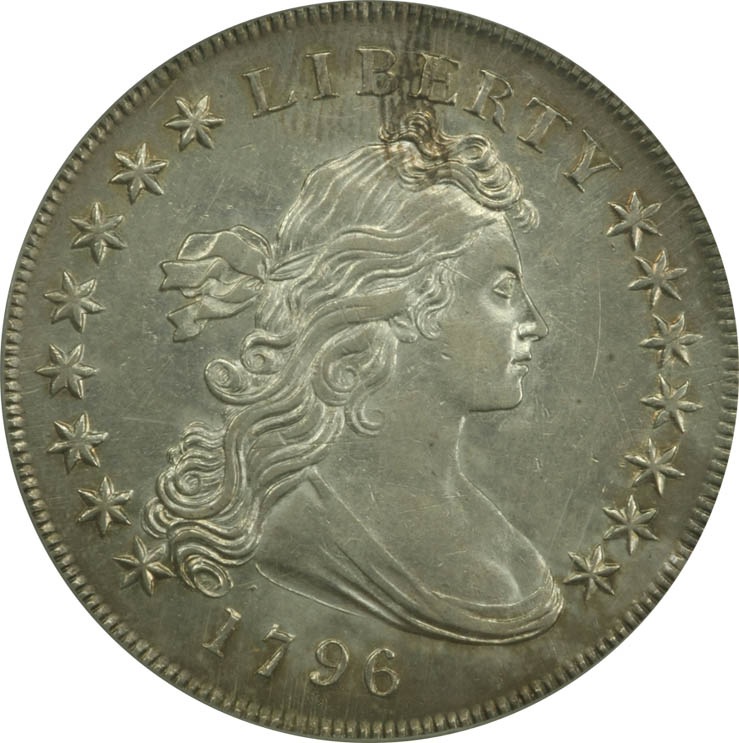
The Draped Bust dollar was America’s first widely circulated dollar coin: struck from 1795 through 1803, with Gilbert Stuart’s portrait of Liberty on the obverse and two different eagle reverses across the series (Heritage).
History
- The Draped Bust portrait began with Mint Director Henry William DeSaussure, who contracted famed portrait artist Gilbert Stuart to replace the Flowing Hair bust. Stuart’s design, believed by some to be a drawing of Philadelphia socialite Ann Willing Bingham, was transferred into plaster models and punches by John Eckstein for engraver Robert Scot; Eckstein was paid $30 for the work in September 1795 (Stack’s Bowers).
- The series used two reverses. Through early 1798 the reverse carried a small, naturalistic eagle; from 1798 onward it showed the Heraldic Eagle with the ribbon motto E PLURIBUS UNUM, borrowed from the Great Seal (PCGS).
- Silver dollars were struck at Philadelphia with no mintmark, since it was the only U.S. mint in operation for the entire series (PCGS).
- The last business strikes are dated 1803, though they were delivered in 1804. The famed 1804 dollars are restrikes produced after the series ended, along with proof restrikes struck from new dies dated 1801, 1802, and 1803 (PCGS).
- Early mint accounting was loose, and for 1795 the surviving records make the exact total struck for each design pairing less straightforward than the mintage tables suggest (Stack’s Bowers).
What is it worth
- PCGS’s older price research (reported in its 1799 article, circa 2003) placed a common 1799 at roughly $950 in G-4, $1,600 in F-12, $4,000 in XF-40, and $25,000+ in uncirculated condition; a 1799 in MS66 realized $258,750 at auction in 2003 (PCGS).
- The 1802 Wide Date trades around $13,500 in AU50, $15,000 in AU53, $17,500 in AU55, and $27,500 in AU58 on the PCGS price guide (PCGS).
- The 1802/1 BB-233 overdate brought an auction record of $193,875 in MS64 at Legend in 2020 (PCGS).
- As a group, these are $1,000+ coins even in low grades today; check current PCGS guide values by date before buying, since spreads between common and key dates are enormous.
Key dates in the series
- 1795 (Off-Center and Centered Bust): the first year of the type, with both bust position varieties collected; mint accounting from the era makes exact totals murky (Stack’s Bowers; PCGS).
- 1796: an early Small Eagle issue that is scarce in higher grades and always in demand as a first-year-style type.
- 1798 Small Eagle: the transitional rarity — the Small Eagle reverse was used only through early 1798 before the Heraldic Eagle arrived, so this is the last of the first type (PCGS).
- 1799/8: the major overdate of the series, famous in the specialist literature as 15 stars over 13.
- 1802/1 (BB-233): the popular overdate; PCGS lists a mintage of 41,650 for the 1802 issue and estimates about 1,250 survivors in all grades (PCGS).
- 1803: the last business-strike date, delivered in 1804, and considerably scarcer than the common 1798 and 1799 dates (PCGS).
What drives the premium
- The business strikes collectors actually encounter are most often 1798 or 1799 dollars; the 1801, 1802, and 1803 issues are considerably scarcer (PCGS).
- Grade is everything: most survivors grade VG to VF, and EF and AU coins are scarce while Mint State pieces are rare (PCGS).
- Original surfaces matter. Adjustment marks — file marks made at the Mint to bring overweight planchets down to standard — and weak striking from worn dies are common on these early coins and are accepted as part of the type (PCGS).
- The premium dates are the 1798 Small Eagle, the 1799/8 and 1802/1 overdates, and the 1801–1803 dates; small differences in die variety can mean large differences in value (PCGS).
Specifications
- Years struck: 1795–1803 (business strikes; 1804-dated pieces are restrikes) (PCGS)
- Designer: portrait by Gilbert Stuart; engraved by Robert Scot (Heritage)
- Diameter: 40.00 mm (PCGS)
- Weight: 27.00 g (PCGS)
- Composition: 90% silver (PCGS)
- Edge: lettered HUNDRED CENTS ONE DOLLAR OR UNIT (PCGS)
- Mint: Philadelphia (no mintmark) (PCGS)
- 1799 mintage: 423,515 (PCGS)
- 1802 mintage: 41,650 (PCGS)
Collector notes
- This is the series that launched the American silver dollar: every entry-level collector who wants a first-generation U.S. dollar starts here, so demand for problem-free 1798 and 1799 examples is deep and constant (PCGS).
- Buy certified. These dollars are among the most counterfeited early U.S. coins, and the adjustment marks and weak strikes common to the issue can be confused with damage by the untrained eye (PCGS).
- The 1804 dollar’s story belongs to the diplomacy era that followed this series: it is covered elsewhere on The Coin Wiki, and any genuine example is a six- or seven-figure museum-level coin (PCGS).
- Specialists collect by Bolender die variety, and 1795 alone offers Off-Center Bust and Centered Bust pairings to chase (Stack’s Bowers).
Market check
Compare live listings for this coin on eBay:
Search eBay for Draped Bust Dollar
As an eBay Partner, The Coin Wiki may earn from qualifying purchases.
Sources
- PCGS CoinFacts — Draped Bust dollar series overview
- PCGS CoinFacts — Small Eagle type, 1795–1798
- PCGS — 1799 Draped Bust dollar: a popular type coin for the ages
- PCGS CoinFacts — 1802/1 Draped Bust dollar (BB-233)
- Stack’s Bowers — 1795 Off-Centered Bust Draped Bust dollar
- PCGS CoinFacts — 1802/1 Draped Bust dollar (BB-233)