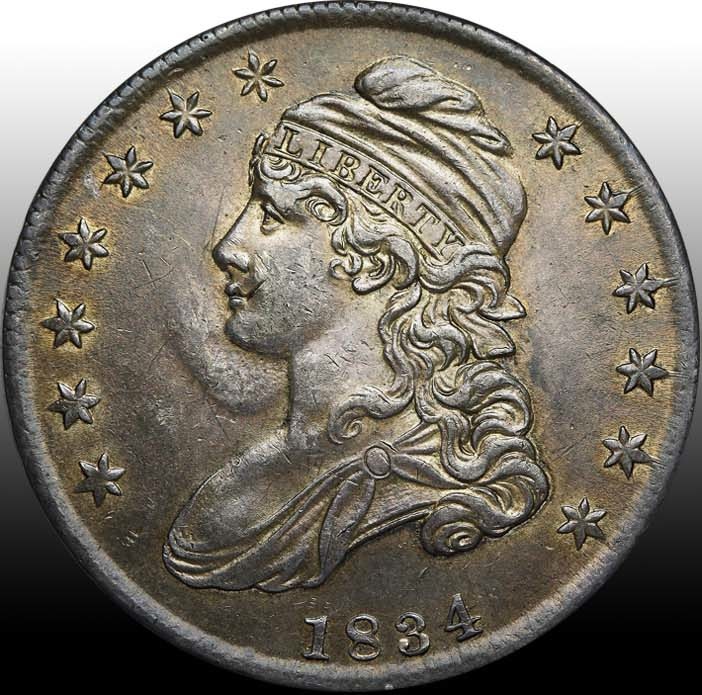
Specifications
- Denomination
- Half dollar
- Series
- Capped Bust half dollar
- Designer
- John Reich; reeded-edge format reworked by Christian Gobrecht
- Weight
- 13.48 g
- Diameter
- 32.5 mm
The Capped Bust half dollar was the workhorse of early American silver: minted 1807–1839, it carried John Reich’s Liberty through the War of 1812 and the steam-press revolution (CoinWeek).
History
- The design was created by John Reich, the Mint’s assistant engraver, whose capped Liberty with a starred obverse defined the series from its 1807 debut (CoinWeek).
- Half dollars were the circulating silver workhorse of the era: with silver-dollar production suspended, the half dollar was the largest silver coin most Americans would ever handle (CoinWeek).
- An 1816 fire at the Philadelphia Mint suspended silver coinage, which is why no 1816-dated half dollars exist and the 1815/2 overdate became the key of the early years (Numismatic News).
- Late in 1836 the Mint introduced the reeded edge with steam presses and the close collar, replacing the old lettered edge and shrinking the coin; Christian Gobrecht reworked Reich’s Liberty for the new, smaller format (PCGS; GreatCollections).
- The 1839-O was the first circulation-strike half dollar struck with a mintmark, a landmark for branch-mint collecting (PCGS).
What is it worth
- Common dates in lower grades start around $100; an 1814 in XF-40 was valued around $480 in Numismatic News’s 2012-era research (Numismatic News).
- The 1815/2 overdate had a mintage of 47,150 and was valued around $3,650 in VF-20, $14,500 in MS-60, and $85,000 in MS-65 when reported in 2012 (Numismatic News).
- The 1817/4 is an extreme rarity with 11 known; PCGS’s price guide lists it at $335,000 in circulated grades and $400,000 in XF (PCGS).
- The 1817/3 is listed by PCGS at $1,000 in F12, a bargain among the early overdates (PCGS).
- Check current PCGS guide values by date and Overton variety before buying — die-variety premiums are the lifeblood of this series.
Key dates in the series
- 1815/2: the key of the first decade, mintage 47,150, and the only 1815-dated coin in the series (Numismatic News; CoinWeek).
- 1817/3: a popular early overdate listed at $1,000 in F12 on the PCGS price guide (PCGS).
- 1817/4: the series’ greatest rarity, with 11 known (PCGS).
- 1836 reeded edge: the first year of the new format, with a mintage of just 1,200 (PCGS).
- 1839-O: the first half dollar struck for circulation with a mintmark (PCGS).
What drives the premium
- Collectors attribute lettered-edge halves by Overton number, and researchers have identified more than 789 different dies — the series offers one of the widest variety fields in American coinage (CoinWeek).
- Edge type: lettered-edge pieces (1807–1836) are the classic large format; the reeded-edge 1836–1839 issues are a separate, much smaller type (PCGS; CoinWeek).
- Grade: most certified examples fall between Extremely Fine and near-Mint State; CoinWeek notes prices stay moderate through Choice AU, then rise steeply at the Gem level and above (CoinWeek).
- Originality matters — these were heavy circulation coins, and problem-free VF and XF examples with honest wear bring strong bids.
- Branch-mint scarcity at the tail end: the 1838-O and 1839-O are the first New Orleans halves and always in demand (PCGS).
Specifications
- Years struck: 1807–1839 (lettered edge 1807–1836; reeded edge 1836–1839) (PCGS)
- Designer: John Reich; reeded-edge format reworked by Christian Gobrecht (CoinWeek; GreatCollections)
- Diameter: 32.50 mm (lettered edge); about 30 mm (reeded edge) (PCGS)
- Weight: 13.48 g (CoinWeek; PCGS lists 13.50 g) (lettered edge); 13.36 g (reeded edge) (PCGS)
- Composition: 89.2% silver (lettered edge) (PCGS); 90% silver (reeded edge, per the Act of January 18, 1837) (GreatCollections)
- Edge: lettered FIFTY CENTS OR HALF A DOLLAR (1807–1836); reeded (late 1836–1839) (PCGS)
- Mints: Philadelphia (no mintmark); New Orleans (O, 1838–1839) (PCGS)
Collector notes
- This is the series that built early American numismatics: researchers have identified more than 789 dies, and specialists collect by Overton number (CoinWeek).
- The 1815/2 survived in quantity partly because a hoard (the so-called Harmony Hoard) reached the market in the 1990s and kept prices in check — but top grades remain genuinely scarce (Numismatic News).
- Lettered-edge halves were struck in an open collar, so diameters vary slightly; that is normal and not damage (CoinWeek).
- A type set needs just two coins — one lettered-edge and one reeded-edge — making this one of the most approachable major early series (PCGS).
- Proofs exist for 1820–1836, with fewer than 15 struck in most years; none are confirmed before 1820 (CoinWeek).
Market check
Compare live listings for this coin on eBay:
Search eBay for Capped Bust Half Dollar
As an eBay Partner, The Coin Wiki may earn from qualifying purchases.
Sources
- CoinWeek — Capped Bust half dollar, lettered edge 1807–1836
- PCGS Price Guide — Capped Bust half dollar
- PCGS Set Registry — Capped Bust half dollars, reeded edge basic set
- Numismatic News — The Capped Bust half dollar, 1807–1836
- Numismatic News — Harmony Hoard kept half prices down (1815/2)
- GreatCollections — reeded-edge half dollar research (Gobrecht rework; 1837 fineness)