
Specifications
- Denomination
- 25 cents
- Series
- Washington Quarters — Bicentennial
- Designer
- John Flanagan
- Years of issue
- 1975–1976
- Weight
- 5.67 g
- Diameter
- 24.3 mm
- Edge
- Reeded
- Key mintages
- Clad circulation: 809,784,016 (P) and 860,118,839 (D); San Francisco collector issues: 7,059,099 clad proof, 11,000,000 silver-clad uncirculated, 4,000,000 silver-clad proof (historytools.org). Silver-clad pieces weigh 5.75 g and contain 0.0739 oz ASW (washingtonquarters.org; JM Bullion).
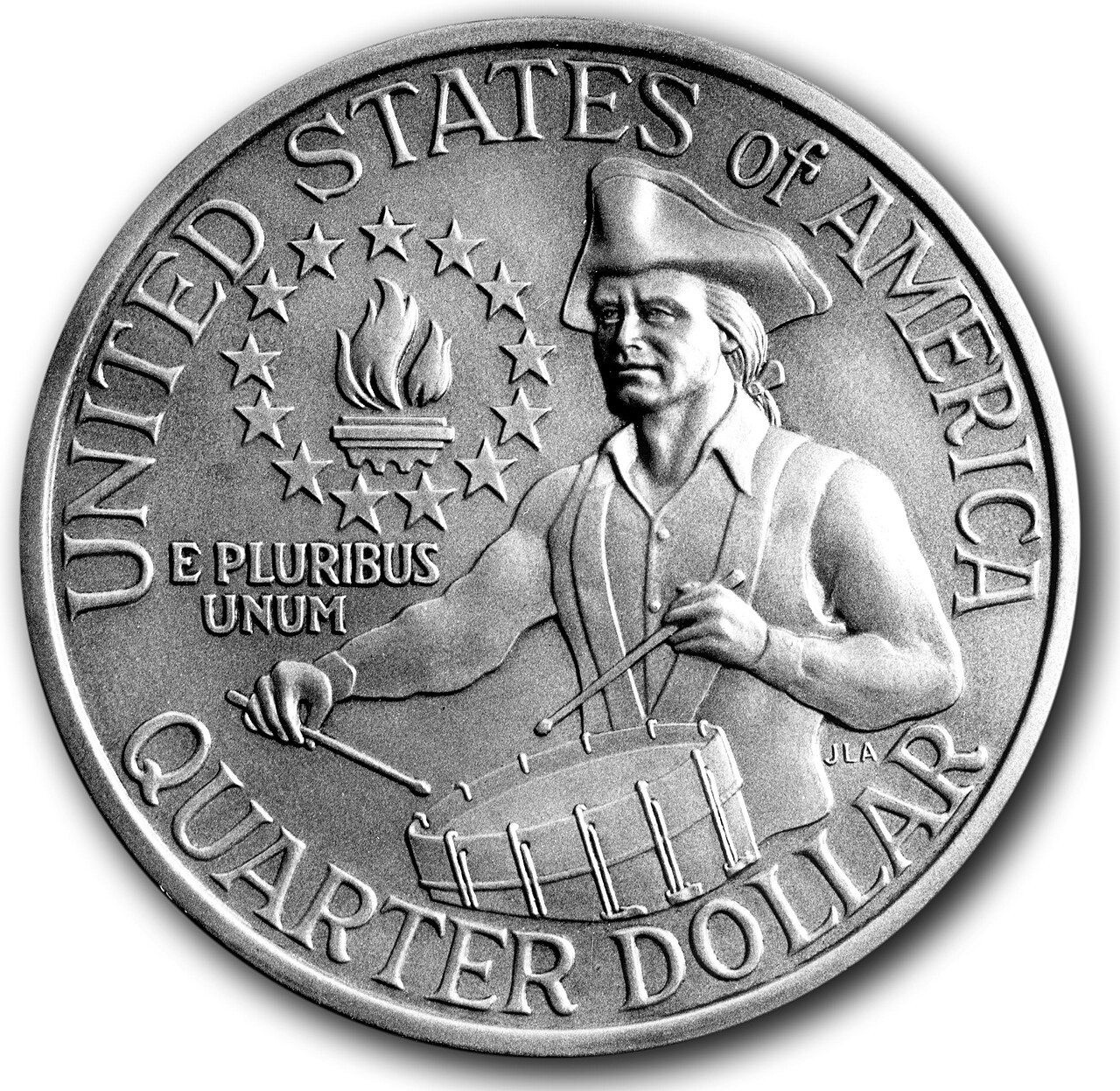
Circulation pieces are worth face value; the 40% silver San Francisco collector issues carry silver value plus a collector premium.
History
- The Bicentennial quarter was struck in 1975 and 1976 with the dual date 1776–1976 to mark 200 years of American independence. A nationwide design competition produced the reverse: a colonial drummer boy with the torch of victory encircled by 13 stars, designed by Jack L. Ahr, replacing the heraldic eagle for this issue (derasaty.net; JM Bullion). The obverse kept John Flanagan’s Washington portrait.
- Circulation strikes were made at Philadelphia and Denver in standard copper-nickel clad, while San Francisco struck collector versions in both clad and 40% silver-clad compositions (antiquesknowhow.com). The 40% silver-clad coins weigh 5.75 grams (versus 5.67 grams for clad), measure 24.3 mm, and contain 0.0739 troy ounces of silver; their outer layers are 80% silver / 20% copper bonded to an inner core of 20.1% silver / 79.9% copper (washingtonquarters.org; JM Bullion; rec.collecting.coins).
- Reported mintages: 809,784,016 Philadelphia clad, 860,118,839 Denver clad, 7,059,099 San Francisco clad proof, 11,000,000 San Francisco silver-clad uncirculated, and 4,000,000 San Francisco silver-clad proof — a total near 1.69 billion (historytools.org; nasdaq.com). All silver coins were struck at San Francisco and bear the ‘S’ mint mark (historytools.org).
- Circulated clad examples are worth face value, while the 40% silver issues trade at a premium reflecting both their metal content and collector demand; condition is the main value driver, with high-grade and error examples the standouts — nasdaq.com cites a 1976-S silver quarter that sold for $19,200 at auction in very high grade (nasdaq.com).
What is it worth
- Circulated clad examples are worth face value (nasdaq.com).
- The 40% silver issues trade at a premium reflecting both their metal content and collector demand; nasdaq.com cites a 1976-S silver quarter that sold for $19,200 at auction in very high grade.
- 1976-S 40% silver clad proof — 4,000,000 struck, the scarcest regular issue (historytools.org).
- 1976-S 40% silver clad uncirculated — 11,000,000 struck (historytools.org).
- 1776-1976 (P) and 1976-D clad circulation — face value unless high grade (historytools.org).
What drives the premium
- Condition is the main value driver, with high-grade and error examples the standouts (nasdaq.com).
- The 40% silver composition is the other premium driver: each silver-clad coin contains 0.0739 troy ounces of silver (washingtonquarters.org; JM Bullion).
How to identify the valuable variety
- An ‘S’ mint mark alone does not mean silver: San Francisco also struck copper-nickel clad proofs. Weigh the coin — about 5.75 g indicates the 40% silver composition, 5.67 g is clad (washingtonquarters.org).
- The 40% silver issues were sold only in collector sets, never released for general circulation; worn 40% silver examples found in change are genuine but came from broken-up sets (bullionsharks.com).
Specifications
- Composition: Copper-nickel clad (91.67% copper, 8.33% nickel) or 40% silver / 60% copper silver-clad (washingtonquarters.org)
- Weight: 5.67 g (clad); 5.75 g (silver-clad) (washingtonquarters.org)
- Diameter: 24.3 mm (washingtonquarters.org)
- Edge: Reeded (JM Bullion)
- Alignment: Not verified in consulted references
- Designers: John Flanagan (obverse); Jack L. Ahr (reverse) (washingtonquarters.org)
- Mint: Philadelphia (no mint mark), Denver (D), San Francisco (S) (nasdaq.com)
Collector notes
- Reported mintages: 809,784,016 Philadelphia clad, 860,118,839 Denver clad, 7,059,099 San Francisco clad proof, 11,000,000 San Francisco silver-clad uncirculated, and 4,000,000 San Francisco silver-clad proof (historytools.org).
- Premiums concentrate in the 40% silver issues and in high-grade or error examples; ordinary circulated clad pieces are face value (nasdaq.com).
Market check
Compare live listings for this coin on eBay:
Search eBay for 1776–1976 Bicentennial Quarter
As an eBay Partner, The Coin Wiki may earn from qualifying purchases.
Related Coins
Live on eBay
Live asking prices — not sale records.
 ONE 1776-1976 (D) Bicentennial Washington Quarter – D Mint….Nice Coin$1.09View on eBay
 1776-1976 D Filled Bicentennial Quarter$225.00View on eBay
 1776-1976 D US Bicentennial Quarter $22.22View on eBay
As an eBay Partner, The Coin Wiki may earn from qualifying purchases.
FREE DOWNLOAD
Before you spend that coin, check it.
The Pocket Change Key-Date Checklist covers the cents, nickels, dimes, quarters and halves still hiding in circulation — including the 1943 and 1983 errors worth five figures. One page to print, a lifetime of jars to check.