
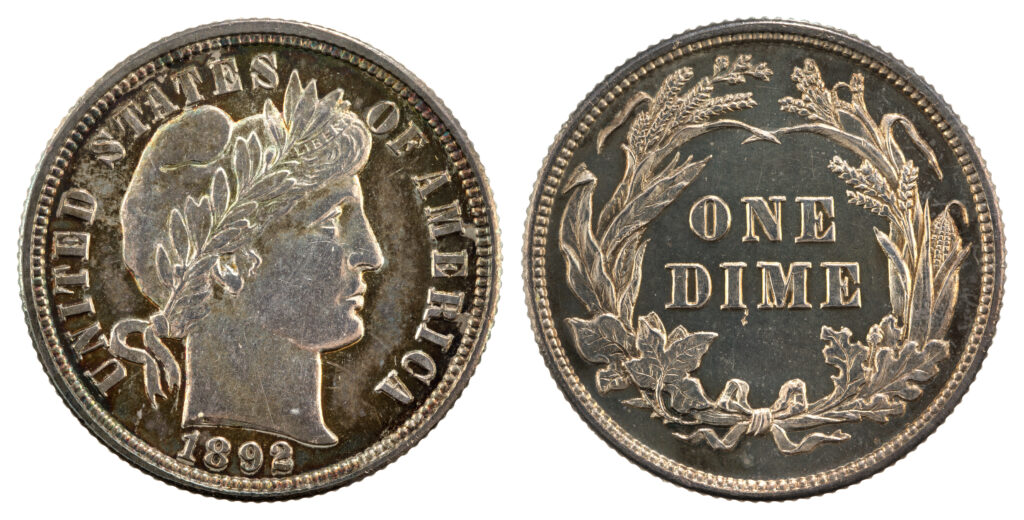
Specifications
- Denomination
- Dime
- Series
- Barber dime
- Designer
- Obverse and reverse: Charles E. Barber
- Years of issue
- 1892–1916 (plus 1891 patterns)
- Weight
- 2.5 g
- Diameter
- 17.91 mm
- Edge
- Reeded
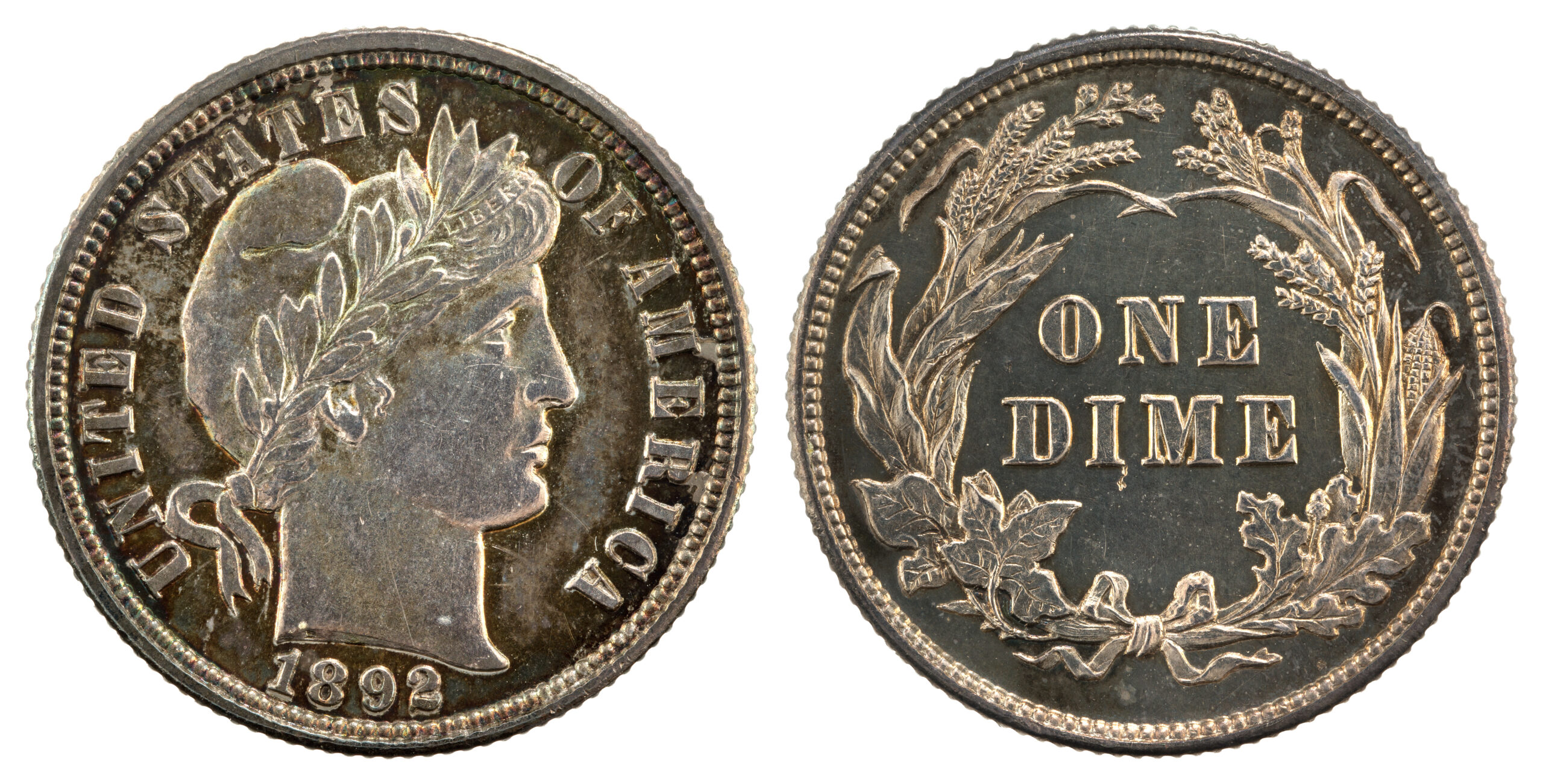
Barber dimes ran 1892–1916 — common dates trade in the low double digits, but the 1894-S is a seven-figure rarity and the 1895-O and 1901-S are the keys everyone chases.
History
- The Barber dime is one of three silver denominations designed by U.S. Mint Chief Engraver Charles E. Barber and struck from 1892 through 1916, alongside the Barber quarter and half dollar. Barber took the chief engraver’s post in 1880 and served nine presidents until his death in 1917 (Wikipedia).
- The redesign came from an 1890 law that made every U.S. coin eligible for a new design 25 years after its first issue. Mint Director Edward O. Leech held a public design competition in 1891 with a $500 winner-take-all prize; invited artists refused the terms, and the jury of Augustus Saint-Gaudens, Barber, and Boston seal engraver Henry Mitchell rejected all entries. Leech then ordered Barber to prepare the new designs himself, and President Benjamin Harrison approved them in November 1891. Striking began in January 1892 (Wikipedia).
- The obverse shows Liberty facing right, her hair in a Phrygian cap beneath a laurel wreath, with LIBERTY in tiny letters on a band above her forehead. Unlike the quarter and half dollar, the dime’s obverse has no stars around the rim. The reverse — a wreath enclosing ONE DIME — was carried over from the earlier Seated Liberty dime. There was no room for IN GOD WE TRUST on the dime, so the motto was omitted (PCGS).
- The series is known for two obverse styles (1892–1900 with rounded leaf tips in the wreath on Liberty’s head; 1901–1916 with pointed tips) and two reverses (Type A with a thin right ribbon below the bow, 1892–1905; Type B with a thick right ribbon, 1901–1916), as documented by variety specialist John McCloskey (Stack’s Bowers).
- In 1916 the Mint struck Barber dimes to meet commercial demand while the new Mercury dime was being prepared; the series ended that year as the Mercury dime, Standing Liberty quarter, and Walking Liberty half dollar took over (Wikipedia).
What is it worth
- A generic common-date Barber dime in G-4 books around $15, with most well-circulated common dates changing hands in the low double digits (PCGS). Value climbs with grade, mint mark, and date scarcity, and every issue is 90% silver, so melt value sets a floor (PCGS).
- Uncirculated common dates are available but get expensive quickly: even first-year Philadelphia issues book several hundred dollars in MS-63 and into the thousands in MS-67 (PCGS).
- Proofs were struck each year from 1892 to 1915 for collectors and can be found with some searching; they trade at collector premiums well above business strikes of the same date (PCGS).
Key dates in the series
- 1894-S — only 24 were struck at San Francisco in June 1894, and just nine are known today; the finest examples are graded as proofs. The Norweb specimen sold for $1.25 million at Stack’s Bowers in September 2026, and the finest known brought $1,997,500 at Heritage in 2016 and $1.9 million in 2007. It ranks No. 4 in the 100 Greatest U.S. Coins (Stack’s Bowers; Smithsonian; Heritage via Numismatic News). This date is covered in depth in the site’s dedicated 1894-S entry.
- 1895-O — “after the ultra-rare 1894-S, the scarce 1895-O will be the date collector’s biggest challenge” (PCGS). The site’s dedicated 1895-O entry carries sourced per-date figures.
- 1901-S — considered elusive in Uncirculated grade (Stack’s Bowers). The site’s dedicated 1901-S entry carries sourced per-date figures.
- Also scarce: the 1893/2 overdate, the 1894-O, the 1895, and the 1895-O; the branch-mint issues of 1896 and 1897 are scarce in Uncirculated (Stack’s Bowers).
What drives the premium
- Mint mark and date scarcity above all: San Francisco and New Orleans issues from the 1890s carry the strongest premiums, while Philadelphia dates from the 1900s are the affordable backbone of a set (PCGS; Stack’s Bowers).
- Grade rarity: superb Uncirculated coins are difficult to find, and Uncirculated pieces from the branch mints are genuinely elusive (PCGS; Stack’s Bowers).
- Varieties: the 1893/2 overdate and the obverse/reverse hub changes add collectible sub-varieties within the series (Stack’s Bowers).
- Originality: attractively toned, uncleaned examples command premiums over dipped or impaired pieces (PCGS).
Specifications
- Composition: 90% silver, 10% copper (Wikipedia)
- Weight: 2.50 g (Wikipedia)
- Silver content: 0.07234 troy oz ASW (Wikipedia)
- Diameter: 17.91 mm (Wikipedia)
- Edge: Reeded (Wikipedia)
- Designers: Obverse and reverse: Charles E. Barber (Wikipedia)
- Mints: Philadelphia (no mint mark), New Orleans (O), San Francisco (S), Denver (D); mint mark on the reverse beneath the wreath (Wikipedia)
- Years: 1892–1916 (plus 1891 patterns) (Wikipedia)
Collector notes
- For type purposes, the series is easy: PCGS notes that a type collector “will encounter no difficulty acquiring an example in any desired grade from Good to AU” (PCGS).
- Date-and-mintmark sets are a real challenge because of the 1894-S; most collectors build the set excluding it (PCGS).
- The 1894-S story — whether struck to balance a $2.40 bullion-account discrepancy or as gifts for bankers, with three pieces reportedly given to the San Francisco superintendent’s daughter — is one of the great legends of U.S. numismatics (Wikipedia).
- Mint marks sit on the reverse beneath the wreath, so check there first when sorting a mixed lot of old dimes (Wikipedia).
Market check
Compare live listings for this coin on eBay:
As an eBay Partner, The Coin Wiki may earn from qualifying purchases.
Sources
- PCGS CoinFacts — Barber Dime: https://www.pcgs.com/coinfacts/category/barber-dime-1892-1916/702
- Wikipedia — Barber coinage: https://en.wikipedia.org/wiki/Barber_coinage
- Stack’s Bowers — Barber dime value guide: https://stacksbowers.com/coin-resource-center/us-coins/dimes/barber-dime/barber-dime-circulation-strike/
- PCGS Price Guide — Barber dime: https://www.pcgs.com/prices/completesetdetail/barber-dime-1892-1916/67/grades-1-20/0
- Wikipedia — 1894-S Barber dime: https://en.wikipedia.org/wiki/1894-S_Barber_dime
- Smithsonian Magazine — 1894-S sale: https://www.smithsonianmag.com/smart-news/a-legendary-132-year-old-dime-recently-sold-for-more-than-12-million-at-auction-what-makes-it-so-extraordinary-180989476/
- ANA Reading Room — King of Barber Dimes: https://readingroom.money.org/king-of-barber-dimes-sells-for-1-25-million/
- Numismatic News — FUN rarities: https://www.numismaticnews.net/events/rarities-auctioned-at-fun
FREE DOWNLOAD
Before you spend that coin, check it.
The Pocket Change Key-Date Checklist covers the cents, nickels, dimes, quarters and halves still hiding in circulation — including the 1943 and 1983 errors worth five figures. One page to print, a lifetime of jars to check.