
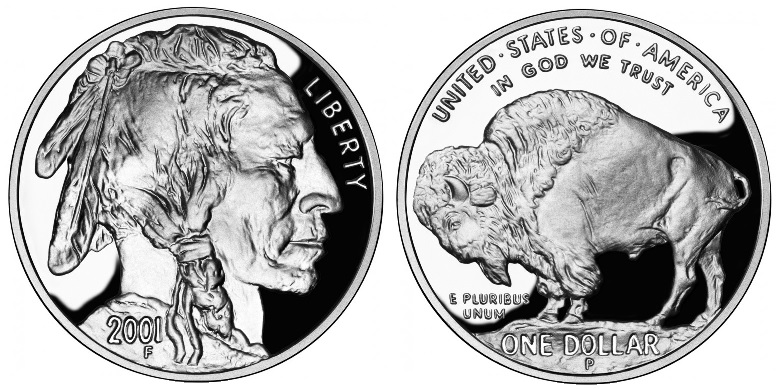
The 2001 Buffalo silver dollar revived James Earle Fraser’s beloved Buffalo nickel design — and sold out in two weeks. Denver uncirculated and Philadelphia proof versions remain among the most popular modern commemoratives ever issued.
History
Authorized by Public Law 106-375 with a maximum mintage of 500,000, the American Buffalo silver dollar commemorates the Smithsonian’s National Museum of the American Indian and the Buffalo nickel — the design serves as its direct basis. The obverse shows Fraser’s composite Native American profile (modeled on the Sioux Iron Tail, the Kiowa Big Tree, and the Cheyenne Two Moons), and the reverse shows the bison, based on the original 1913 Buffalo nickel reverse. The coins went on sale June 7, 2001 and sold out just two weeks later, on June 21. Demand was so strong that the National Museum of the American Indian asked for an additional 250,000 to 500,000 coins — the request was denied, cementing the issue’s scarcity.
What is it worth
The Buffalo dollar consistently trades at a healthy premium over its silver content — it is one of the few modern commemoratives with genuine, sustained collector demand. Current guide values were not documented in the consulted references — compare live listings in the Market check below. As a data point rather than a value claim, dealer asking prices observed in the consulted references ran about $285 for an uncirculated example and $350 for a proof. The coin’s floor is its melt: 0.7736 troy ounce of silver, so it never trades far below silver value. Proof and uncirculated versions trade in the same general range, with the Denver uncirculated — the lower-mintage of the two — often carrying the slight edge.
What drives the premium
Three factors: the two-week sellout (instant sellouts create collector legends), the Fraser design (the Buffalo nickel is arguably the most beloved U.S. coin design ever), and the hard cap at half a million coins. Original Mint packaging and the certificate of authenticity add value; graded MS69/PR69 examples are the most liquid form for resale. Uncirculated versions struck at Denver had the lower mintage, so they get the scarcity premium.
How to identify the valuable variety
There are exactly two issues: the 2001-D uncirculated (227,131 struck at Denver) and the 2001-P proof (272,869 struck at Philadelphia). Check the mintmark below the bison on the reverse: “D” for the scarcer Denver issue, “P” for the proof. Both were also sold in a two-coin set containing one of each, and in the American Buffalo Coin and Currency Set. Be aware that only original 2001-dated U.S. Mint issues carry the premium — modern private “buffalo” rounds and replicas are bullion at best.
Specifications
Weight: 26.73 grams. Composition: 90% silver, 10% copper (0.7736 oz of pure silver). Diameter: 38.1 mm. Edge: reeded. Designer: James Earle Fraser (1913 design, adapted 2001). Mints: Denver (uncirculated), Philadelphia (proof).
Collector notes
This coin is the modern commemorative that converted casual buyers into collectors — many dealers report it as the best-selling modern silver dollar of its era. If buying, the two-coin set in original government packaging is the most popular format and the easiest to resell. Store proof examples in their capsules; hairlines on the mirrored fields punish the grade.
Market check
Compare live listings for this coin on eBay:
Search eBay for 2001 Buffalo Silver Dollar
As an eBay Partner, The Coin Wiki may earn from qualifying purchases.
FREE DOWNLOAD
Before you spend that coin, check it.
The Pocket Change Key-Date Checklist covers the cents, nickels, dimes, quarters and halves still hiding in circulation — including the 1943 and 1983 errors worth five figures. One page to print, a lifetime of jars to check.