
In 1974 the U.S. Mint struck more than 1.5 million Lincoln cents in aluminum — then melted nearly all of them when Congress refused to authorize the change. The few that escaped have never once sold at public auction, so every “value” you’ve ever seen attached to this coin is an estimate. Here is the sourced story.
History
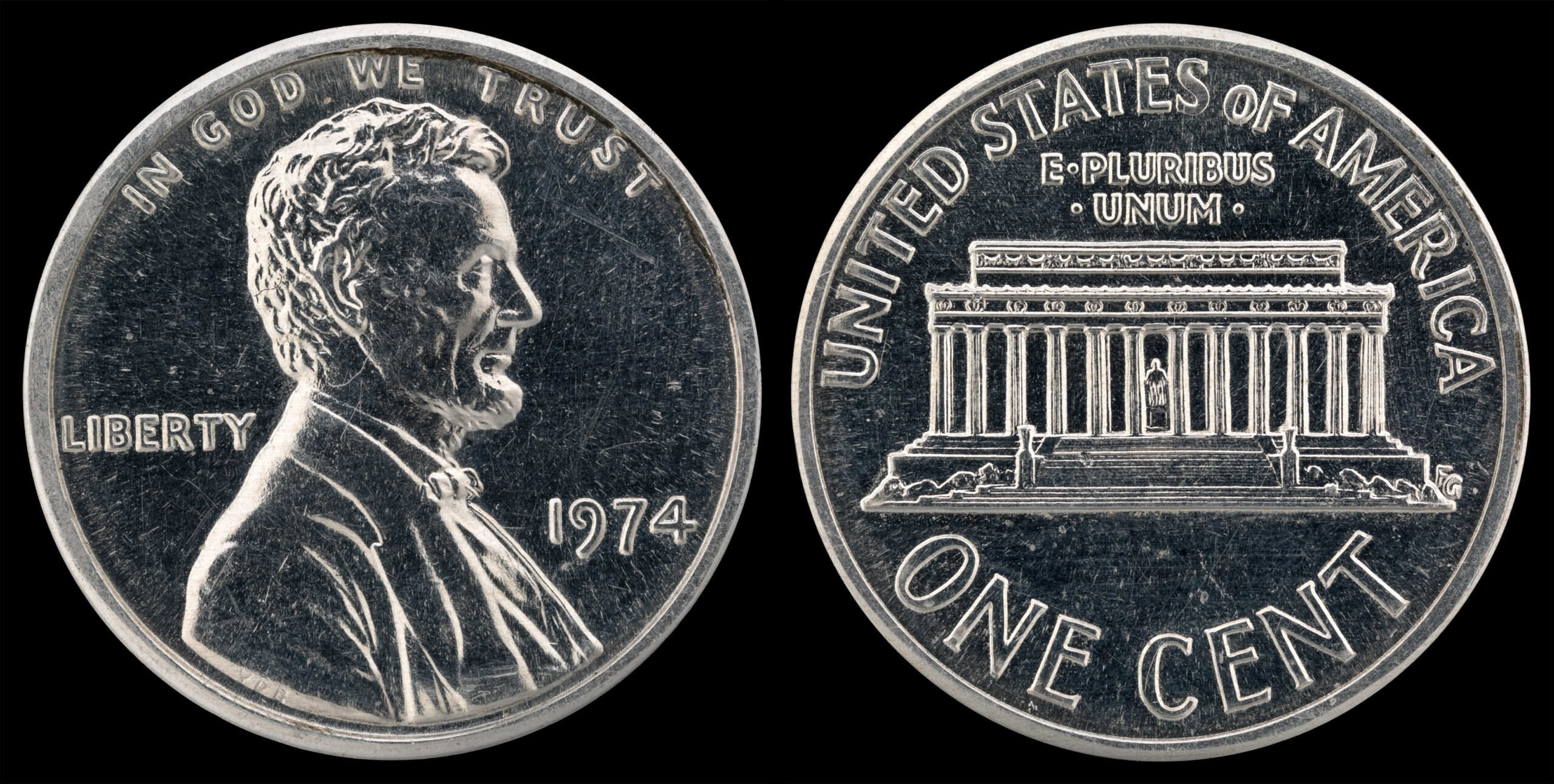
In late 1973, the price of copper on world markets rose until the metallic value of the cent nearly equaled its face value, threatening the Mint with a severe seigniorage deficit. The Mint tested alternate metals, including aluminum and bronze-clad steel, and settled on a composition of 96 percent aluminum with trace elements for stability — chosen for its long die life and resistance to tarnishing. Although produced in 1973, the trial pieces were struck with 1974-dated dies in anticipation of a 1974 release. In total, 1,571,167 were struck.
To build congressional support, the Mint distributed roughly three dozen examples to members of the House Banking and Currency Committee and the Senate Banking Committee — nine congressmen and four senators received pieces, along with some Treasury officials — and Mint Director Mary Brooks handed out additional specimens. The proposal was rejected after the copper-mining and vending-machine industries lobbied against it, pediatricians warned an ingested aluminum cent would be hard to detect on X-rays, and copper prices fell enough to make the bronze cent economical again.
The Mint recalled the trial strikes and ordered them destroyed. About 12 to 14 were never returned — and the Mint later admitted it had kept no records of who received examples and had never told recipients the coins had to come back.
What is it worth
No 1974 aluminum cent has ever been offered at public or known private sale, so there is no market price — only estimates. When a 1974-D specimen was consigned to Heritage’s April 2014 sale, Heritage estimated $250,000 or more; dealer Michael McConnell estimated $250,000 up to $2 million or more. The coin was withdrawn before it could sell, so the market has never tested any of these numbers.
Honest disclosure: any dollar figure attached to the 1974 aluminum cent is speculation. Neither certified example has ever changed hands in a public transaction. Treat published estimates as what they are: educated guesses.
What drives the premium
Four things make this coin legendary among collectors. First, it was never issued: a trial strike for a circulating coinage Congress killed, which some numismatists classify as a rejected regular issue rather than a pattern. Second, it survived a deliberate melt order. Third, only two examples have ever been certified by PCGS. Fourth, the federal lawsuit and Mint recovery of the 1974-D specimen gave it national publicity few patterns ever receive.
How to identify the valuable variety
A genuine piece is the standard 1974 Lincoln cent design (Brenner obverse, Gasparro Memorial reverse) struck in silvery aluminum. The giveaway is weight: 0.937 grams versus 3.11 grams for bronze — a precise scale settles the question instantly.
Two cautions. First, PCGS has certified just the Toven specimen (MS62) and the 1974-D (MS63); any other claimed example needs professional authentication before anyone discusses value. Second, the Mint considers unreturned trial strikes to be U.S. government property subject to seizure by the Secret Service — get independent legal advice before buying, selling, or transporting a claimed example.
Specifications
Face value: 1 cent. Composition: 96% aluminum with trace metals. Weight: 0.937 grams. Diameter: 19.05 mm. Thickness: 1.55 mm. Edge: plain. Obverse: Abraham Lincoln, designed by Victor D. Brenner (1909). Reverse: Lincoln Memorial, designed by Frank Gasparro (1959). Trial strikes produced: 1,571,167, none released. Pattern catalog: Judd J2151 / Pollock P2084 (the 1974-D is Judd J2153).
Collector notes
One example was donated to the Smithsonian Institution’s National Numismatic Collection, where it remains today. Related experimental pieces include 66 aluminum trial cents dated 1975 (Judd J2155) and a 1942 aluminum Lincoln wheat cent pattern — the 1942 piece, unlike the 1974 cents, is considered legal to own and sold at Heritage Auctions in May 2009. The Denver Mint die setter who struck the 1974-D pieces told Coin World he made fewer than 12 of them, one at a time, on aluminum blanks supplied from Philadelphia — even though no Mint records authorize any Denver production.
Market check
Compare live listings for this coin on eBay:
Search eBay for 1974 Aluminum Cent
As an eBay Partner, The Coin Wiki may earn from qualifying purchases.
Sources
- Wikipedia — “1974 aluminum cent”
- PCGS CoinFacts — 1974 1C Aluminum
- Coin World — “PCGS authenticates 1974-D aluminum cent”
- Numismatic News — “More valuable than gold”
- Numismatic News — “U.S. Mint recovers 1974-D aluminum cent”
- CoinNews — “1974-D Aluminum Lincoln Cent Returned to US Mint”