Specifications
- Denomination
- Half dollar
- Designer
- David Parsons and Benjamin Hawkins
- Weight
- 12.5 g
- Diameter
- 30.61 mm
- Edge
- Reeded
The Wisconsin Historical Society was still selling the 1936 Wisconsin Territorial Centennial half dollar in the late 1950s — a slow sellout that keeps this 1936 issue affordable, with the 2020 deluxe Red Book listing it at $175 to $250 depending on condition (Wikipedia).
History
- Organizers of the 1936 centennial of the Wisconsin Territory’s establishment (1836) sought a commemorative half dollar as a fundraiser, and Senator Robert M. La Follette Jr. introduced the legislation on January 30, 1936. After amendments — notably a 25,000-coin minimum at a single mint — the bill passed without debate and became law with President Franklin D. Roosevelt’s signature on May 15, 1936 (Wikipedia).
- The Wisconsin Centennial Commission first hired local art student David Parsons, but his poorly executed, very-high-relief models were rejected by the Bureau of the Mint. The Commission of Fine Arts recruited New York sculptor Benjamin Hawkins, who completed the finished models within weeks in June 1936; both men are credited on the coin. The Medallic Art Company of New York reduced the models to hubs (Wikipedia).
- The Philadelphia Mint struck 25,015 pieces in July 1936 — after the centennial celebration (June 27–July 5) had ended. Sold at $1.50 by mail order, sales were weak because of the late release and local appeal; the Wisconsin Historical Society sold the remainder at $1.25 (raised to $3 in 1952) until the supply was exhausted in the late 1950s (Wikipedia).
- This entry is part of the Classic U.S. Commemoratives series.
What is it worth
- The 2020 deluxe edition of R.S. Yeoman’s A Guide Book of United States Coins lists the coin for $175 to $250 depending on condition (Wikipedia).
- The price climbed slowly: about $1.25 uncirculated by 1940, $3 by 1950, $14 by 1960, and $325 by 1985 (Wikipedia).
- At the top end, an exceptional specimen sold for $17,625 in 2015, and richly toned gem examples routinely outsell blast-white ones of equal technical grade (Wikipedia; GreatCollections).
What drives the premium
- Toning: many coins were stored in albums and paper that produced rich concentric toning, and such coins consistently outsell blast-white survivors (GreatCollections).
- Original packaging: coins were sold in plain cardboard holders with slots for up to five coins, and orders shipped in envelopes imprinted “L.M. HANKS” or rubber-stamped for return to the state superintendent — the envelopes alone are valued at $50–$75 (Wikipedia).
- Type-set demand rather than hype: with no varieties and a full 25,000-plus distribution, premiums come from eye appeal, not rarity (Wikipedia).
Specifications
- Composition: 90% silver, 10% copper (Wikipedia)
- Weight: 12.5 g (Wikipedia)
- Silver content: 0.36169 troy oz (Wikipedia)
- Diameter: 30.61 mm (Wikipedia)
- Thickness: 2.15 mm (Wikipedia)
- Edge: Reeded (Wikipedia)
- Alignment: Not verified in consulted references
- Designers: David Parsons and Benjamin Hawkins (Wikipedia)
- Mint: Philadelphia (no mintmark), 1936 only (Wikipedia)
Collector notes
- Mintage context: 25,015 struck including 15 pieces for the 1937 Assay Commission (Wikipedia).
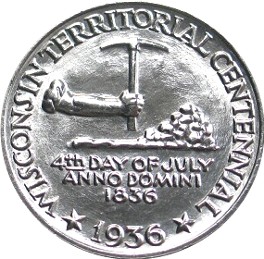
- One side shows a miner’s forearm gripping a pickaxe over a pile of lead ore — a reference to the 1820s lead boom that drew settlers to southwestern Wisconsin — with the date of the territory’s founding, the 4th of July, 1836. The other side shows a badger (the state animal and Wisconsin’s nickname) on a log, backed by three arrows symbolizing the conflict of the Black Hawk War and an olive branch for the peace that followed; Hawkins’ initial H appears below the log (Wikipedia; ANA).
- Early Wisconsin miners lived in their mine shafts rather than building houses, which is how Wisconsinites became “badgers” (Wikipedia).
- Design critics have not been kind: Don Taxay called it “one of our poorest issues,” and art historian Cornelius Vermeule compared it to a baking-soda box logo. The flat, sculptural relief strikes up well, though — weak strikes are unusual, so grading turns on surface preservation (Wikipedia; GreatCollections).
Market check
Compare live listings for this coin on eBay:
Search eBay for 1936 Wisconsin Territorial Centennial Half Dollar
As an eBay Partner, The Coin Wiki may earn from qualifying purchases.
Sources
- Wikipedia — Wisconsin Territorial Centennial half dollar
- American Numismatic Association — 1936 Wisconsin Territorial Centennial Half Dollar
- GreatCollections — 1936 Wisconsin Half Dollar, PCGS MS-66