
Specifications
- Denomination
- Half dollar
- Designer
- Obverse: P. T. Barnum — Henry Kreis; reverse: stylized eagle — Henry Kreis
- Weight
- 12.5 g
- Diameter
- 30.61 mm
- Edge
- Reeded
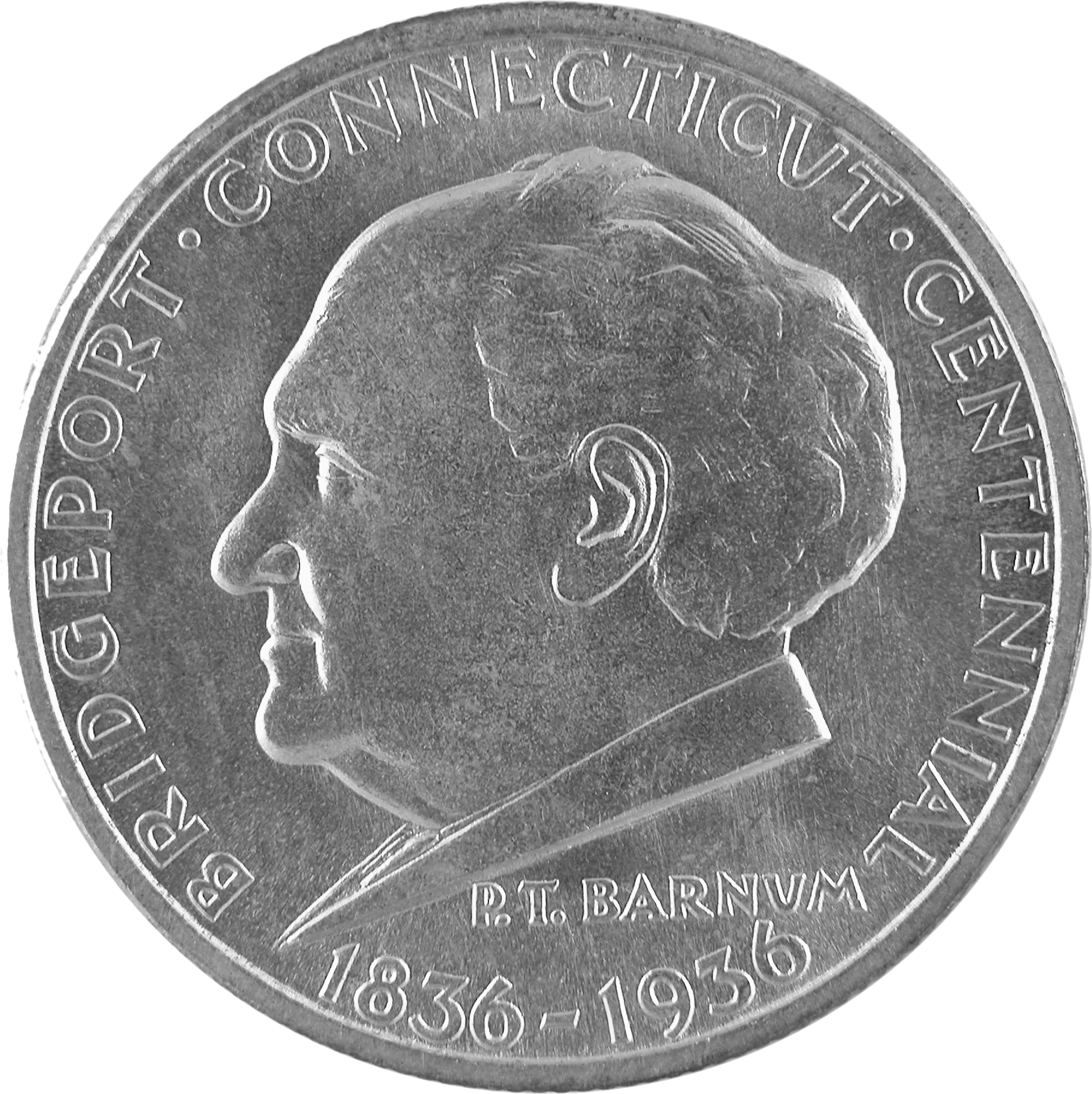
The only U.S. coin honoring a circus showman — P.T. Barnum’s portrait made the 1936 Bridgeport half dollar a crowd favorite, but the dealer-hoarded remainder kept it cheap for decades while original color examples quietly became the real prize (Wikipedia; GreatCollections).
History
- The Bridgeport, Connecticut, Centennial half dollar honored the 100th anniversary of Bridgeport’s 1836 incorporation as a city. A bill introduced into the Senate by Connecticut’s Augustine Lonergan on March 10, 1936, passed both houses without opposition; President Franklin D. Roosevelt signed it on May 15, 1936, authorizing not fewer than 25,000 half dollars. Bridgeport Centennial, Inc., running the celebrations, was the designated purchaser (Wikipedia).
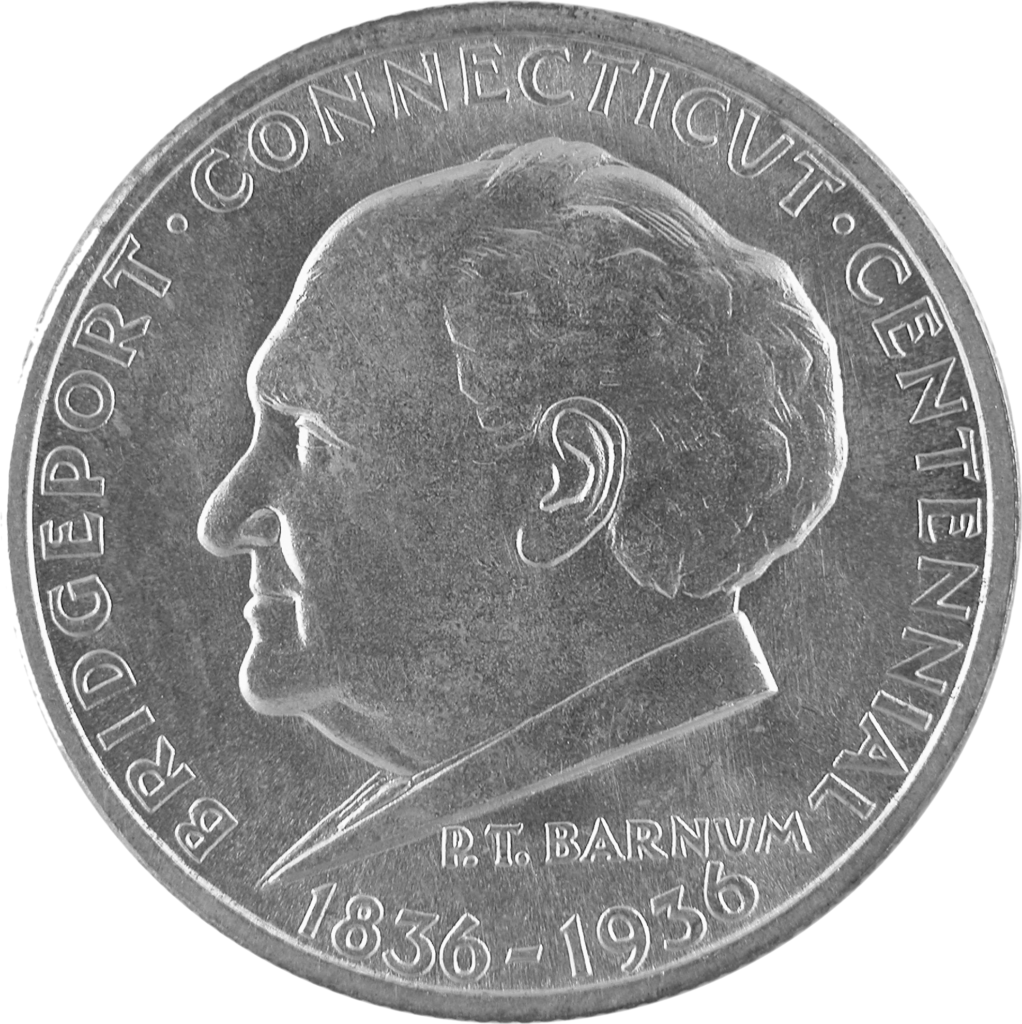
- Bridgeport hired Henry Kreis, designer of the 1935 Connecticut Tercentenary half dollar, whose left-facing bust of P.T. Barnum and “modernistic” Art Deco eagle both recall his earlier work. After Commission of Fine Arts review (Lee Lawrie suggested moving LIBERTY and IN GOD WE TRUST to the reverse to make room for the state name in full), the Medallic Art Company of New York cut the coin-sized hubs and coinage began in September 1936 (Wikipedia).
- The coins went on sale in September 1936 at $2 each — after most of the centennial celebrations (June 4 to October 3) had already passed — mostly through local Bridgeport banks, in small cardboard boxes with a limit of five per purchaser. Several thousand remained unsold and were transferred to the Bridgeport Community Chest, which sold them wholesale to coin dealers at a slight advance on face value; dealer Toivo Johnson of Maine once held about a thousand, and rolls of 20 sold at conventions for years — one coin investment firm was still working through them in the early 1970s (Wikipedia).
- Barnum was a fitting local hero: the showman served as Bridgeport’s mayor in 1875, developed East Bridgeport, presented Seaside Park to the city, and is buried there (Wikipedia; ANA). This entry is part of the Classic U.S. Commemoratives series.
What is it worth
- The 2018 deluxe edition of R. S. Yeoman’s A Guide Book of United States Coins lists the Bridgeport half dollar from $120 to $300 depending on condition, and an exceptional specimen sold for $1,880 in 2015 (Wikipedia).
- The long-run price history shows how the hoard shaped the market: about $1.50 uncirculated by 1940, $2.50 by 1950, $12 by 1960, and $250 by 1985 (Wikipedia).
- GreatCollections’ account of the issue notes it is a comfortable mid-mintage, “always available” type-set coin, but flags that original color — as opposed to the blast-white dipped coins that are “everywhere” — is what serious buyers pursue (GreatCollections).
What drives the premium
- Original surfaces: the type was dipped freely, so coins still carrying original color command attention over the ubiquitous blast-white examples (GreatCollections).
- Marks on the eagle: the flat planes and long clean lines of Kreis’s stylized eagle are unforgiving — marks that would disappear into a busier design sit in plain view and decide how a Bridgeport grades (GreatCollections).
- Barnum crossover demand: putting a circus impresario on federal coinage draws buyers outside the coin market who simply want Barnum in silver (GreatCollections).
- Superb-grade scarcity at the top: GreatCollections notes the type is “always available” but serious buyers compete for the toned, original pieces (GreatCollections).
Specifications
- Composition: 90.0% silver, 10.0% copper (Wikipedia)
- Weight: 12.5 g (Wikipedia)
- Silver content: 0.36169 troy oz (Wikipedia)
- Diameter: 30.61 mm (Wikipedia)
- Thickness: 2.15 mm (Wikipedia)
- Edge: Reeded (Wikipedia)
- Alignment: Not verified in consulted references
- Designers: Obverse: P. T. Barnum — Henry Kreis; reverse: stylized eagle — Henry Kreis (Wikipedia)
- Mint: Philadelphia (no mintmark), 1936 (Wikipedia)
Collector notes
- Mintage context: 25,015 struck in September 1936, including 15 pieces for the following year’s Assay Commission; 25,000 were struck for the public, none returned to the Mint (Wikipedia; ANA).
- The obverse reads BRIDGEPORT CONNECTICUT CENTENNIAL around the border with P.T. BARNUM below the bust and 1836–1936 at the base. The reverse eagle carries the mottoes in the lower right field, with Kreis’s initial K incuse at the extreme right border near the rock (Wikipedia).
- The eagle provoked the most colorful contemporary criticism: dealer B. Max Mehl called it “the biggest joke as a specimen of our noble bird that ever appeared on a coin,” claiming it resembled an airplane — while the ANA’s trivia notes that inverted, the eagle “strongly resembles a shark” (Wikipedia; ANA).
- Critical opinion was kinder overall: Art Deco composition (Swiatek and Breen) and art historian Cornelius Vermeule, who cited it as “one of the more successful commemorative coins” with “P. T. Barnum in large, thoughtful profile and a thrusting eagle of conceptual, metallic style” (Wikipedia).
Market check
Compare live listings for this coin on eBay:
Search eBay for 1936 Bridgeport Half Dollar
As an eBay Partner, The Coin Wiki may earn from qualifying purchases.
Sources
FREE DOWNLOAD
Before you spend that coin, check it.
The Pocket Change Key-Date Checklist covers the cents, nickels, dimes, quarters and halves still hiding in circulation — including the 1943 and 1983 errors worth five figures. One page to print, a lifetime of jars to check.