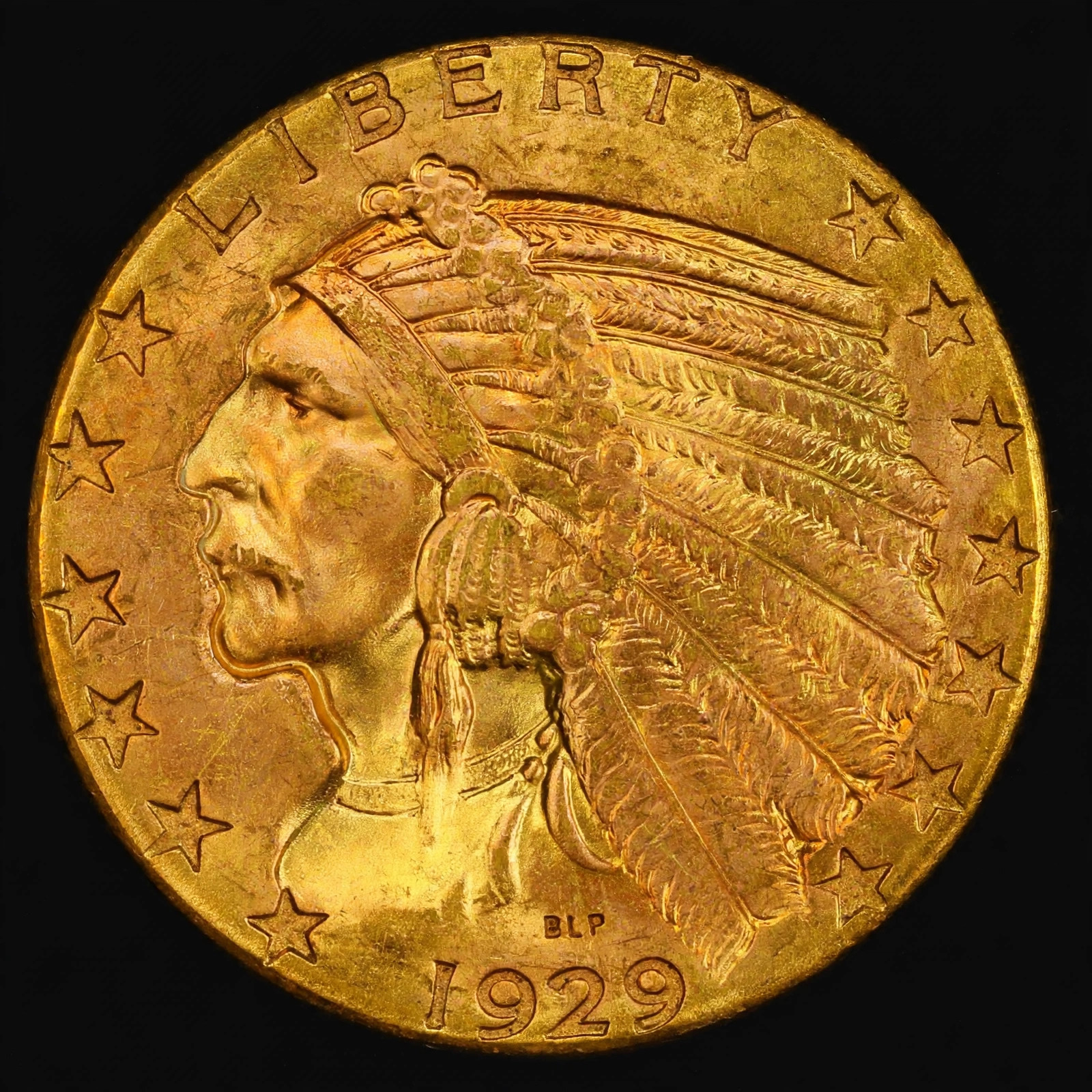
The key date of the Indian half eagle series: 662,000 struck, but the vast majority melted before ever reaching circulation (Stack's Bowers).
History
- Philadelphia struck 662,000 business-strike Indian Head half eagles in 1929 after a 14-year hiatus — the first since 1916 and the final year half eagles were ever produced for circulation (CoinWeek; Stack’s Bowers, accessed 2026-09-16).
- No proofs were struck in 1929, making it the only Philadelphia issue in the Indian half eagle series without a corresponding proof (CoinWeek, accessed 2026-09-16).
- The October 1929 crash and the Depression destroyed demand: few coins entered commerce, and the undistributed mintage sat in Treasury vaults. After Executive Order 6102 (1933) ended gold coin issuance and the Gold Reserve Act of 1934, undistributed pieces were melted — Heritage places the melt in 1934; Stack’s Bowers says the federal government melted such undistributed rarities in 1937 (Heritage Auctions; Stack’s Bowers; Wikipedia, accessed 2026-09-16).
- No example was known until one appeared in a March 1944 auction, selling for $225 (per Walter Breen, via CoinWeek); Stack’s Bowers estimates just 700–750 survivors from the 662,000 mintage (CoinWeek; Stack’s Bowers, accessed 2026-09-16).
- The incuse design was created by Boston sculptor Bela Lyon Pratt — a student of Augustus Saint-Gaudens — at the request of Theodore Roosevelt’s friend William Sturgis Bigelow; Mint engravers under Chief Engraver Charles E. Barber modified Pratt’s models, to Pratt’s displeasure (Wikipedia, accessed 2026-09-16).
- The 1929 is the key date of the Indian half eagle series, ahead of the 1909-O (Wikipedia, accessed 2026-09-16).
Key dates and varieties
- 1909-O — runner-up key of the Indian half eagle series (Wikipedia)
- 1929 — final year of half eagle production; no proofs struck; 662,000 mintage mostly melted (CoinWeek; Stack’s Bowers)
Specifications
- composition
- designers
- diameter
- edge
- mint
- weight
Collector notes
- KEY DIAGNOSTIC MARKERS: incuse (recessed) designs — the Indian Head gold pieces are the only U.S. circulating coins with recessed designs (Wikipedia). Designer initials BLP appear just above the date; Philadelphia pieces carry no mintmark (Wikipedia).
- Strikes are often weak: even uncirculated examples are ‘not always’ well struck in all areas (Heritage Auctions). An interior crease often lines the circumference on genuine examples (Stack’s Bowers, citing specialists Fuljenz and Schein).
- Value factors: most survivors are in uncirculated grades (the coins never circulated), so circulated examples are the outliers; grade and strike quality drive premiums.
- Population caveat: third-party grading totals are inflated by resubmissions and cannot be stated as a surviving population — the 700–750 survival estimate comes from Stack’s Bowers (2017).
Market check
Compare live listings for this coin on eBay:
Search eBay for 1929 Indian Head Half Eagle ($5)
As an eBay Partner, The Coin Wiki may earn from qualifying purchases.