
Specifications
- Denomination
- Half dollar
- Weight
- 12.5 g
- Diameter
- 30.61 mm
- Edge
- Reeded

Only 10,000 struck for the public — and Wikipedia notes it is the scarcest commemorative half dollar by design, making it the coin that decides whether a complete type set ever gets finished (Wikipedia; GreatCollections).
History
- The Hawaii Sesquicentennial half dollar was struck in 1928 to honor the 150th anniversary of Captain James Cook’s landing in Hawaii in January 1778, marking him as the first European to reach the islands. Celebrations were set for August 1928, halfway between the sesquicentennials of his landing and his death there in February 1779 (Wikipedia).
- In 1927 the legislature of the Territory of Hawaii asked Washington to authorize the coin. Treasury Secretary Andrew Mellon, who normally opposed commemorative issues, raised no objection, and the bill passed Congress without opposition or amendment, signed by President Calvin Coolidge as the Act of March 7, 1928. The Cook Sesquicentennial Commission of Hawaii was designated to buy the coins at face value and vend them at a premium (Wikipedia).
- Honolulu artist Juliette May Fraser produced the original sketches in under two days, and sculptor Chester Beach modeled them into plaster. Approval was not smooth: the Mint objected to the high relief, and Hawaii’s delegate to Congress, Victor Stewart Kaleoaloha Houston, quibbled over details such as an anklet on the chief’s leg and the shape of the palm tree. Beach complied, the Commission of Fine Arts endorsed the design, and Secretary Mellon approved it in May 1928 (Wikipedia).
- The Philadelphia Mint struck 10,008 pieces in June 1928, with 8 pieces above the authorized mintage reserved for the 1929 Assay Commission. Fifty of the 10,000 were specially finished as sandblast proofs and presented to individuals and institutions, including President Coolidge and the British Admiralty. The Bank of Hawaii distributed the coins for the commission at $2 each — the highest issue price for a commemorative half dollar to that point. Sales began October 8, 1928, and supplies were quickly exhausted; the coin’s profits helped fund a Captain James Cook collection now housed in the Bishop Museum in Honolulu (Wikipedia). This entry is part of the Classic U.S. Commemoratives series.
What is it worth
- The 2015 edition of R. S. Yeoman’s A Guide Book of United States Coins lists the Hawaii half dollar from $1,850 to $11,000 depending on condition, and the sandblast proofs up to $50,000 — though Wikipedia notes none of the proofs had recently sold at auction, and an exceptional regular-type specimen sold for $25,850 in 2013 (Wikipedia).
- GreatCollections calls it “the most sought after of all the classic commemorative half dollars” and “the coin that decides whether a complete type set can be finished,” drawing demand from commemorative specialists, type collectors, and Hawaiian buyers (GreatCollections).
- Certified population data underlines the tight supply: APMEX’s product page for an MS-64 example notes a public mintage of 9,958, a PCGS population of 1,129 at MS-64, and 837 graded higher (APMEX).
What drives the premium
- Scarcity above all: 10,008 struck, 8 for assay, only 50 sandblast proofs, and no later melt figure — it is the smallest mintage in the classic commemorative series by design (Wikipedia).
- Originality: many coins were bought by non-collectors, carried, given as gifts, or cleaned, so problem-free uncirculated pieces command large premiums. GreatCollections warns that Cook’s flat cheek registers any rub instantly (GreatCollections).
- Proof provenance: the 50 sandblast presentation pieces sit at the top of the market at up to $50,000 in the 2015 guide (Wikipedia).
- Authentication risk: at least three different counterfeits are known, so certification matters on high-value purchases (Wikipedia).
Specifications
- Composition: 90.0% silver, 10.0% copper (Wikipedia)
- Weight: 12.5 g (Wikipedia)
- Silver content: 0.36169 troy oz (Wikipedia)
- Diameter: 30.61 mm (Wikipedia)
- Thickness: 2.15 mm (Wikipedia)
- Edge: Reeded (Wikipedia)
- Alignment: Not verified in consulted references
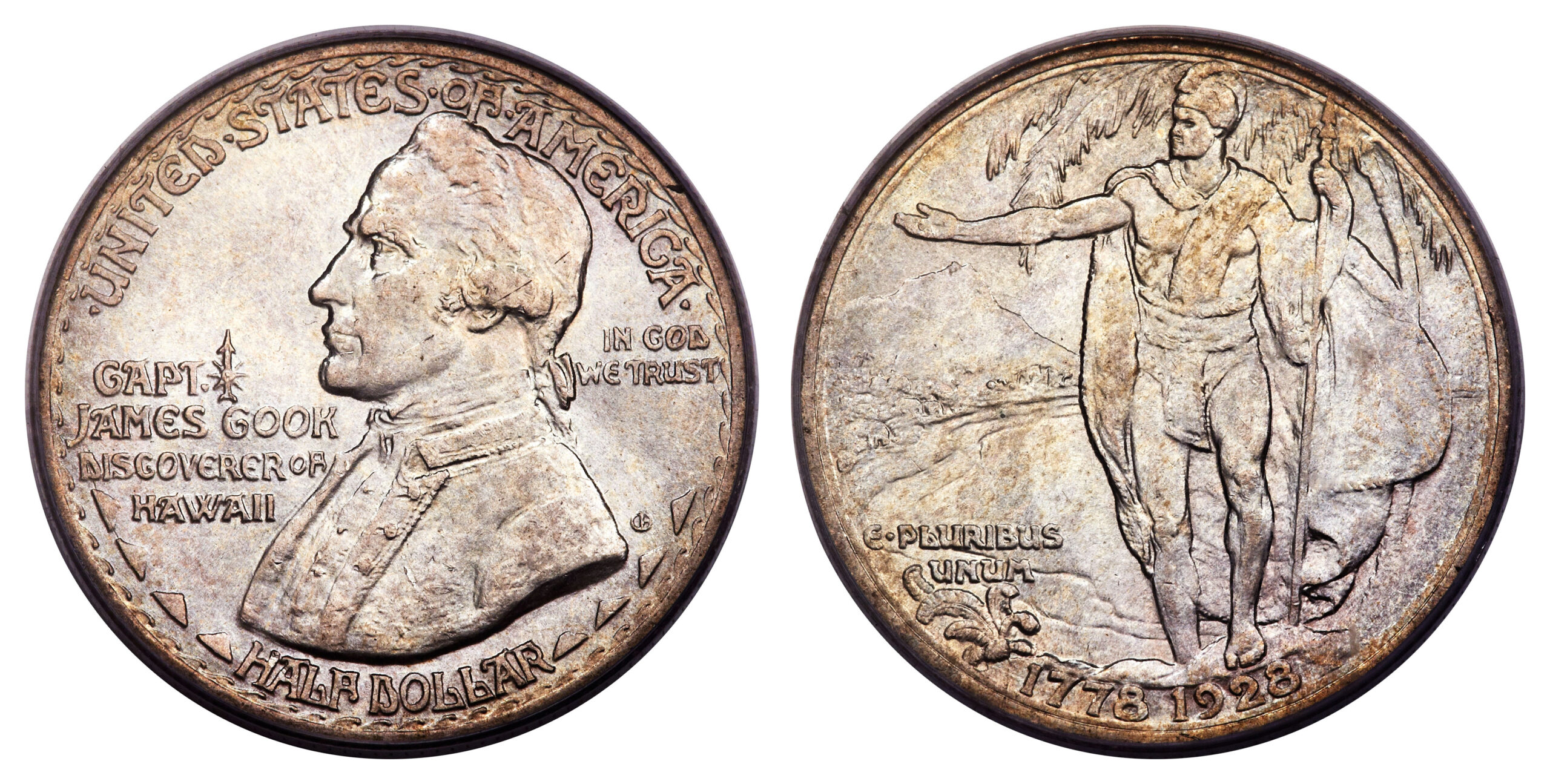
- Designers: Obverse: Captain James Cook; reverse: a Hawaiian chieftain with extended arm, Waikiki Beach and Diamond Head in background — Chester Beach, based on sketches by Juliette May Fraser (Wikipedia)
- Mint: Philadelphia (no mintmark), 1928 (Wikipedia)
Collector notes
- The obverse legend reads “CAPT. JAMES COOK DISCOVERER OF HAWAII” with the words HALF DOLLAR below flanked by eight triangles representing the eight largest volcanic islands of Hawaii: Oahu, Maui, Kauai, Hawaii, Niihau, Lanai, Kahoolawe, and Molokai. Designer’s initials CB sit right of the bust’s base (Wikipedia).
- The reverse is based on Thomas R. Gould’s statue of King Kamehameha I in Honolulu, intended to symbolize the past and future glory of the Kingdom of Hawaii; the reverse carries only “E PLURIBUS UNUM” and the dates 1778 1928 (Wikipedia).
- A persistent rumor of hoards totaling as many as 1,500 coins withheld from the Hawaiian allocation is unconfirmed — though one documented group of 137 pieces, set aside by the Bank of Hawaii for employee sale, stayed in bank vaults until a 1986 auction (Wikipedia).
- The coin was the first U.S. commemorative half dollar to honor a Pacific territory, and GreatCollections notes demand from Hawaii-based buyers who want it for its local meaning (GreatCollections).
Market check
Compare live listings for this coin on eBay:
Search eBay for 1928 Hawaiian Half Dollar
As an eBay Partner, The Coin Wiki may earn from qualifying purchases.
Sources
- Wikipedia — Hawaii Sesquicentennial half dollar
- GreatCollections — 1928 Hawaiian Sesquicentennial Half Dollar PCGS MS-66 (Item 477938)
- APMEX — 1928 Hawaiian Half Dollar MS-64 PCGS