
Specifications
- Denomination
- 1c
- Series
- Lincoln cent, wheat reverse (1909-1958)
- Designer
- Victor D. Brenner
- Years of issue
- 1922
- Weight
- 3.11 g
- Diameter
- 19 mm
- Edge
- Plain
- Key mintages
- No separate mintage — variety of the 1922-D issue; parent Denver mintage 7,160,000 (Heritage Auctions). ~15,000 survivors est. (CACG).
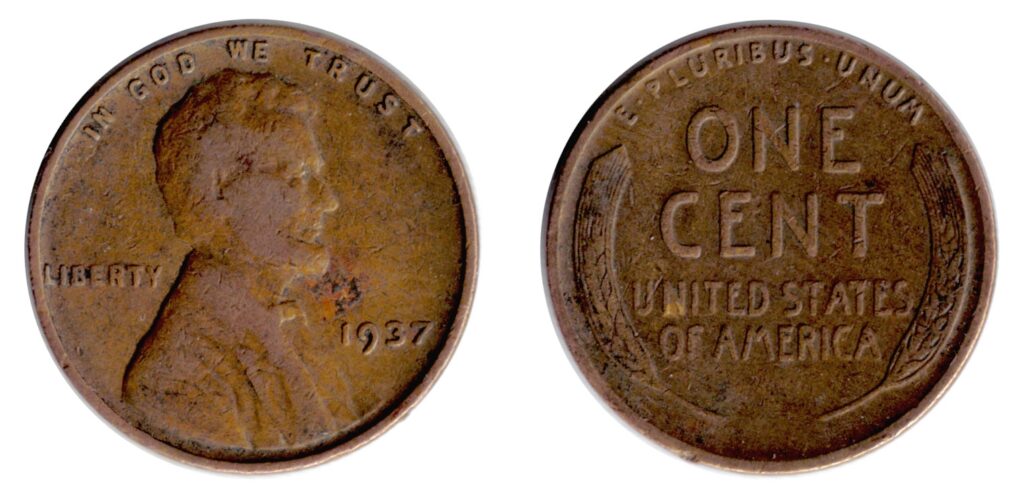
Zero Philadelphia cents were struck in 1922 — Denver's mintmark-less Die Pair 2 fills the hole.
History
- No Lincoln cents were struck at the Philadelphia Mint in 1922, nor any in San Francisco — so collectors pursued the 1922-D cents that appear to lack the D mintmark as a substitute (CoinWorld; accessed 2026-09-16)
- The story per Q. David Bowers: the dies first produced regular 1922-D cents, then weakened from extensive use; on one die of Die Pair 2 the D was completely ground off when the die was relapped to reduce surface roughness and extend its life (CoinWorld; accessed 2026-09-16)
- Three Denver die pairs show the odd characteristic, but Die Pair 2 is the one specialists seek: the heavily lapped obverse (mintmark gone) was paired with a fresh reverse die, making it the only ‘true’ 1922 Plain variety today (CoinWeek; accessed 2026-09-16)
- Other pairs reached ‘No D’ status through grease-filled dies (Pairs 1 and 3) or sheer die wear at end of die life (Pair 4B), all with weak reverses — and are worth far less (Numismatic News; accessed 2026-09-16)
- Despite early controversy over authentication, the variety’s inclusion in the Red Book and grading-service registry sets made it a must-have for series specialists (CoinWorld; accessed 2026-09-16)
Key dates and varieties
- Variety of the 1922-D issue — no separate mintage; parent Denver mintage was 7,160,000 (Heritage Auctions; accessed 2026-09-16)
- Probably only about 15,000 surviving examples of the 1922 Plain from that parent mintage (CACG / CAC Grading; accessed 2026-09-16)
- The Die Pair 2 Strong Reverse is the premium variety: an MS-64 brown CAC example realized $47,000 at Legend Rare Coin Auctions in August 2020 (CoinWorld; accessed 2026-09-16)
Specifications
- composition
- designers
- diameter
- edge
- mint
- weight
Certified populations: Est. 15,000 surviving examples of the 1922 Plain (CACG); rare in all grades, especially Mint State (CAC Grading)
Collector notes
- Die Pair 2 Strong Reverse diagnostics (the recognized genuine variety): the reverse is boldly defined on the upper wheat stalks and the legends, struck from a fresh die; the obverse shows the usual softness on the motto and portrait from lapping, and the second 2 in the date has a distinctive shape altered by the die polishing (CoinWorld; accessed 2026-09-16)
- Weak Reverse varieties come from Die Pairs 1, 3, and 4B: severely worn obverse and reverse dies; Die Pair 1 shows a die crack from the L in PLURIBUS through the O in ONE, while on Pairs 1 and 3 grease or foreign matter filled the mintmark (Heritage Auctions; accessed 2026-09-16)
- Beware the two big traps: ‘Weak D’ cents (any faint trace of mintmark) deceptively marketed as No D, and 1922-D cents with the mintmark physically removed — buy only examples certified by PCGS, NGC, or CAC (CoinWorld; accessed 2026-09-16)
- Value factors: Strong Reverse vs. Weak Reverse is everything; CAC notes the key authenticity checks are the characteristically strong reverse, the distinctive second 2 in the date, and the particular strength of the word TRUST (CAC Grading; accessed 2026-09-16)
Value ladder
- Strong-reverse Plain values run about $750 in G-4, $11,000 in MS-60, and $200,000 in MS-65; PCGS reports only two examples in MS-65. (Numismatic News; accessed 2026-09-17)
Why 1922 has no Philadelphia cents
In 1922 Denver was diverted to a crash silver-dollar program under the Pittman Act, striking around the clock, 24 hours a day, six days a week; Denver had even skipped its cent issue the year before, so there is no 1921-D cent either. The entire national 1922 cent production was the 7,160,000 Denver pieces. (Numismatic News; accessed 2026-09-17)
How the mintmark disappeared
On some dies, grease and debris clogged the mintmark cavity — a struck-through-type condition — so planchet metal could not flow into it and the D appeared progressively weaker across die states until it vanished. (Numismatic News; accessed 2026-09-17)
Attribution standard
ANACS’s prime criterion for “1922 Plain” attribution — the thin, wormy second “2” in the date with a strongly defined reverse — was adopted around 1984 from the INS Authentication Bureau. (Numismatic News; accessed 2026-09-17)
A note on demand
Authentication difficulty itself supports demand: when the difference between “no D” and “almost no D” is five figures, buyers want certified coins. (Numismatic News; accessed 2026-09-17)
Market check
Compare live listings for this coin on eBay:
Search eBay for 1922 'No D' Lincoln Cent
As an eBay Partner, The Coin Wiki may earn from qualifying purchases.
Related Coins
Live on eBay
Live asking prices — not sale records.
 1922 No D Strong Reverse Die 2 Lincoln Wheat Cent ANACS VG 8 Photo Certificate$845.00View on eBay
 1922 No D Lincoln Wheat Cent 1C Strong Reverse PCGS F 12$1,289.99View on eBay
 1922 Plain No D 1c Lincoln Wheat Cent Strong Reverse$775.00View on eBay
As an eBay Partner, The Coin Wiki may earn from qualifying purchases.
FREE DOWNLOAD
Before you spend that coin, check it.
The Pocket Change Key-Date Checklist covers the cents, nickels, dimes, quarters and halves still hiding in circulation — including the 1943 and 1983 errors worth five figures. One page to print, a lifetime of jars to check.