
Specifications
- Denomination
- Half dollar
- Designer
- Laura Gardin Fraser
- Weight
- 12.5 g
- Diameter
- 30.61 mm
- Edge
- Reeded

The 1922 Grant Memorial half dollar comes in two varieties — a common no-star (net 67,405) and a scarce with-star (net 4,256) — and the 2018 deluxe Red Book lists the star variety from $900 all the way to $9,750 (Wikipedia; APMEX).
History
- The Ulysses S. Grant Centenary Memorial Association (the “Grant Commission,” chaired by former Ohio chief justice Hugh L. Nichols) wanted commemorative coins to fund celebrations and memorial projects for the 100th anniversary of Grant’s birth (April 27, 1822). Congress authorized 10,000 gold dollars and up to 250,000 silver half dollars; President Warren G. Harding signed the bill on February 2, 1922 (Wikipedia).
- Commission of Fine Arts sculptor-member James Earle Fraser selected his wife, Laura Gardin Fraser — who had designed the 1921 Alabama Centennial half dollar — to sculpt the coins. She modeled Grant’s portrait from a Mathew Brady studio photograph, signing the bust with her initial G (Wikipedia; APMEX).
- The Commission asked for 5,000 of the gold dollars to carry an incuse star to create a chase variety; the Mint struck 5,000 starred pieces of each denomination in March 1922 — the starred silver half dollars were “unasked for” and “a bonus that greatly surprised the committee” (Wikipedia).
- The no-star halves sold for $1 and the star halves for $1.50. The Commission sold all the gold and most of the silver, returning 750 star and 27,650 no-star half dollars for melting. Proceeds helped renovate Grant’s birthplace in Point Pleasant, Ohio, though “the buildings and highway never came to fruition” (Wikipedia).
- This entry is part of the Classic U.S. Commemoratives series.
What is it worth
- The 2018 deluxe (Mega Red, 4th edition) A Guide Book of United States Coins lists the with-star half dollar for between $900 and $9,750, and the no-star for between $110 and $1,000, depending on condition (Wikipedia).
- The star variety has been prized since the beginning: by 1935 it sold for $65, the highest value of any U.S. silver commemorative at the time. The spread widened over the decades — $1.50 vs. $37 in 1940, $2.50 vs. $55 in 1950, and $25 vs. $135 in 1970 (Wikipedia).
How to identify the valuable variety
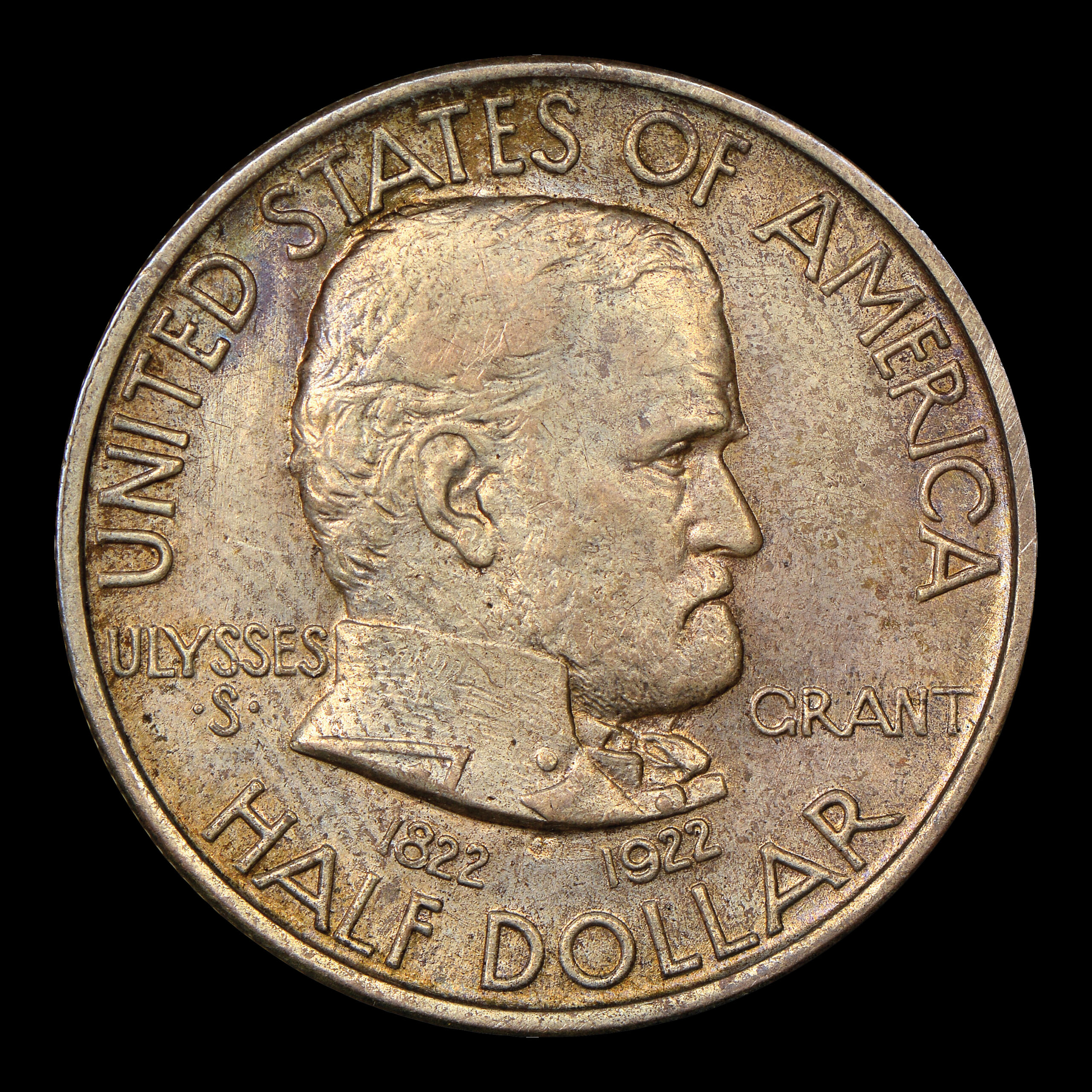
- The star is a small five-pointed incuse star punched into the obverse field above the word “GRANT” (APMEX). The Philadelphia Mint struck 5,006 star and 95,055 no-star half dollars; after melting, net distributions were 4,256 with star and 67,405 without (Wikipedia; APMEX).
- Because the star commands such a premium, it has been faked: in 1935 a Bronx dentist bought several hundred no-star half dollars and punched stars into them, and other counterfeiting has followed. Buy the star variety certified by PCGS or NGC (Wikipedia).
What drives the premium
- Rarity: at 4,256 net, the star is one of the lowest-mintage classic commemorative varieties — required for a complete set, so specialist and registry demand never sleeps (GreatCollections/APMEX).
- The accidental origin: the star was a marketing gimmick meant only for the gold dollar, which makes the silver star a famous mint-made “mistake” collectors love (Wikipedia).
- Surface quality on the star: the star sits in an open field that shows every mark, so clean examples around it are considerably scarcer than the mintage suggests (GreatCollections).
Specifications
- Composition: 90% silver, 10% copper (Wikipedia)
- Weight: 12.5 g (Wikipedia)
- Silver content: 0.36169 troy oz (Wikipedia)
- Diameter: 30.61 mm (Wikipedia)
- Edge: Reeded (not individually verified; standard for the issue)
- Alignment: Not verified in consulted references
- Designer: Laura Gardin Fraser (Wikipedia)
- Mint: Philadelphia (no mintmark), 1922 only (Wikipedia)
Collector notes
- Obverse details: Grant in military coat facing right, “ULYSSES S GRANT” around the bust, the dates 1822–1922, “UNITED STATES OF AMERICA” and “HALF DOLLAR” (APMEX). Reverse: Grant’s frame birthplace house with wooden fence and trees, “IN GOD WE TRUST” and “E PLURIBUS UNUM” — no inscription identifies the house; “the design itself tells the story” (Wikipedia).
- A companion gold dollar with an identical design (minus denomination) exists in both star and no-star varieties — a separate entry in this wiki’s future (Wikipedia).
- Most of the no-star halves went to dealers and collectors, but some were spent and show circulation wear (Wikipedia).
Market check
Compare live listings for this coin on eBay:
Search eBay for 1922 Grant Memorial Half Dollar
As an eBay Partner, The Coin Wiki may earn from qualifying purchases.
Sources
- Wikipedia — Grant Memorial coinage
- APMEX Learning Guide — 1922 Grant Memorial Commemorative Coins
- GreatCollections — 1922 Grant Memorial Half Dollar with Star