
Specifications
- Denomination
- Half dollar
- Designer
- Obverse: Abraham Lincoln — George T. Morgan; reverse: eagle adapted from the Seal of Illinois — John R. Sinnock
- Weight
- 12.5 g
- Diameter
- 30.61 mm
- Edge
- Reeded
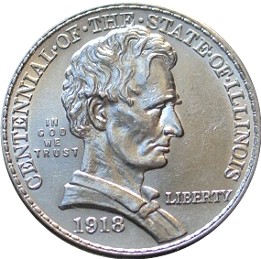
Lincoln on a U.S. coin for the first time — the 1918 Illinois Centennial opened the classic commemorative half dollar era, but a bank-held hoard and heavy bagmarks make choice examples harder to find than the six-figure mintage suggests (GreatCollections; Numismatic News).
History
- Illinois wanted a commemorative for the centennial of its 1818 admission to the Union. H.R. 8764 was introduced on January 16, 1918, by Congressman Loren E. Wheeler; the authorized mintage was cut from 200,000 to 100,000 during the legislative process, and President Woodrow Wilson signed the bill on June 1, 1918 (Wikipedia).
- The designs were prepared in the Mint’s own Engraving Department. Chief Engraver George T. Morgan created the obverse: a beardless Abraham Lincoln, shown as he looked living in Illinois before his 1860 election, worked from a photograph of Andrew O’Connor’s statue of Lincoln on the Springfield State Capitol grounds. Assistant engraver John R. Sinnock designed the reverse as an adaptation of the Seal of Illinois — an eagle perched on a rock mound with the rising sun beyond, holding a scroll with the state motto STATE SOVEREIGNTY, NATIONAL UNION and clutching the Federal shield (Wikipedia).
- Treasury Secretary William G. McAdoo had specifically ordered the Illinois motto on the scroll replaced with the national motto, but the Illinois inscription was retained anyway — numismatic historian Don Taxay speculated the Illinois Centennial Commission insisted on it (Wikipedia).
- The Philadelphia Mint struck 100,058 pieces in August 1918, with the 58 above the round number reserved for the 1919 Assay Commission. They were sold at $1 each: the commission distributed them at face value to county affiliates to sell at a premium for local celebrations or, where celebrations had passed, for World War I relief. Dealer B. Max Mehl bought several thousand at just over face value, and a local bank held 30,000 for 15 years, releasing them during the 1933 Bank Holiday at a slight advance on par — flooding the market until they were absorbed in the 1936 commemorative boom (Wikipedia). This entry is part of the Classic U.S. Commemoratives series.
What is it worth
- The 2017 edition of R. S. Yeoman’s A Guide Book of United States Coins lists the Illinois half dollar from $130 to $685 depending on condition; an exceptional specimen sold at auction in 2014 for $7,040. At the height of the second commemorative boom in 1980, uncirculated specimens sold for about $300 (Wikipedia).
- An older Numismatic News market review lists the issue at $135 in AU-50, $150 in MS-60, and $565 in MS-65 — dated figures that show the grade structure the market has long followed (Numismatic News).
- GreatCollections notes the mintage is generous for the series but that superb pieces are harder to come by than a six-figure mintage implies, since the coins were saved individually and casually rather than warehoused for the collector trade; at MS-67 the coin sits at the top of the certified population (GreatCollections).
What drives the premium
- Original surfaces: the coins traveled the Midwest in bags for years, so bagmarks are the norm — heavily marked examples trade far below choice uncirculated coins (Numismatic News).
- First-in-series status: it is the first commemorative half dollar of the 1918–1954 run, “the issue that opened the long series rather than one of the many that closed it” (GreatCollections).
- Lincoln crossover demand: GovMint notes it is “the very first silver coin to depict Lincoln,” giving it a following among Lincoln collectors beyond the commemorative specialty (GovMint; GreatCollections).
- Artistic pedigree: Don Taxay called the obverse “undoubtedly the finest work Morgan ever did in his forty-eight years with the Mint,” and Q. David Bowers called Sinnock’s reverse “the finest work he ever did for a legal tender coin” (Wikipedia).
Specifications
- Composition: 90.0% silver, 10.0% copper (Wikipedia)
- Weight: 12.5 g (Wikipedia)
- Silver content: 0.36169 troy oz (Wikipedia)
- Diameter: 30.61 mm (Wikipedia)
- Thickness: 2.15 mm (Wikipedia)
- Edge: Reeded (Wikipedia)
- Alignment: Not verified in consulted references
- Designers: Obverse: Abraham Lincoln — George T. Morgan; reverse: eagle adapted from the Seal of Illinois — John R. Sinnock (Wikipedia)
- Mint: Philadelphia (no mintmark), 1918 (Wikipedia)
Collector notes
- Mintage context: 100,058 struck in August 1918, including 58 pieces for the Assay Commission; 100,000 were authorized. No mintmark — all Philadelphia (Wikipedia).
- The reverse shows an olive branch but no arrows of war, even though the symbols are often paired — Anthony Swiatek and Walter Breen suggested that on a coin designed in the closing months of World War I, the arrows “might have been considered just a bit raw” (Wikipedia).
- Art historian Cornelius Vermeule noted this is “the only [pre-1954] commemorative coin to honor Abraham Lincoln” — a distinction that shapes collector demand (Wikipedia).
- Check grading high points first: Lincoln’s cheekbone and the hair above his ear take the first friction, and attractively toned examples from long album storage draw competition when they appear (GreatCollections).
Market check
Compare live listings for this coin on eBay:
Search eBay for 1918 Illinois Centennial Half Dollar
As an eBay Partner, The Coin Wiki may earn from qualifying purchases.
Sources
FREE DOWNLOAD
Before you spend that coin, check it.
The Pocket Change Key-Date Checklist covers the cents, nickels, dimes, quarters and halves still hiding in circulation — including the 1943 and 1983 errors worth five figures. One page to print, a lifetime of jars to check.