Specifications
- Denomination
- $4
- Series
- Stella pattern (1879-1880)
- Designer
- Charles E. Barber
- Engraver
- Charles E. Barber
- Years of issue
- 1879
- Composition
- 85.7% Gold, 4.3% Silver, 10% Copper
- Weight
- 7 g
- Diameter
- 21.6 mm
- Edge
- Reeded
- Mintage
- 425
- Key mintages
- Pattern coin, not a business strike. Mint records show 425 delivered (25 metric-alloy Judd-1635/Pollock-1832 + 400 standard-alloy Pollock-1833); Garrett and Guth suggest up to 725 may have been struck (Heritage).
Melt value: $838.66
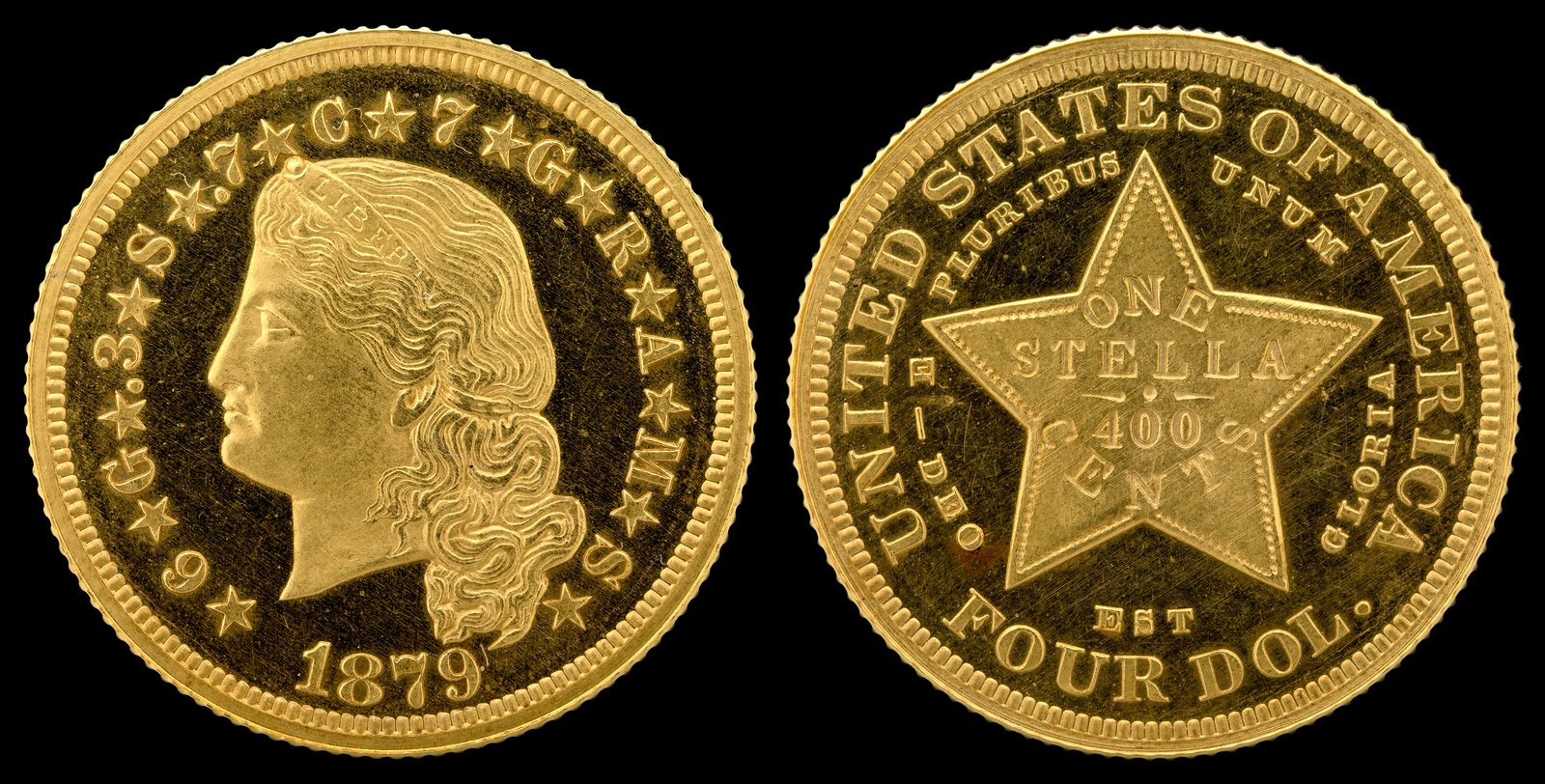
425 struck: the $4 gold pattern Congressmen bought at cost — and ended up wearing as jewelry.
History
- The Stella was a $4 gold pattern proposed in 1879 by John A. Kasson, former chairman of the House Committee on Coinage, Weights, and Measures, to give U.S. coinage a metric valuation Europeans would accept in international trade (Heritage Auctions; accessed 2026-09-16)
- Charles Barber’s Flowing Hair obverse was struck in two alloys: 25 pieces in the metric alloy (85.71% gold, 4.29% silver, 10% copper) delivered to Congress as three-piece pattern sets, then about 400 more in the standard 90% gold / 10% copper alloy; Mint records show 425 delivered total, though Garrett and Guth suggest up to 725 may have been struck (Heritage Auctions; accessed 2026-09-16)
- Both obverse types share a common reverse of William Wheeler Hubbell’s conception: a five-pointed star inscribed ONE STELLA / 400 CENTS, ringed by UNITED STATES OF AMERICA and FOUR DOL., with E PLURIBUS UNUM and DEO EST GLORIA (‘God is the Glory’) between the star’s points (Heritage Auctions; accessed 2026-09-16)
- Congress rejected the international metric-coinage scheme; the several hundred pieces already struck became a scandal when Congressmen who bought them at production cost were found to have turned them into jewelry — including pieces adorning the necks of madams operating Washington’s most infamous bordellos (Wikipedia; accessed 2026-09-16)
- The four gold Stella varieties (1879/1880, Flowing Hair and Coiled Hair) are among the most famous U.S. patterns, routinely included in advanced gold type sets despite being patterns; the 1879 Flowing Hair is the ‘common’ one and the ideal type coin (Heritage Auctions; accessed 2026-09-16)
Key dates and varieties
- Four gold varieties exist (1879 and 1880, Flowing Hair and Coiled Hair); the 1879 Flowing Hair is the only one produced in notable quantity, with the 1880 Coiled Hair the extreme rarity — a Coiled Hair sold for $2.75M at auction in 2015 (Heritage Auctions; accessed 2026-09-16)
- Mint-record mintage: 425 delivered (25 metric-alloy + 400 standard-alloy); estimates range from 400 to over 700 (Heritage Auctions; accessed 2026-09-16)
- Metric-alloy originals (Judd-1635, Pollock-1832) vs. standard-alloy restrikes (Pollock-1833): most certified survivors are believed to be standard .900 gold despite the inscribed metric border (Heritage Auctions; accessed 2026-09-16)
- Do NOT treat this as a business strike: all are patterns/proofs, none circulated as regular coinage (Wikipedia; accessed 2026-09-16)
Specifications
- composition
- designers
- diameter
- edge
- mint
- weight
Collector notes
- Genuine diagnostics: all genuine pieces are proofs with mirrored fields and frosted devices; the 1880 restrikes typically show weak definition in the hair over Liberty’s ear and light central planchet striations — these are as-made features, not damage (Heritage Auctions; accessed 2026-09-16)
- Check the obverse border inscription ★6★G★.3★S★.7★C★7★GRAMS★ (6 grams gold, 0.3 silver, 0.7 copper, 7 grams total) against a certified reference piece; also confirm the reverse star reads ONE STELLA / 400 CENTS with DEO EST GLORIA below (Heritage Auctions; accessed 2026-09-16)
- Because the design is famous and valuable, buy only PCGS- or NGC-certified examples and be wary of jewelry-mount damage — many were ex-jewelry (Wikipedia; accessed 2026-09-16)
- Value factors: Cameo contrast and proof grade drive price; metric-alloy originals command premiums over standard-alloy restrikes (Heritage Auctions; accessed 2026-09-16)
Market check
Compare live listings for this coin on eBay:
Search eBay for 1879 Flowing Hair Stella
As an eBay Partner, The Coin Wiki may earn from qualifying purchases.