
Coin photo needed — no freely licensed image found. We publish only real photographs; this page will gain its photo when a usable one is located.
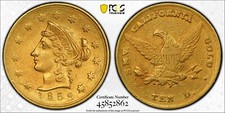
The 1852 Wass, Molitor & Co. $10 “Close Date” — the rarest of the firm’s three 1852 ten-dollar varieties, with six to eight known — sold for $354,375 in September 2026, the finest known by 18 grading points.
History
- Wass, Molitor & Co. was founded in October 1851 in San Francisco by two Hungarian exiles of the failed 1848 revolution, Count Samuel C. Wass and Agoston P. Molitor — both trained at the School of Mines in Germany. Their assay office on Montgomery Street could return processed gold in about two days, versus a week or more elsewhere. (CoinWeek, Oct 1 2026)
- On January 6, 1852 the firm began issuing $5 gold pieces, adding $10 pieces about a week later after local merchants petitioned them amid a small-denomination coin shortage. Output ran $7,000–$8,000 per day. (Heritage Auctions; PCGS CoinFacts)
- The coins were trusted: John L. Moffat complained to the Treasury Secretary that Wass, Molitor pieces traded at a 2–3% premium over U.S. Assay Office issues, and a contemporary Herald editorial calculated they contained $5.04 in gold per $5 coin. (PCGS CoinFacts)
- Three 1852 $10 varieties exist: K-3 (Small Head), K-4 (Large Head, Wide Date), and K-5 (Close Date, Short Neck) — the K-5 is the rarest “by a large margin.” (Heritage Auctions; Greysheet)
- The die story explains the rarity: in 1851 the firm purchased the reverse die of the 1850 Dubosq & Co. $10 and paired it with three successive 1852 obverses. By the time the Close Date obverse entered service, the reverse was heavily cracked and failed after only a few impressions. (Ron Guth, PCGS CoinFacts; GreatCollections via CoinWeek)
- The variety was considered unique until the Eliasberg sale in 1996. The S.S. Central America shipwreck recovery (sank September 1857) added four more Close Date $10 pieces. Published censuses disagree: GreatCollections reports 6 known, Greysheet reports 8. (CoinWeek, Oct 1 2026; Heritage Auctions)
- The record: $354,375 at GreatCollections on September 27, 2026 (hammer $315,000 plus buyer’s premium) in the Centennial Collection of Territorial Rarities sale, drawing 74 bids. Graded PCGS AU-58 with a CAC Green sticker — the finest known by 18 grading points — with provenance from A.C. Nygren (1924) to Louis E. Eliasberg Sr. (1996), and identified as the Red Book plate coin for the variety. (CoinWeek, Oct 1 2026)
Key dates and varieties
- K-5 “Close Date” — short-neck Liberty portrait with closely spaced 1852 date digits; the reverse should show the heavily cracked late-die-state Dubosq die. (PCGS CoinFacts; CoinWeek, Oct 1 2026)
- K-4 “Wide Date” — wide, uneven date plus an extensive network of obverse die cracks. (Heritage Auctions)
- K-3 “Small Head” — the “plugged obverse”: per Kagin (1981), an 1851 date was drilled out of the die and a “2” plugged in. (Heritage Auctions)
Specifications
- Denomination: $10 (ten dollars)
- Diameter: 27 mm; gold content 0.4838 troy oz (APMEX dealer data)
- Composition: approximately .900 fine gold — “consistent 0.900 fineness” across Wass, Molitor issues (American Numismatic Association, 2025). PCGS CoinFacts lists weight, diameter, and mintage as N/A for this variety (PCGS #10351).
- Edge: reeded; Strike: business strike (CoinWeek, Oct 1 2026)
- Obverse: Liberty with coronet reading “W. M. & CO.” (never LIBERTY), 13 stars, date below
- Reverse: heraldic eagle with “S.M.V. CALIFORNIA GOLD / TEN D.” (S.M.V. = Standard Mint Value)
- Catalog: Kagin K-5; PCGS #10351; NGC ID ANJP; Greysheet GSID 11883; rarity R.7 (Heritage)
- Mintage: unknown — no original mintage figure was ever recorded
Collector notes
- Authentication starts with the legends: the coronet must read “W. M. & CO.” and the reverse “S.M.V. CALIFORNIA GOLD / TEN D.” — with a reeded edge and dimensions at the federal eagle standard (~27 mm). (CoinWeek, Oct 1 2026)
- Variety confirmation: the short-neck portrait plus tightly spaced date marks the K-5, and a genuine example shows the heavily cracked late-die-state reverse — the die failed after only a few strikes, so heavy reverse cracking is expected, not a defect. (Ron Guth, PCGS CoinFacts)
- Report the census as six to eight known — the published sources disagree, so don’t cite a single number. (CoinWeek, Oct 1 2026)
- No freely licensed photograph of an exact 1852 Wass, Molitor $10 Close Date could be located on Wikimedia Commons or Smithsonian Open Access (the Smithsonian holds an 1852 Wass-Molitor $10 with no public image) — this page will gain its photo when a usable one is found. (research 2026-10-03)
Market check
Compare live listings for this coin on eBay:
Search eBay for 1852 Wass, Molitor $10 Close Date
As an eBay Partner, The Coin Wiki may earn from qualifying purchases.
Related Coins
Live on eBay
Live asking prices — not sale records.
As an eBay Partner, The Coin Wiki may earn from qualifying purchases.
FREE DOWNLOAD
Before you spend that coin, check it.
The Pocket Change Key-Date Checklist covers the cents, nickels, dimes, quarters and halves still hiding in circulation — including the 1943 and 1983 errors worth five figures. One page to print, a lifetime of jars to check.