
Specifications
- Denomination
- Dime
- Designer
- Robert Scot
- Years of issue
- 1796
- Weight
- 2.7 g
- Diameter
- 19.8 mm
- Mintage
- 22,135
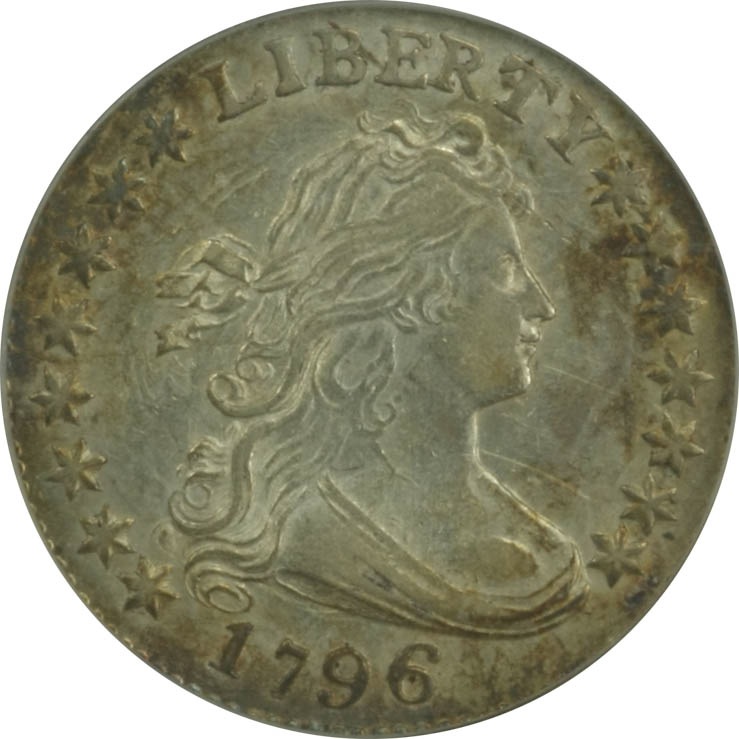
The 1796 dime is where America’s ten-cent piece begins: the first year of the denomination, with Robert Scot’s Draped Bust obverse and a Small Eagle reverse — and no denomination anywhere on the coin (PCGS).
History
- Dime production began in 1796 at the Philadelphia Mint; the whole series is a one-year first: no dimes had been struck before, and no 1797 dimes exist without the design (PCGS).
- The obverse carries Robert Scot’s Draped Bust portrait of Liberty, and the reverse shows the Small Eagle that the Mint used across its early silver coinage (PCGS).
- Because the denomination was understood from the coin’s size, the 1796 dime carries no statement of value on either side — just LIBERTY, the date, stars, and the eagle with UNITED STATES OF AMERICA (PCGS).
- The mintage was 22,135 pieces, and PCGS estimates about 850 survivors in all grades, with 75 in MS60 or better and 18 in MS65 or better (PCGS).
- Specialists attribute the year by JR die variety; the JR-2 is distinguished by a berry between the lowest leaf on the left side and the ribbon bow, and PCGS calls it slightly scarcer than the other pairings (PCGS).
What is it worth
- Older Numismatic News research placed a G-4 around $1,300 and an MS-60 around $12,000; treat those as historical anchors rather than current prices (Numismatic News).
- PCGS’s price guide shows how steep the top end is: MS65 lists at $175,000, MS66 at $215,000, MS66+ at $475,000, MS67 at $1,100,000, and MS68 at $1,650,000 (PCGS).
- JR-2 examples carry a premium over the other die pairings at equivalent grades, per PCGS’s variety analysis (PCGS).
- Problem coins — cleaned, damaged, or repaired — trade at deep discounts; with only about 850 estimated survivors, the market punishes problems hard (PCGS).
What drives the premium
- First-year status: this is the birth of the American dime, and every dime type set needs one (PCGS).
- Survival: 22,135 struck and an estimated 850 survivors means attrition took roughly nineteen of every twenty coins (PCGS).
- Condition rarity: only about 75 pieces are estimated in MS60 or better, so uncirculated examples are trophies (PCGS).
- Die variety: the JR-2’s berry diagnostic makes it slightly scarcer and worth a premium (PCGS).
- Originality: adjustment marks, weak strikes, and honest wear are common to the issue; cleaned or damaged coins lose most of the premium (PCGS; Numismatic News).
Specifications
- Year struck: 1796 (PCGS)
- Designer: Robert Scot (PCGS)
- Diameter: 19.80 mm (PCGS)
- Weight: 2.70 g (PCGS)
- Composition: 89.2% silver, 10.8% copper (PCGS)
- Edge: reeded (PCGS)
- Mint: Philadelphia (no mintmark) (PCGS)
- Mintage: 22,135 (PCGS)
Collector notes
- Some 1796 dimes were struck with proof-like, mirrored dies, and presentation-quality pieces exist; even so, most survivors show the adjustment marks and soft strikes typical of the early Mint (Numismatic News; PCGS).
- The Small Eagle reverse and the absence of a denomination are the quickest authentication tells — a 1796 dime should never say ONE DIME (PCGS).
- This is a series key for early-dime and type collectors alike; buy certified, because counterfeits and altered dates are common at these price levels.
- For the budget-conscious, the JR-1 and JR-3 pairings offer the same first-year history at a smaller premium than the scarcer JR-2 (PCGS).
Market check
Compare live listings for this coin on eBay:
Search eBay for 1796 Draped Bust Dime
As an eBay Partner, The Coin Wiki may earn from qualifying purchases.
Sources
FREE DOWNLOAD
Before you spend that coin, check it.
The Pocket Change Key-Date Checklist covers the cents, nickels, dimes, quarters and halves still hiding in circulation — including the 1943 and 1983 errors worth five figures. One page to print, a lifetime of jars to check.