
Specifications
- Denomination
- 1 pond
- Series
- Kruger pond — South African Republic (ZAR)
- Designer
- Otto Schultz (portrait and arms; unsigned on the 1898 issue)
- Years of issue
- 1898
- Composition
- 91.7% Gold, 8.3% Copper
- Weight
- 7.988 g
- Diameter
- 22 mm
- KM
- KM 10.2
- Mintage
- 137000
- Key mintages
- 137,000 (Heritage); 136,870 (NumisBids). Single-shaft type (KM-10.2). 1898/99 overdate: 130 struck (muntstuk.com).
Melt value: $833.46
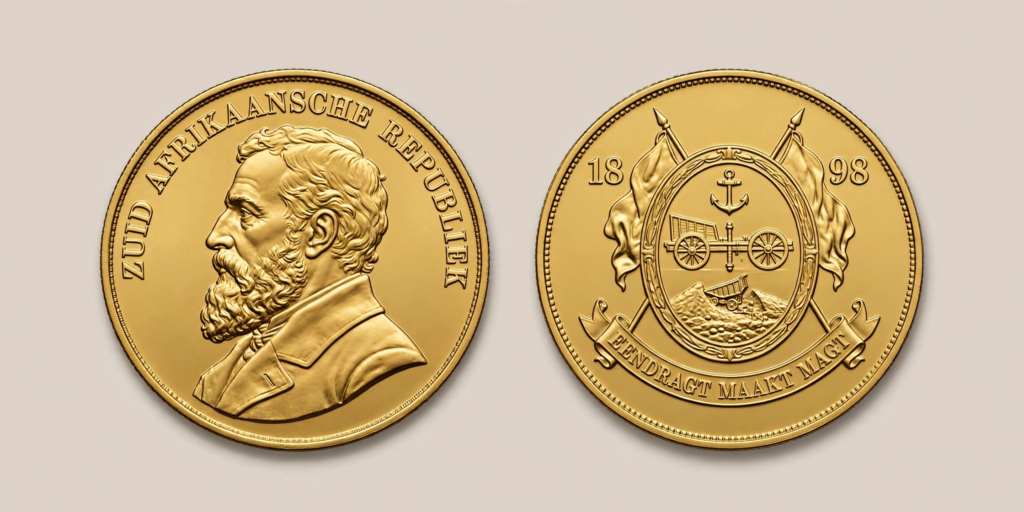
The grandfather of the Krugerrand — Paul Kruger's gold pound from the last years of the Boer republic.
History
- After the Witwatersrand gold discoveries made the South African Republic (Zuid-Afrikaansche Republiek, ZAR) one of the world’s richest gold producers, President Paul Kruger moved to end dependence on foreign mints: in 1890–91 a lease was granted to the Nationale Bank of the ZAR to establish a State Mint in Pretoria, with the new coins to match the British Coinage Act of 1870 in weight (Rand Coin; Medium — Legacy of the South African Mint, accessed 2026-09-16).
- Anxious to get the new coins into circulation, Kruger had the first 1892-dated coins ordered from the Berlin Imperial Mint; the first consignments arrived with two shafts on the wagon in the coat of arms instead of the correct single shaft, causing ‘quite a stir’ — subsequent 1892 issues were corrected to the single-shaft wagon with correctly sized wheels (Rand Coin, accessed 2026-09-16).
- Both sides were designed by Berlin medallist Otto Schultz, whose wax-model portrait of Kruger was later adapted by Tommy Sasseen for the Krugerrand; on the 1892 double-shaft issues only, Schultz’s initials ‘O.S.’ appear below the bust’s shoulder — ‘os’ being Afrikaans for ox (Rand Coin; Numismatic News, accessed 2026-09-16).
- The obverse carries Schultz’s suited, bearded bust of Kruger facing left, ringed by the legend ZUID AFRIKAANSCHE REPUBLIEK; the reverse shows the circular shield of arms — the wagon with its single shaft, an eagle above, the scroll motto EENDRAGT MAAKT MAGT (‘unity makes strength’) — with ‘1 POND ⋆ 1898 ⋆’ above (NumisBids; Spink; Britannia Coin Company, accessed 2026-09-16).
- Ponds were struck to the same specifications as the British sovereign: 22-carat gold, just under 8 grams, 22 mm in diameter, with a milled (reeded) edge (Britannia Coin Company, accessed 2026-09-16).
- The 1898 issue was struck at the Pretoria mint with the single-shaft arms (KM-10.2) — Heritage records a mintage of 137,000 and NumisBids 136,870, and Baldwin’s describes 1898 as a ‘rare year’ of the series (Heritage Auctions lot 25524; NumisBids — The Coin Cabinet Auction 107 lot 112; Baldwin’s, accessed 2026-09-16).
- These coins circulated in the prosperous years before the Second Boer War, when the ZAR was enriched by the Witwatersrand and gripped by tensions with Britain; most ponds were destroyed or lost in the war that followed, which is why a recently surfaced hoard — found in Europe in an original mint bag and acquired by the South African Mint for NGC ‘Lost Hoard’ grading — was considered so unusual (Britannia Coin Company; GovMint, accessed 2026-09-16).
- The pond is nicknamed ‘the grandfather of the Krugerrand’: the 1967 bullion coin kept Schultz’s Kruger effigy (via Sasseen’s adaptation) while pairing it with Coert Steynberg’s springbok reverse (GovMint; Numismatic News, accessed 2026-09-16).
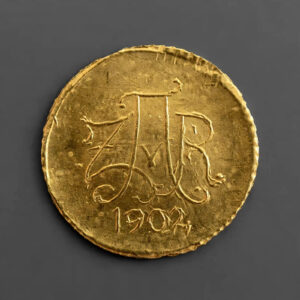
- The series ran 1892–1900 at Pretoria, with a 1900 issue of 788,000, a famous 1898/99 overdate of just 130 pieces, and the emergency 1902 Veldpond (KM 11, 986 pieces) struck in the field after the republic’s fall (muntstuk.com; LastDodo, accessed 2026-09-16).
Key dates and varieties
- 1892 (double shaft, Berlin) — first year, 15,650 struck (muntstuk.com; Britannia Coin Company)
- 1892 (single shaft) — the corrected issue; scarcer than the double shaft (Rand Coin)
- 1898 — 137,000 (Heritage) / 136,870 (NumisBids); a ‘rare year’ (Baldwin’s)
- 1898/99 overdate — 130 struck (muntstuk.com)
- 1900 — 788,000, the largest issue (muntstuk.com)
- 1902 Veldpond — KM 11, 986 struck in the field (muntstuk.com; LastDodo)
Specifications
- composition
- designers
- diameter
- edge
- weight
Collector notes
- Beware forgeries: muntstuk.com explicitly warns against fakes of the 1894, 1897, 1898, 1898/99, 1900 and Veldpond issues.
- The 1898 is single shaft (KM-10.2) — a double-shaft wagon on an 1898-dated pond is wrong (NumisBids; Rand Coin).
- No ‘O.S.’ initials belong on an 1898 — Schultz signed only the 1892 double-shaft pieces (Rand Coin).
- Verify weight (7.988 g) and 22 mm diameter in 22-carat gold; an off-weight or magnetic coin is a red flag.
- Heritage notes a long vertical die break down the left side of the reverse shield on some 1898s — a die characteristic, not a scratch (Heritage Auctions lot 25524).
- NGC has certified hundreds of 1898 ponds (APMEX cites 304 at MS-62 with 376 higher) — buy certified or from established dealers for anything above bullion grade.
Market check
Compare live listings for this coin on eBay:
Search eBay for 1898 Pond (Paul Kruger)
As an eBay Partner, The Coin Wiki may earn from qualifying purchases.
Related Coins
Live on eBay
Live asking prices — not sale records.

As an eBay Partner, The Coin Wiki may earn from qualifying purchases.
FREE DOWNLOAD
Before you spend that coin, check it.
The Pocket Change Key-Date Checklist covers the cents, nickels, dimes, quarters and halves still hiding in circulation — including the 1943 and 1983 errors worth five figures. One page to print, a lifetime of jars to check.